In summary:
- Effective breath control is not about lung capacity, but about physiological efficiency and muscular control.
- Mastering diaphragmatic breathing with 360-degree expansion is the foundation for powerful, tension-free support.
- Long tones are essential for training the embouchure to manage a steady, efficient airstream, reducing air wastage.
- Correct posture is non-negotiable; it directly opens the thoracic cavity, maximizing usable air volume.
- Performance anxiety is a physiological response that can be managed with targeted breathing exercises and mental focus.
That frustrating feeling of your sound weakening and your air giving out in the middle of a beautiful, long phrase is a universal hurdle for the intermediate flutist. You take a huge breath, yet it vanishes halfway through the solo. The common advice to « use more support » or « just relax » often leads to more tension, a tighter sound, and even greater breathlessness. You might have practiced long tones for years, but still feel that familiar panic as the end of the phrase seems a mile away.
Many players believe the solution lies in having larger lungs or simply trying harder. They focus on the intake of air, overlooking the far more critical aspect: the efficiency of its release. This is where a shift in perspective is required. We must stop treating breathing as an unconscious act and start approaching it as a highly-trainable physiological system. The secret to endless-seeming phrases is not in brute force, but in refined control and the elimination of counterproductive physical tension.
This guide moves beyond the platitudes. We will deconstruct the mechanics of the body’s breathing apparatus, from the core muscles that provide foundational support to the micro-adjustments of your embouchure that govern air expenditure. It’s about re-engineering your technique for maximum efficiency, turning your body into a finely-tuned instrument that powers your flute with grace and stamina.
We will explore the precise muscular engagements for powerful support, the role of posture in unlocking your full capacity, and the mental frameworks needed to stay calm under pressure. Follow these principles, and you will build the control needed to not just play the notes, but to shape and sustain them with confidence.
Summary: A Physiological Approach to Flute Breathing
- The Book on Belly: Strengthening Support Without Tension
- Boring but Essential: Why Long Tones Fix Your Airy Sound
- Rolling In or Out: How Angle Affects Your Air Efficiency
- Slouching Kills Tone: Standing Tall to Open the Lungs
- The Straw Trick: Learning to Sniff and Blow Simultaneously
- Tension Kills Speed: Learning to Relax While Playing Fast
- Warm-Up and Focus: Creating a Bubble Before the Curtain Rises
- The Performer’s Mindset: Overcoming Stage Fright and Owning the Room
The Book on Belly: Strengthening Support Without Tension
The term « diaphragmatic breathing » is ubiquitous, yet widely misunderstood. It is not about « pushing » with your stomach. True support is about creating a stable, controlled exhalation powered by a foundational engagement of the diaphragm and surrounding core musculature. The goal is to create a powerful, steady airstream without introducing tension in the throat, shoulders, or chest. When you inhale correctly, your diaphragm contracts and lowers, creating a vacuum that draws air into the lungs. The key is to control its ascent during exhalation.
Many flutists make the mistake of either taking a shallow, chest-dominant breath, which limits air volume and causes shoulder tension, or « bracing » their abs too hard on the exhale, which constricts the airflow. The feeling you’re aiming for is a 360-degree expansion around your lower torso upon inhalation—not just the belly moving forward, but your sides and lower back expanding as well. This engages the intercostal muscles and allows for the fullest possible breath.
To train this coordinated movement, conscious practice away from the instrument is essential. The following exercise builds the foundational muscle memory for efficient, supportive breathing. Perform this daily to retrain your body’s default pattern.
- Step 1: Lie on your back with your knees bent and feet flat on the floor.
- Step 2: Place one hand on your chest and the other on your abdomen, just below the ribcage.
- Step 3: Inhale slowly through your nose, allowing only the abdomen to rise while the chest remains relatively still.
- Step 4: Focus on lateral expansion; feel the sides of your ribcage and your lower back expanding outward into the floor.
- Step 5: Exhale slowly through pursed lips, feeling the abdomen fall as you engage your core muscles without squeezing or crunching.
- Step 6: Repeat for 5-10 minutes, maintaining relaxed shoulders and neck throughout.
This exercise separates the action of the diaphragm from the inefficient tension of the upper body, building the core of your breath support system.
Boring but Essential: Why Long Tones Fix Your Airy Sound
Long tones are the bedrock of a beautiful flute sound, yet they are often practiced with a focus on duration rather than quality. Their true purpose is not just to see how long you can hold a note, but to train your embouchure for maximum air efficiency. An airy, weak, or short-lived tone is rarely a problem of insufficient air; it is a problem of how that air is being shaped and directed. A large, unfocused aperture wastes a tremendous amount of air, much like an open garden hose running at full blast.
The goal of long-tone practice is to find the smallest, most focused aperture (the opening between your lips) that produces the clearest, most resonant sound. This micro-adjustment dramatically reduces the volume of air required to produce a good tone, allowing your breath to last significantly longer. You are training your lips to provide the necessary resistance to the air column, creating a back-pressure that results in a stable, rich sound.
Case Study: Air Efficiency Over Lung Capacity
A principal flutist for the Vienna Volksoper suffered an accident that damaged his lungs, leaving him with only approximately 70% of his original lung capacity. Despite this significant reduction, he was able to sustain his breath better than many of his students with full lung capacity. This case demonstrates that air efficiency and control technique matter substantially more than absolute lung volume for sustained flute playing.
To truly understand this concept, visualize the point of contact between your breath and the instrument. The image below highlights the precision required.
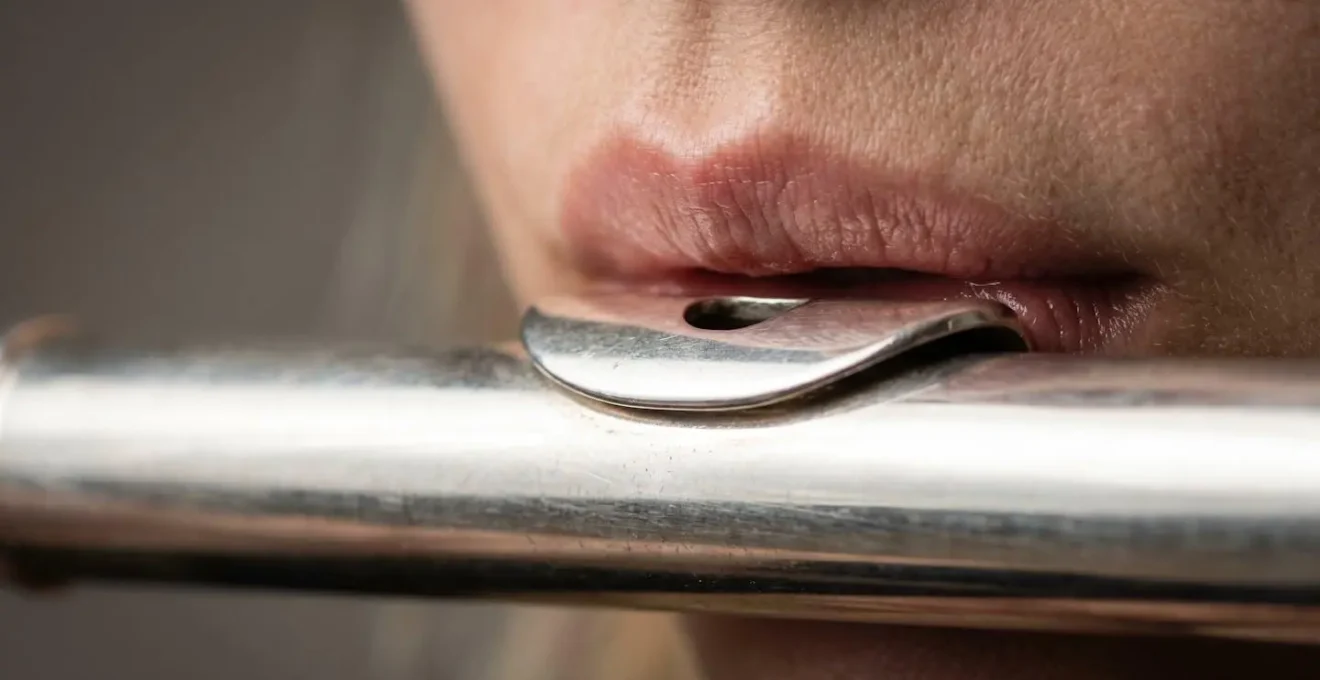
As you can see, the relationship between the lips and the embouchure plate is one of millimeters. During long tones, experiment with subtle changes: roll the flute slightly, adjust lip pressure, and change the angle of your airstream. Listen for the moment the sound locks into focus and feels almost effortless. That is the point of maximum efficiency.
This disciplined practice transforms long tones from a test of endurance into a masterclass in control, directly translating to longer, more beautifully shaped phrases in your music.
Rolling In or Out: How Angle Affects Your Air Efficiency
Once you’ve established foundational support and begun refining your aperture with long tones, the next layer of control comes from the angle of your flute. The position of the lip plate on your chin—whether you roll it slightly in towards you or out away from you—has a profound impact on tone color, pitch, and, most importantly, air efficiency. An incorrect angle is a primary cause of air wastage for many developing players. The flute is a uniquely demanding instrument in this regard; research reveals the flute requires an enormous amount of air because the musician blows over a hole, with only a small fraction of the airstream actually entering the instrument to produce sound.
A common tendency for players running out of air is to roll the flute too far inward. This is often an unconscious attempt to gain a feeling of control or to darken the sound, but it has a disastrous effect. Rolling in covers too much of the embouchure hole, forcing the player to use a very high-velocity, narrow airstream to produce a sound. This « over-blowing » is extremely inefficient and leads to a thin, tight sound that quickly depletes your air supply. It feels like you’re fighting the instrument.
Conversely, rolling the flute too far out uncovers the embouchure hole too much. This creates a wide, unfocused sound that is often airy and flat in pitch. It requires a huge volume of air to fill the space, and you will find your breath disappears almost instantly. The sweet spot is a position where the outer edge of the embouchure hole is aligned with the edge of your lower lip. This allows for a balanced and flexible embouchure, capable of producing a rich, focused sound without excessive air expenditure. Use a mirror to check this alignment. Practice moving between a slightly rolled-in and rolled-out position on a single long tone, listening for the point where the sound is both resonant and feels easiest to produce.
This seemingly small adjustment is a massive lever for breath control, allowing you to achieve a full, resonant tone with a fraction of the effort.
Slouching Kills Tone: Standing Tall to Open the Lungs
You can master the most sophisticated diaphragmatic breathing techniques, but if your posture is collapsed, you are fundamentally restricting your body’s ability to take in and use air. Slouching, whether standing or sitting, compresses the thoracic cavity, limiting the space your lungs have to expand. It is the physiological equivalent of trying to fill a water bottle that has been squeezed in the middle. No matter how well you breathe, your usable lung capacity is compromised.
Proper posture for a flutist is not a rigid, military-style stance. It is an aligned, dynamic state of balance. The Alexander Technique offers a powerful framework for this, emphasizing a lengthening of the spine and a release of habitual tension. The core idea is to allow the head to lead the body upward, creating space between the vertebrae and opening the entire torso. This alignment allows the rib cage to expand freely in all directions—front, sides, and back—giving the diaphragm maximum room to descend and the lungs to achieve their fullest volume.
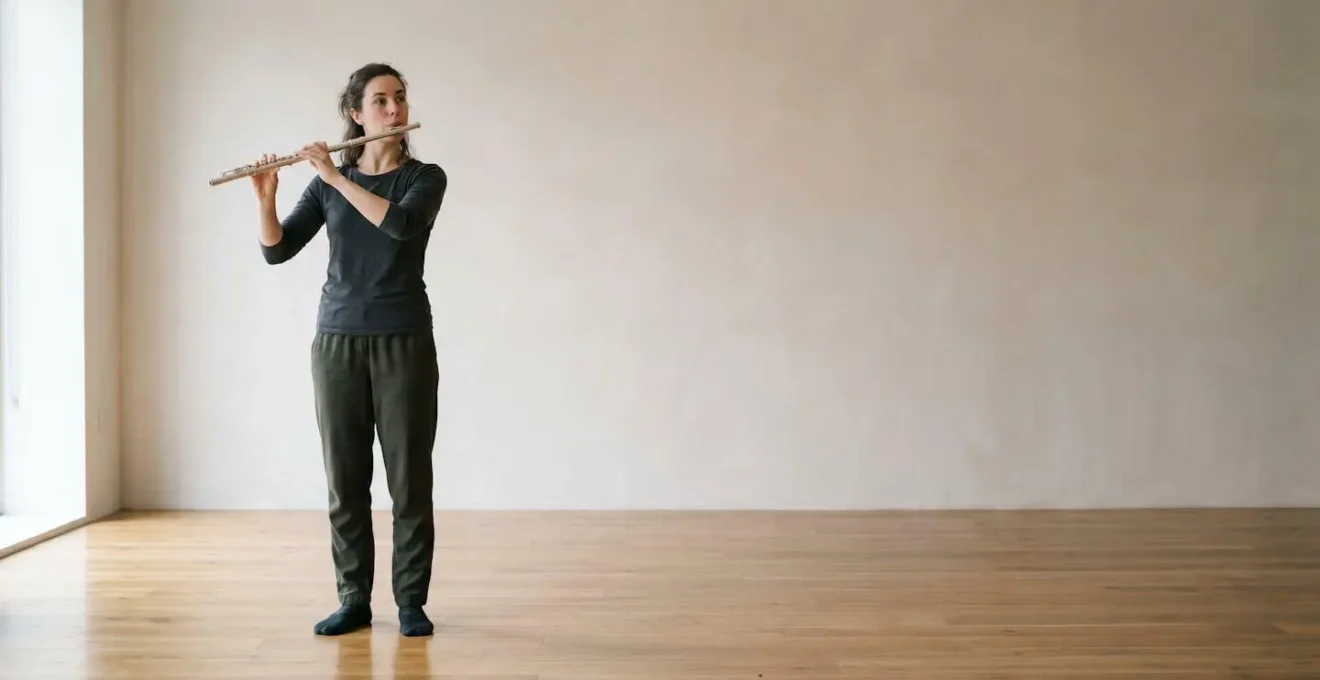
This upright alignment does more than just increase air volume; it also ensures the air column traveling from your lungs to your lips is unobstructed. A kink in the system, such as a forward-thrusting head or slumped shoulders, creates turbulence and requires more pressure to overcome, wasting precious air. A 2023 study on the effects of the Alexander Technique found that musicians who underwent lessons showed significant improvements in spinal extension and head positioning, describing their posture as more « easy and upright. » These changes were not temporary; they were maintained weeks later, demonstrating a lasting impact on their playing foundation.
Think of your spine as the central support pillar for your sound. By keeping it long and free, you are building the ideal architecture for powerful, efficient, and effortless breathing.
The Straw Trick: Learning to Sniff and Blow Simultaneously
Circular breathing is an advanced technique that allows a wind player to sustain a tone for an indefinite period by inhaling through the nose while simultaneously expelling air stored in the cheeks. While not essential for most repertoire, it represents the ultimate mastery of air management and can be a game-changer for contemporary music or long, meditative passages. For the flutist, it presents a unique challenge. As expert Rachel Taylor Geier notes, « Circular breathing on the flute is quite difficult because the flute does not have much natural resistance. Flutists must have great control over their embouchure to create enough resistance to keep the airflow moving. »
The core mechanism involves using your cheeks as a bellows. You puff them out with air from your lungs, then seal off your throat and use your cheek muscles to push that stored air out through your embouchure. In that brief moment, as the cheeks are compressing, you take a quick, sharp « sniff » of air through your nose to partially refill your lungs. The key is to smooth the transition between cheek-air and lung-air so the tone remains uninterrupted.
The « straw trick » is the classic method for learning this complex coordination, as it provides immediate visual feedback. It breaks the process down into manageable steps:
- Fill a glass with water and place a drinking straw in it.
- Begin by blowing air through the straw to create a continuous stream of bubbles using normal lung air.
- While maintaining the bubbles, practice puffing your cheeks to store a reservoir of air.
- Close your throat and use only your cheek muscles to push the stored air through the straw, keeping the bubbles going. This feels like a controlled « spit. »
- While your cheeks are pushing the air out, take a quick, sharp sniff of air through your nose.
- Focus on making the switch from cheek-air back to lung-air as seamless as possible to eliminate any pause or « hiccup » in the bubble stream.
While difficult, practicing this technique, even without perfecting it for performance, will dramatically increase your awareness and control over every part of your breathing apparatus.
Tension Kills Speed: Learning to Relax While Playing Fast
When faced with a fast, technical passage, the body’s instinctive reaction is often to tense up. The fingers grip, the shoulders rise, the jaw clenches, and—most critically—the breath becomes shallow and rapid. This tension is the single greatest enemy of both speed and stamina. It creates a vicious cycle: tension leads to inefficient breathing, which leads to a feeling of breathlessness, which creates panic and even more tension. Breaking this cycle requires conscious, in-the-moment intervention.
Relaxation in this context does not mean going limp. It means using only the precise amount of muscular effort required for the task and no more. Your core must remain engaged for support, and your fingers must be firm, but your jaw, neck, shoulders, and arms should be as free of tension as possible. A tight jaw restricts your embouchure’s flexibility, and tense shoulders constrict the very airway you rely on. This is not a mental state of « just relaxing »; it is a learned physical skill of targeted release.
The most effective tool for this is a quick body scan, a mental checklist you can run through in seconds before tackling a difficult passage or even during a moment’s rest within the music. It serves as a system reset, interrupting the escalating tension before it sabotages your playing. With practice, this scan becomes an automatic reflex.
Your Pre-Flight Check for Releasing Tension
- Identify Tension Hotspots: Consciously check your primary points of tension. Start at the jaw. Is it clenched? Move to the neck and shoulders. Are they creeping up toward your ears?
- Inventory Your Grip: Scan down your arms to your hands. Are your fingers gripping the flute with excessive force? Acknowledge the current level of tension.
- Confront with Your Goal: Contrast this physical tightness with the feeling required for fluid playing. Is your tense state aligned with the goal of speed and ease? The answer is always no.
- Contrast the Sensation: Briefly recall the physical memory of playing with ease. Mentally separate the feeling of « tension » from the feeling of « control. » They are not the same.
- Execute a Release Plan: Before you play the first note of the passage, take one deep, controlled breath and, on the exhale, consciously allow your jaw to soften, your shoulders to drop, and your finger grip to relax to the minimum necessary pressure.
By learning to play with this state of « active relaxation, » you conserve energy and air, allowing you to navigate the most demanding passages with confidence and endurance.
Warm-Up and Focus: Creating a Bubble Before the Curtain Rises
The transition from the practice room to the performance stage is where breath control is most severely tested. The physiological effects of adrenaline and performance anxiety—a racing heart, shallow breathing, and muscle tension—are the direct enemies of the calm, supported airstream you’ve worked so hard to cultivate. It’s no surprise that studies show that a staggering 60-80% of professional musicians report experiencing significant performance anxiety. The key to overcoming this is not to ignore the anxiety, but to have a dedicated pre-performance ritual designed to regulate your body’s stress response.
Your warm-up on the day of a performance should be less about technical drills and more about centering your mind and body. It is about creating a « bubble » of focus that insulates you from external pressures and internal doubts. This ritual should be a three-stage process that moves from general somatic awareness to specific musical application, with breath as the constant anchor.
First, begin with five minutes of somatic breathing away from the instrument. Sit quietly, place your hands on your abdomen, and simply observe the rhythm of your breath. Practice the 360-degree diaphragmatic breathing from the first section, consciously slowing your exhalation to calm your nervous system. Second, move to the mechanical stage with your flute. Spend ten minutes on gentle, dynamic long tones (crescendo and decrescendo), focusing entirely on the physical sensation of controlling the rate of air consumption. Finally, enter the musical stage. Spend the last ten minutes applying these controlled breathing techniques directly to the most demanding phrases of your piece, practicing your planned recovery breaths between passages. This cements the link between your calm physiological state and the music itself.
This deliberate process shifts your focus from « What if I mess up? » to the concrete, controllable sensation of a full, easy breath, giving you a stable anchor in the storm of performance pressure.
Key takeaways
- Support is Control, Not Force: Master 360-degree diaphragmatic breathing to create a powerful air column without introducing tension.
- Efficiency Trumps Capacity: Use long tones to refine your aperture; a focused airstream is the secret to making your breath last longer.
- Posture is Your Foundation: An aligned, upright posture is non-negotiable for maximizing your usable lung capacity and ensuring an unobstructed airway.
- Relaxation is an Active Skill: Consciously scan for and release tension in your jaw, shoulders, and hands to break the anxiety-breathlessness cycle.
The Performer’s Mindset: Overcoming Stage Fright and Owning the Room
You’ve trained your body, refined your technique, and prepared with a focused warm-up. The final piece of the puzzle is the mind. Performance anxiety is not a sign of weakness; it is a powerful physiological and psychological response to a high-stakes situation. The key to mastering it is to reframe your relationship with it. Instead of trying to eliminate fear, you learn to perform alongside it, using your breath as a tool to remain the pilot of your own system.
A University of Sydney study provides compelling evidence for this. Researchers tested pre-performance breathing exercises on musicians and found that a simple, 30-minute routine of slow, diaphragmatic breathing significantly reduced anxiety levels and improved heart rate variability. The crucial mechanism was the prolongation of the out-breath, which directly activates the body’s parasympathetic nervous system—the « rest and digest » system that counteracts the « fight or flight » response of adrenaline. Your breathing technique is a direct lever to manage your body’s chemistry.
This leads to a profound shift in mindset. You are not a passive victim of your nerves; you are an active agent with the tools to manage them. Music therapist Dr. Louise Montello captures this transformation perfectly:
When you become the witness you start to gain control over your fears. You can consciously choose what you want to believe about yourself and your music, so you’re no longer giving your power to internalized judges.
– Dr. Louise Montello, Practices to Ease Performance Anxiety
On stage, when you feel the familiar wave of anxiety, your job is not to fight it. It is to acknowledge it (« Ah, there is the fear ») and immediately return your focus to the physical sensation of your breath—the expansion in your lower back, the controlled release of the airstream. Your breath becomes your anchor in the present moment, pulling your attention away from future « what-ifs » and grounding you in the physical act of making music.
This is the ultimate goal: to transform your breath from a source of anxiety into your most reliable, calming, and empowering partner on stage.