Blog
Embarking on a musical journey later in life is often met with unfounded hesitation. Many prospective musicians assume that without childhood lessons, the window for musical fluency has permanently closed. However, acquiring instrument skills as an adult is not only entirely possible, but it also comes with distinct cognitive and emotional advantages. This foundational resource is designed to systematically dismantle learning barriers, offering you proven methodologies tailored specifically for the adult brain and a busy lifestyle.
Whether your goal is to strum chords around a campfire or perform complex classical pieces, understanding how to practice efficiently is more crucial than the sheer number of hours logged. By combining targeted physical conditioning, smart technological integration, and a logical approach to music theory, you can achieve remarkable progress. The concepts explored here will serve as your roadmap, bridging the gap between raw enthusiasm and tangible musical competence.
The Distinct Advantages of Adult Music Pedagogy
Many adults believe they are at a disadvantage when starting an instrument at 40 or beyond. However, pedagogy for adults differs vastly from how children are taught. You do not want a teacher whose methods revolve around nursery rhymes and rote repetition. Instead, an effective adult learning environment respects your autonomy and leverages your mature cognitive abilities.
Leveraging Logic Over Intuition
Children often absorb music through mimicry, but why adults learn theory faster than kids comes down to one powerful tool: analytical logic. You already understand fractions, mathematical patterns, and structural hierarchies. When presented with concepts like scales or chord progressions, your brain can categorize and apply these rules systematically. This logical framework drastically accelerates your comprehension of the underlying mechanics of music, allowing you to bypass years of blind repetition.
Defining Your Personal Musical Success
Before diving into rigorous practice, it is vital to establish what success looks like for you. The dichotomy between the campfire guitar and the concert hall is a perfect illustration. If your goal is to strum popular songs and sing with friends, your curriculum should prioritize chord transitions and rhythm. Conversely, if you aspire to play classical recitals, your focus will lean heavily toward sight-reading and microscopic technical refinement. Owning your specific goal prevents frustration and keeps your motivation entirely self-directed. Furthermore, adults bring a wealth of life experience to their playing, allowing them to infuse simple notes with genuine emotion that cannot be taught.
Building a High-Yield Daily Practice Routine
The most common hurdle for older beginners is finding the time to play. However, you can achieve remarkable progress in just 15 minutes a day, entirely without quitting your job or sacrificing your lifestyle. In the realm of adult music education, consistency always trumps sheer duration.
The Anatomy of a 30-Minute Session
If you can carve out half an hour, how you structure a 30-minute daily practice determines your ultimate trajectory. A scientifically backed routine divides this time into specific, purposeful blocks:
- The 5-Minute Scale Routine: Begin by waking up your hands before tackling your repertoire. This primes your neuromuscular connections and establishes a solid rhythmic foundation.
- Slow Technical Refinement (10 minutes): Dedicate time to playing at 50% speed. While it requires patience, playing slowly fixes mistakes permanently by preventing your brain from memorizing incorrect fingerings.
- Repertoire Integration (15 minutes): Spend the remaining time applying these techniques to the actual pieces you are passionate about learning, ensuring your technical work translates to real music.
Smart Practice Strategies and Memory Retention
Merely repeating a song from beginning to end is highly inefficient. Instead, try randomizing sections of your piece. Studies in motor learning show that block practice (repeating the exact same measure endlessly) is less effective for long-term memory than switching between different difficult passages. Additionally, you must utilize the mirror of truth: using your phone to hear reality. Recording your practice sessions provides objective feedback, revealing rushing tempos or missed dynamics that your subjective ear might ignore while playing. Finally, always end your session with positive reinforcement. The last thing you play sticks in your subconscious, so conclude with a piece you play well to ensure you return the next day with confidence.
Physical Care and Modern Technological Tools
Adult bodies require a different approach to physical exertion than younger ones, and modern tools can significantly ease the learning curve, making practice both safer and more organized.
Overcoming Physical Barriers
It is completely normal to experience stiff fingers when starting a new instrument. Tendons and ligaments need time to adapt to new, unnatural stretching positions. Implementing gentle stretching exercises for older beginners before and after you play is non-negotiable. Warming up your wrists, massaging your forearms, and performing slow finger extensions will prevent repetitive strain injuries and naturally increase your reach across the fretboard or keyboard over time.
The Digital Music Stand
Beyond physical preparation, leveraging technology can streamline your workflow. An iPad for musicians is an absolute game-changer, effectively transforming your tablet into a comprehensive music stand and mobile studio. With digital sheet music applications, you can annotate scores effortlessly, turn pages hands-free with a Bluetooth foot pedal, and organize thousands of PDFs without the clutter of heavy, physical binders.
Applied Music Theory for Songwriters and Performers
Music theory is not a set of restrictive rules; it is a vocabulary that allows you to express exactly what you feel. For those interested in composition or simply wanting to understand their favorite songs, mastering harmonic functions is the key to breaking out of the infamous four-chord loop that dominates much of popular mainstream music.
Advanced Harmonic Techniques
To elevate your compositions or piano arrangements, you can integrate several sophisticated harmonic devices that instantly add a professional polish to your sound:
- The V of V (Secondary Dominant): Adding a dominant chord that resolves to your standard dominant creates a powerful, undeniable lift. For instance, in C Major, playing a D Major chord before heading to the G Major chord pulls the listener aggressively forward, making it the perfect tool for a dramatic chorus transition.
- Borrowing Chords: Learning how to use a minor IV chord in a major key injects a sudden, poignant sense of melancholy. Slipping an F minor chord into a C Major progression pulls at the listener’s heartstrings and is a staple of cinematic scores.
- Slash Chords: By placing a non-root note in the bass, you can craft smooth, descending basslines. Writing a « G/B » chord allows for stepwise bass motion down to an A minor, stripping away the clunky, amateurish sound of jumping randomly around the keyboard.
Phrasing and Rhythmic Impact
Theory also dictates how your song flows from section to section. When building a bridge, you need a navigation map to find keys that fit together organically, providing a refreshing contrast before returning to your final, triumphant chorus. Furthermore, theory extends deeply into lyrical delivery. Understanding the subtle interplay between strong and weak beats allows you to place your most crucial, emotionally resonant lyrics on the precise rhythmic accents that yield maximum impact on the listener.
Mastering a musical instrument as an adult is a profoundly rewarding endeavor that blends intellectual stimulation with emotional expression. By adopting a pedagogical approach suited to your logical mind, structuring your micro-practice sessions for optimal memory retention, and embracing practical music theory, you can entirely bypass years of trial and error. Remember that consistency, self-compassion, and the right strategic tools are your greatest assets. Your musical journey is entirely in your hands, ready to be shaped one deliberate note at a time.
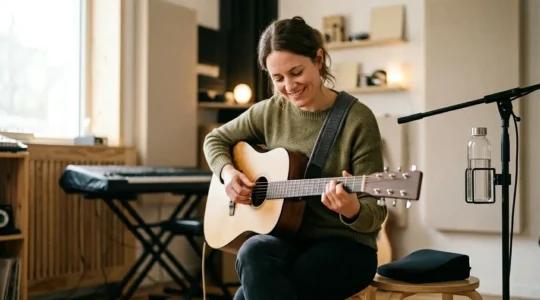
Beyond Pain: A Clinical Guide to Ergonomic Accessories for Peak Musical Performance
Contrary to common belief, ergonomic accessories aren’t just for managing pain—they are performance enhancement tools grounded in biomechanics. Proper ergonomic intervention improves the entire kinetic chain, enhancing precision, endurance, and artistic expression. A tool designed for a static task (like…
Lire la suite
How to Structure a 30-Minute Daily Practice for Maximum Results
In summary: Stop aimless « noodling » and adopt a structured, 30-minute system based on cognitive science, not just tradition. Focus on quality over quantity; targeted techniques like slow practice and interleaving are more effective than hours of mindless repetition. Use technology…
Lire la suite
Music Theory for Songwriters: Breaking Out of the 4-Chord Loop
In summary: Stop thinking of music theory as rules and start using it as a creative toolbox to solve songwriting problems. Introduce « creative friction » with borrowed chords (like a minor iv in a major key) to add instant emotional depth….
Lire la suite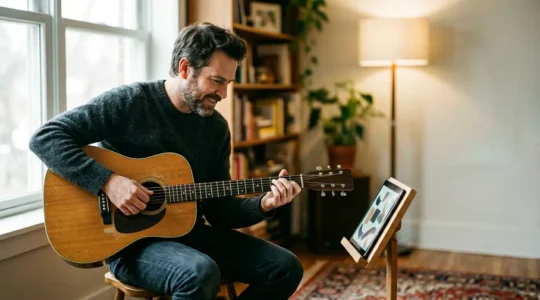
Starting an Instrument After 40: Why Your Adult Brain is Your Greatest Asset
Contrary to popular belief, learning an instrument after 40 isn’t about overcoming disadvantages; it’s about leveraging unique adult cognitive strengths. Short, focused practice (15 minutes/day) is more effective than long, infrequent sessions. Adult analytical skills allow for a much faster…
Lire la suite