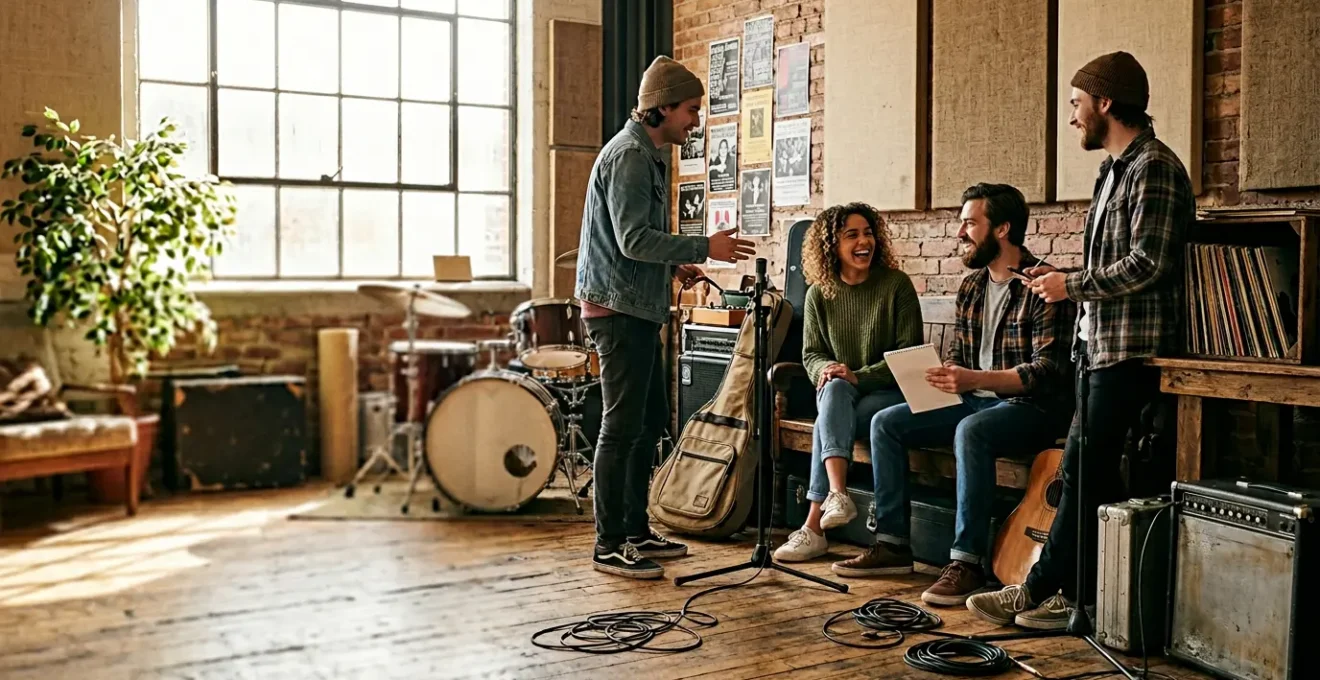
Contrary to popular belief, finding a band isn’t about getting lucky with an online ad; it’s about strategically embedding yourself into your local music ecosystem.
- Success depends more on your professional etiquette and networking than your raw talent.
- Understanding the business realities of venues and rehearsals separates sustainable bands from short-lived projects.
Recommendation: Shift your focus from « finding players » to « becoming a known, reliable part of the scene. » Your reputation will attract the right collaborators.
That feeling of playing an instrument alone in your room, full of riffs and ideas but with no one to share them with, is a musician’s universal frustration. You know you have what it takes, but the path from solo player to a gigging band seems impossibly vague. The standard advice is always the same: post an ad on Craigslist, maybe show up to an open mic. While not entirely wrong, this approach misses the fundamental truth of every thriving local scene: it’s a living, breathing musical ecosystem.
Simply throwing a message in a bottle into the vast ocean of the internet rarely attracts serious collaborators. The real work, and the real reward, comes from understanding the unspoken rules, the social currency, and the professional etiquette that holds this ecosystem together. It’s not just about what you play; it’s about how you present yourself, how you prepare, and how you contribute to the scene as a whole. Thinking like a promoter—understanding what venues want, what audiences respond to, and what makes a band reliable—is the secret weapon.
But if the key isn’t just about finding players, what is it? The answer lies in shifting your mindset from passive searching to active, strategic engagement. It’s about building a reputation before you even have a band. It’s about treating every interaction as an audition, not just for a spot on stage, but for a place within the community. This isn’t a mystical process; it’s a series of deliberate, actionable steps.
This guide will break down that process. We’ll explore where dedicated musicians actually connect, demystify the financial and logistical realities of rehearsing, and reveal what it really takes to get that first gig. We will cover the strategic decisions behind your setlist, the internal politics of band leadership, and the professional mindset required to not just join a band, but to thrive in it.
Summary: Support Your Local Scene: How to Join or Start a Local Band
- Craigslist vs Open Mics: Where Do the Serious Musicians Hang Out?
- Garage vs Rented Studio: The Cost of Making Noise
- The Demo Tape: Getting Your First Slot at the Local Pub
- Covers vs Originals: Balancing Art with Audience Expectations
- The Leader Dilemma: Who Decides the Setlist?
- Hired Gun: Life as a Studio Player vs Touring Member
- Learning the Songs: Why « Jamming » Doesn’t Mean « Learning on the Spot »
- Joining a Band: How to Survive Your First Rehearsal
Craigslist vs Open Mics: Where Do the Serious Musicians Hang Out?
The digital age promises connection at the click of a button, but the most common advice— »post an ad »—is often a shot in the dark. While sites like Bandmix or local forums can occasionally yield results, they are flooded with varying levels of commitment. The serious players, the ones who make up the backbone of a local scene, are rarely found through anonymous posts. They are found in person, where their skills, passion, and professionalism are on full display. With over 24,080 professional musicians and singers across the U.S., the talent is out there, but it congregates in specific nodes of the musical ecosystem.
Open mics and local shows are your primary hunting grounds. But don’t just go to play; go to listen, to network, and to be seen. Show up consistently. Support other artists. Buy a drink. Talk to the sound guy. These actions signal that you are a contributing member of the scene, not just someone looking to take from it. This is strategic visibility. When you do perform, be over-prepared. A tight, well-rehearsed three-minute song says more about your seriousness than an hour of sloppy jamming.
Your online presence should support your offline efforts, not replace them. Create a simple « musical resume »—a YouTube channel with a few videos of you playing well, or a Soundcloud with a couple of demos. This isn’t about going viral; it’s about having a link ready when you meet a potential collaborator. It shows you’ve done the work and respect their time. The goal is to make it easy for other serious musicians to say « yes » to you. They aren’t scrolling Craigslist; they’re at the bar after the show, talking about music with other people who showed up.
Garage vs Rented Studio: The Cost of Making Noise
Once you’ve found your collaborators, the romantic image of hashing out songs in a dusty garage quickly collides with a less-glamorous reality: logistics and money. Making noise costs something, whether it’s your neighbor’s patience or actual cash. This is the first test of a band’s viability. Treating your band like a small business from day one, with a clear understanding of expenses, is what separates the hobbyists from the groups that actually make it to the stage. Your choice of rehearsal space is a major financial and practical decision that shapes your band’s entire workflow.
The « free » garage space comes with hidden costs: strained relationships with neighbors, potential legal complaints, and often terrible acoustics that mask problems in your playing. While it offers flexibility, it isolates you from the wider musical ecosystem. On the other end, professional rehearsal studios offer soundproofing, PA systems, and a chance to network with other bands. The trade-off is the pressure of the clock and a recurring expense that requires commitment from every member.

A transparent conversation about finances is non-negotiable. Who pays for what? How will you track shared expenses for strings, drumheads, or studio time? A simple shared spreadsheet can prevent immense conflict down the road. This isn’t about killing the creative vibe; it’s about building a foundation of trust and shared responsibility so you can focus on the music. The table below, based on an analysis of different rental models, breaks down the core options you’ll face.
| Rental Model | Typical Cost | What’s Included | Best For | Drawbacks |
|---|---|---|---|---|
| Pay-by-the-Hour | $25-$50/hour | Used PA system, some gear | Occasional rehearsals, quick sessions | Clock pressure, costs add up fast, limited productivity |
| Monthly Rental (NYC example) | $400-$650/month | Private lockout space, 24/7 access, soundproofing | Serious bands with regular schedule | Higher upfront commitment, requires consistent use |
| Garage/Home Space | Free (or minimal) | Complete flexibility, own equipment | Budget-conscious beginners | Neighbor complaints, legal issues, poor acoustics, no networking |
The Demo Tape: Getting Your First Slot at the Local Pub
Your band is tight, your songs are ready, and you’ve figured out your rehearsal situation. Now comes the moment of truth: convincing a venue to give you a stage. In the age of streaming, the « demo tape » has evolved, but its purpose remains the same: to act as your professional calling card. A booker or promoter is a busy professional. They don’t have time to « discover » your genius; you have to present it to them in a clean, concise, and compelling package. It’s less about one great song and more about showing you understand the business of live music.
As Doug Hoffman, co-owner of a local club, explains, the first impression is everything. He’s not just listening for a good tune; he’s looking for a complete package. As he states in an interview with Atomic Disc from a club owner’s perspective:
Primarily when I book an act for the first time I am looking for a clean presentation of an aesthetic. A character or even mythos of the band to immerse people in. Paramount is a good looking website, a sound that I can identify as having heart, and some description of what kind of music the band or act describe themselves as.
– Doug Hoffman, Co-owner of Salem club, the Space
This means your pitch needs an Electronic Press Kit (EPK). This is no longer optional. It should include a short bio, a few high-quality photos, and, most importantly, 2-3 of your best songs. Live performance videos are even better, as they prove you can deliver on stage. Keep your pitch email brief and to the point. Tell them who you are, what you sound like, and provide a realistic estimate of your draw. Being honest that you can guarantee 20 friends is far better than promising a crowd you can’t deliver. Your first gig is a live audition for better slots in the future, so start with a Tuesday or Wednesday opening slot to prove your reliability.
Covers vs Originals: Balancing Art with Audience Expectations
One of the first creative and strategic hurdles a new band faces is the setlist. Do you pour your heart into original compositions or do you win over the crowd with familiar hits? This isn’t just an artistic question; it’s a business decision. From a promoter’s perspective, the answer is frustratingly pragmatic: cover bands often pay the bills. A venue owner knows that a good tribute or cover band can consistently draw a large, thirsty crowd ready to party, which translates directly to revenue. This reality has become even more pronounced in recent years.
An informal discussion among professional musicians highlights this industry shift, revealing that many local scenes are now dominated by cover acts. One musician noted that venues which once championed original music now rely on tribute bands that can pull in 800+ people a night. This doesn’t mean you have to sell your artistic soul. The smartest bands understand this dynamic and use it to their advantage. A well-executed, surprising cover can be the hook that gets an audience to pay attention to your originals. It shows your musicianship, your taste, and your ability to connect with a room.
The key is balance and strategy. Don’t just play the most obvious songs. Choose covers that align with your band’s « aesthetic, » as a booker would say. A punk band playing a Johnny Cash song or a soul band reinterpreting a Radiohead track is interesting. It showcases creativity while still providing a familiar entry point for the audience. Use covers to get the gig and build a following, then slowly introduce more of your original material as you prove your worth. Your original music is your long-term identity, but a few great covers are the currency you use to get your foot in the door.
The Leader Dilemma: Who Decides the Setlist?
As soon as a band has more than one member, a fundamental question arises: who is in charge? The arguments over song choices, arrangements, and setlists are legendary, and they’ve broken up more bands than anything else. This isn’t just about creative differences; it’s about governance. Without a clear, agreed-upon structure for making decisions, bands often fall victim to what social critics call the « tyranny of structurelessness. » In an attempt to be a pure democracy, no one takes charge, and an unspoken, often dysfunctional, power dynamic emerges.
As Carl Wilson notes in a Slate Magazine analysis of band leadership, this illusion of no structure is a trap. It doesn’t create equality; it just hides the power struggles, leading to resentment and paralysis.
In shop talk among musicians, this is all often framed as a choice between democracy and dictatorship in band organization. The tyranny of structurelessness—in which the illusion that there is no structure conceals an implicit structure—eventually undermines the group ideal.
– Carl Wilson, Slate Magazine
The solution is to have an explicit conversation about how the band will operate. There is no single « right » model, but choosing one consciously is critical. A benevolent dictatorship, where one person with a clear vision makes the final calls, can be incredibly efficient, especially for a project with a specific artistic goal. A full democracy works for collaborative, experimental projects but can be painfully slow. Other models, like rotating leadership or a « department head » system (e.g., one person handles bookings, another handles music direction), can provide a healthy balance. The table below outlines these common approaches.
| Governance Model | Decision Speed | Creative Freedom | Conflict Risk | Best Use Case |
|---|---|---|---|---|
| Benevolent Dictatorship | Fast | Low for members, high for leader | Medium (resentment can build) | Projects with clear vision, tight deadlines, or touring bands needing quick decisions |
| Full Democracy (Consensus) | Slow | High for all members | High (risk of tyranny of structurelessness) | Early-stage bands, collectives, experimental projects |
| Rotational Leadership | Medium | High (varies by project) | Medium | Bands with diverse member skills, multiple songwriters, or side projects |
| Department Head Model | Medium-Fast | Medium-High | Low (clear roles reduce friction) | Professional bands with business ambitions, multiple revenue streams |
Hired Gun: Life as a Studio Player vs Touring Member
Not every musician’s goal is to start their own band. For many, the ideal role is that of a « hired gun »—a reliable, skilled player who can slot into an existing project for studio sessions or tours. This path requires a different skillset, one focused on adaptability, professionalism, and service. A hired gun is a problem solver. They show up prepared, nail their parts, and serve the vision of the band or artist who hired them. It’s a role built on reputation, and in many local scenes, the best hired guns are the busiest and most respected musicians.
The financial reality of this path can be a mixed bag. While top-tier session players can make a great living, the economics for most local musicians are more modest. A 2024 census in Minneapolis, for example, revealed the average annual income from music was around $28,000. This underscores the need for professionalism and reliability; the players who get the most calls are the ones who are easy to work with and always deliver. Becoming the go-to fill-in player in your scene is a powerful form of networking and can lead to more permanent positions.
The key is to adopt the « audition mindset » in every situation. Your first three months with any new group are a trial period, whether it’s officially stated or not. This is the time to listen more than you talk, to learn the existing parts perfectly before suggesting your own creative ideas, and to demonstrate that you are a low-drama, high-value addition to the team. A musical resume with videos showcasing your versatility is essential for getting these opportunities in the first place.
Your Action Plan: Professional Hired Gun Strategies
- Positioning: Actively market yourself as reliable and prepared. Become known as the go-to fill-in player by learning material quickly and always being on time.
- The Trial Period: For the first three months with a new act, adopt a « trial » mindset. Show up prepared, nail your parts perfectly, and listen more than you talk to understand the group’s dynamic.
- Service Mentality: Prioritize serving the band’s existing vision. Master the established parts and feel before attempting to impose your own creative ideas. Your first job is to fit in seamlessly.
- Build Your Resume: Create 2-3 high-quality videos of you playing in different styles and maintain a Soundcloud with demos. This showcases your versatility and makes it easy for leaders to hire you.
- Strategic Networking: Be consistently visible. Attend shows of bands you admire, hang out at rehearsal studios, and participate in local music events to build connections.
Learning the Songs: Why « Jamming » Doesn’t Mean « Learning on the Spot »
There is a pervasive myth among amateur musicians that band rehearsal is the time to « jam » and figure out the songs together. This could not be further from the professional standard. In a working band, rehearsal is for integration, dynamics, and performance. The actual learning of your individual parts—the notes, the chords, the structure—is homework. Wasting expensive studio time or your bandmates’ patience by learning your part on the spot is the fastest way to get fired or burn out a project. As the experts at Recording Connection bluntly put it, « Time in the studio shouldn’t be spent practicing… you need to be relatively good to go when you show up. »
This is the most crucial piece of professional etiquette a musician can learn. Respecting everyone’s time by showing up prepared is the foundation of trust in a band. This requires developing active listening and practice techniques at home. Don’t just passively listen to the demo; deconstruct it. Map out the song’s structure (verse, chorus, bridge, etc.) before you even pick up your instrument. This creates a mental roadmap that makes learning the actual notes infinitely easier.
Modern tools make this process more efficient than ever. Here are some essential techniques for your personal practice time:
- Chart the Song Structure: Before playing a single note, map out the entire song form: intro, verse 1, chorus 1, verse 2, chorus 2, bridge, solo, outro. This is your blueprint.
- Use Slow-Down Apps: Use applications that can slow down difficult passages without changing the pitch. This allows you to analyze complex runs or tricky rhythms in detail.
- Create « Minus-One » Tracks: If possible, create a version of the song with your instrument removed. Practicing your part in this full context is the best way to ensure it locks in with the rest of the band.
- Establish a Digital Toolbox: A shared Google Drive or Trello board for chord charts, demo MP3s, and lyric sheets ensures everyone is working from the same information.
- Practice vs. Rehearsal: Internalize the crucial distinction. Practice is what you do at home to learn your parts. Rehearsal is what you do together to make it a song.
This level of preparation is not just about technical proficiency; it’s a sign of respect. It tells your bandmates that you value their time and are committed to the project’s success. It’s the difference between a garage jam and a professional rehearsal.
Key Takeaways
- Your reputation for professionalism and reliability is your most valuable asset in the local music scene.
- Treating your band like a small business—discussing finances, goals, and leadership—prevents future conflict.
- The most successful musicians are active participants in their local musical ecosystem, not just passive players.
Joining a Band: How to Survive Your First Rehearsal
You’ve done the work. You’ve networked, prepared a musical resume, and landed an audition or a spot in a first rehearsal. This is the moment where all your preparation pays off. Surviving—and thriving—in this first session is less about showing off your flashiest licks and more about demonstrating that you are a great collaborator. This is your real-life audition, and they’re judging your character and work ethic as much as your chops. The primary goal is to make everyone else in the room sound better.
First and foremost, show up early and prepared. Have your gear in working order, and most importantly, know the songs inside and out. Having done your homework, as we’ve discussed, is the ultimate sign of respect. Walk in ready to play the songs exactly as they were on the demos. This is not the time to suggest a new arrangement for the bridge or a different chord progression in the chorus. Your first job is to prove you can fulfill the existing role perfectly.
During the rehearsal, listen more than you play. Pay attention to the dynamics of the group, both musically and personally. Who is the leader? How does the drummer lock in with the bassist? What are the non-verbal cues they use to signal changes? Your ability to lock into this existing framework is far more impressive than your ability to shred a solo. Be a positive and low-maintenance presence. No one wants to add a difficult personality to the mix, no matter how talented they are. Be enthusiastic, be complimentary, and be ready to work.
Now that you have the roadmap, it’s time to put it into practice. Get out there, go to shows, meet people, and become the musician that everyone wants in their band. Your local scene is waiting for you.