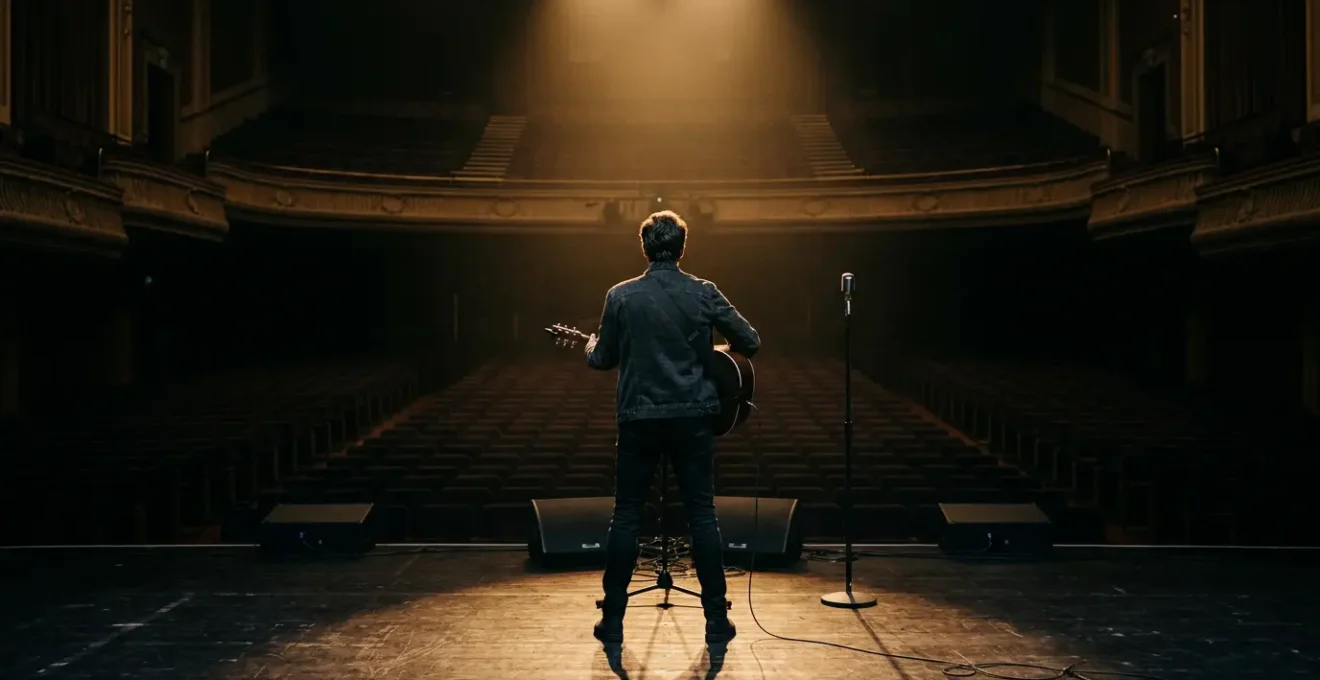
Contrary to popular belief, stage fright isn’t a mental weakness to be overcome with willpower; it’s a physiological event that can be actively managed and controlled.
- Your body’s fight-or-flight response, triggered by adrenaline, can be « hijacked » using specific breathing techniques to restore calm.
- Cognitive biases like the « spotlight effect » make you believe the audience notices every mistake, when in reality, they rarely do.
Recommendation: Instead of fighting your fear, learn to work with your body. Focus on mastering your internal state through breath, posture, and mental framing to transform anxiety into focused energy.
You know the feeling. In the practice room, you’re flawless. The notes flow, the timing is perfect, and the music feels like an extension of yourself. But then the stage lights hit. Your hands feel cold and clumsy, your heart hammers against your ribs, and a passage you’ve played a thousand times suddenly feels like a foreign language. This frustrating gap between your potential and your performance is the classic hallmark of stage fright, or more accurately, Music Performance Anxiety (MPA). It’s not a reflection of your skill or dedication; it’s a biological response getting the better of you.
Many will offer generic advice: « practice more, » « picture the audience in their underwear, » or simply « don’t be nervous. » These platitudes fail because they ignore the root cause. The problem isn’t your talent; it’s your autonomic nervous system launching a full-scale fight-or-flight response as if the audience were a saber-toothed tiger. The truth is, you can’t just think your way out of a physiological state. But what if the key wasn’t to eliminate fear, but to understand and hijack the very systems that produce it?
This guide moves beyond surface-level tips. As a performance psychologist, I’ll show you how to become the master of your own internal state. We will explore the concrete, science-backed techniques to manage your body’s adrenaline response, reframe your relationship with the audience, build a mental fortress before you even step on stage, and use your physical setup—from your shoes to your straps—as an anchor for confidence. This is about turning your body from a source of betrayal into your greatest ally on stage.
This article provides a structured path to reclaiming your confidence on stage. Each section is designed to give you a specific, actionable tool to add to your performance toolkit, moving from immediate physiological control to long-term ergonomic health.
Summary: The Performer’s Mindset: Overcoming Stage Fright and Owning the Room
- Drugs vs Breathing: Managing Adrenaline Naturally
- Scanning the Crowd: How to Look Connected Without Being Terrified
- Warm-Up and Focus: Creating a Bubble Before the Curtain Rises
- The Poker Face: Why the Audience Doesn’t Know You Messed Up
- Comfort vs Style: Why Shoes Matter More Than You Think
- The Book on Belly: Strengthening Support Without Tension
- High-Fidelity Earplugs: Saving Your Ears Without Muffling the Sound
- Ergonomic Accessories: Playing Without Pain
Drugs vs Breathing: Managing Adrenaline Naturally
When your heart pounds and your hands shake, it’s a direct result of adrenaline flooding your system. For decades, some musicians have turned to beta-blockers to chemically blunt this response. While they can reduce symptoms like a racing heart, they are not a silver bullet and can come with significant performance drawbacks. This approach treats the symptom, not the cause, and can disconnect you from the emotional core of your music.
Some performers report feeling indifferent and non-expressive when taking beta-blockers; others claim to lose control of their vibrato.
– Dr. Alice Brandfonbrener, Medical Problems of Performing Artists, Vol. 5, No. 1
A far more powerful and sustainable strategy is to perform a physiological hijack on your own nervous system. You can do this through controlled breathing. The most effective technique, validated by neuroscience, is the « physiological sigh » or « cyclic sighing. » It involves a double inhale through the nose (one long, followed by a short top-up) and a long, slow exhale through the mouth. This specific pattern forces the tiny air sacs in your lungs (alveoli) to re-inflate, and the extended exhale activates the parasympathetic nervous system—your body’s « rest and digest » mode—which directly counteracts the adrenaline rush.

Practicing three to five cycles of this breath before you walk on stage, or even between songs, is the fastest way to manually lower your heart rate and bring your body back under conscious control. It’s not just « taking a deep breath »; it’s a targeted intervention to tell your brain the threat has passed. This gives you control without the emotional flattening that can come with medication.
Scanning the Crowd: How to Look Connected Without Being Terrified
The sea of faces staring back at you is often the single greatest trigger for performance anxiety. The advice to « connect with your audience » feels impossible when every pair of eyes feels like a judgment. The fear is real and widespread; a survey of over 2,000 professional musicians revealed that 24% suffer from significant stage fright. The solution isn’t to force eye contact but to create the *illusion* of connection while maintaining a safe psychological distance.
This is where the « Lighthouse Technique » comes in. Instead of seeing the audience as a monolithic entity, you mentally divide the room into three or four zones: far left, center, far right, and perhaps a balcony. Your job is no longer to look at individuals, but to slowly and deliberately sweep your gaze across one entire zone, like a lighthouse beam scanning the ocean. Hold your gaze on a zone for a full musical phrase (4-8 seconds), then, during a natural pause, move to the next zone.
The key to making this feel comfortable is to use a « soft focus. » Don’t try to lock eyes with anyone. Instead, look at the back wall of the venue, at the space between people’s heads, or at their foreheads. From their perspective, you appear engaged, confident, and connected to the entire room. From your perspective, you are performing a simple, repeatable pattern that keeps your focus broad and prevents you from getting trapped by a single person’s expression. This turns a terrifying social task into a manageable, depersonalized stage choreography.
Warm-Up and Focus: Creating a Bubble Before the Curtain Rises
The moments before a performance are the most critical for managing anxiety. If you walk on stage already tense and distracted, you’re starting at a disadvantage. Your goal is to create a « cognitive airlock »—a pre-show ritual that systematically seals off external pressures and internal doubts, allowing you to step into a bubble of pure focus. This isn’t just about warming up your fingers; it’s about warming up your mind. The need is immense, as recent surveys found that 96% of undergraduate music students suffer from performance anxiety, showing how early this pattern begins.
A powerful pre-show ritual can be structured in three stages:
- The Physical Stage (15 minutes out): Begin with slow, deliberate technical exercises. The goal here isn’t speed, but interoception—feeling the muscles work and reinforcing the mind-body connection. Pair this with gentle stretches for your neck, shoulders, and hands to release stored physical tension.
- The Mental Stage (10 minutes out): Practice the Stoic technique of *Premeditatio Malorum* (the premeditation of evils). Spend two minutes vividly imagining a minor mistake—a cracked note, a brief memory slip—and then visualize your calm, professional recovery. By facing the « worst-case » scenario in a controlled way, you strip it of its power to surprise and derail you.
- The Emotional Stage (5 minutes out): This is where you anchor yourself. Use a designated « anchor object »—a specific guitar pick, a smooth stone in your pocket, a piece of jewelry—that you *only* handle before a show. Hold this object while performing three cycles of the physiological sigh. This process conditions a powerful link between the object and a state of calm.
Just before you walk out, put everything away, take one final grounding breath, and consciously make the mental shift from « preparation » to « performance. » You are now stepping out of the airlock and into your element, fully prepared and protected.
The Poker Face: Why the Audience Doesn’t Know You Messed Up
You hit a wrong note, and your world stops. In your mind, a giant neon sign has just lit up over your head, pointing out your failure to every single person in the audience. This intense feeling of being scrutinized is a powerful cognitive bias known as the spotlight effect. We are the center of our own universe, and we fundamentally overestimate how much others notice our actions and appearance. The psychological reality is, your mistake was likely a blip on their radar, if they noticed it at all.
This isn’t just a comforting thought; it’s a documented psychological phenomenon. The most famous demonstration of this is the « Barry Manilow T-Shirt Experiment. »
Case Study: The Spotlight Effect in Action
In a landmark study, psychologists from Cornell University had participants wear what they considered an embarrassing t-shirt (featuring Barry Manilow) and briefly enter a room of observers. The participants wearing the shirt predicted that about 50% of the people in the room would notice it. The reality? As the research published in the Journal of Personality and Social Psychology shows, only around 25% actually remembered the shirt. People consistently overestimate how much their « flaws » are noticed by a factor of two. This is because we are anchored in our own intense experience and fail to account for the fact that everyone else is wrapped up in their own thoughts and has divided attention.
As a performer, this is your secret weapon. When you make a mistake, your internal reaction is a 10/10. For the audience member who is checking their phone, thinking about what they’ll eat after the show, or just enjoying the overall vibe, your mistake might register as a 1/10, or more likely, a 0/10. The golden rule of performance is to never react to your own mistake. Don’t wince, don’t grimace, don’t apologize. Maintain your « poker face » and move on. By not drawing attention to it, you ensure the spotlight effect works in your favor, rendering your perceived catastrophe invisible.
Comfort vs Style: Why Shoes Matter More Than You Think
When considering your stage presence, you probably think about your shirt, your hair, or your instrument. But the foundation of your physical stability and confidence starts from the ground up: your shoes. The wrong footwear can be a subtle but significant source of physical and mental distraction. Unstable heels can throw off your posture, thin soles can lead to foot fatigue, and a poor fit can be a constant, nagging discomfort. All of these things chip away at your focus.
Your connection to the ground is a direct line of proprioceptive feedback to your brain. When your feet feel stable and supported, your brain receives a signal of safety and groundedness. This physical stability is essential for proper breath support, a relaxed posture, and the confidence to move freely. Choosing shoes for the stage isn’t a matter of vanity; it’s a strategic ergonomic decision. Different playing styles demand different features from your footwear.
The following guide breaks down footwear choices based on your role on stage, ensuring your shoes are working for you, not against you.
| Performer Type | Primary Need | Recommended Features | Avoid |
|---|---|---|---|
| The Stomper (Rock/Drummers) | Ankle support and grip for dynamic movement | Low-profile boots or high-top sneakers with non-slip rubber soles; reinforced ankle support; breathable material | Smooth leather soles; unstable heels; loose-fitting shoes |
| The Swayer (Vocalists/Front performers) | Stable, flat base for diaphragm support | Flat or very low heel (under 1 inch); wide toe box; cushioned insole; even weight distribution | High heels over 2 inches; platform shoes; pointed toes that compress feet |
| The Pedal-Dancer (Guitarists/Keyboardists) | Flexible sole with defined heel for pedal precision | Thin, flexible sole for tactile feedback; defined heel for stability; snug fit; lightweight construction | Thick or cushioned soles that reduce pedal feel; slip-on styles without secure fit |
The Book on Belly: Strengthening Support Without Tension
« Support your sound from the diaphragm! » is another piece of classic advice that often leads to more problems than it solves. For many musicians, « support » is misinterpreted as « bracing » or « tensing. » This creates a rigid, locked core that restricts breath, creates tension in the shoulders and neck, and ultimately chokes your sound and exacerbates anxiety. True support is not about creating an abdominal wall of steel; it’s about achieving an active, engaged core that remains flexible and responsive.
A braced core is the enemy of the physiological sigh we discussed earlier. You cannot achieve a full, calming breath if your abdomen is locked. The goal is to distinguish the sensation of supportive engagement from restrictive tension. The « Laugh Test » is a perfect example: notice the feeling in your core right before a genuine laugh. That is active, ready support, not a rigid clench. Similarly, the « Cough Preparation » engages the same muscles without creating unnecessary tension. Your objective is to maintain this state of readiness at about 70% effort, leaving room for breath and movement.

A properly engaged core has a cascade of positive effects. It supports an open chest and lifted sternum, which not only improves your physical presence but also allows your lungs to expand fully. This posture sends signals of confidence to your brain, creating a positive feedback loop. When your body is aligned and supported without tension, your mind is freer to focus on the music. You’re no longer fighting your own body, so all your energy can be directed outwards into your performance.
High-Fidelity Earplugs: Saving Your Ears Without Muffling the Sound
Stage volume is a double-edged sword. The energy is exhilarating, but the sheer sonic force can be overwhelming. This sensory overload is a significant and often overlooked trigger for anxiety. When your brain is bombarded with excessive volume, it has to work overtime just to process the input, leaving fewer cognitive resources available to focus on the intricate tasks of performing. This is where high-fidelity earplugs become not just a tool for hearing protection, but a critical tool for performance psychology.
Unlike foam earplugs that muffle sound and make you feel disconnected, high-fidelity earplugs are designed to act as an auditory filter. They provide a flat frequency response, meaning they turn down the entire sound spectrum evenly. You hear everything clearly—the highs, mids, and lows—just at a reduced, more manageable volume. Research has long shown the link between high stress and performance; for instance, research from the 1980s found that 58% of Vienna Symphony Orchestra musicians experienced nervous stress during concerts. Reducing the cognitive load is a key intervention.
High stage volumes can cause sensory overload, triggering an anxiety response. Earplugs act as an ‘auditory filter,’ reducing the brain’s workload and freeing up mental resources to focus on performance.
– Performance Psychology Research, Music Performance Anxiety Literature Review
By reducing the overall decibel level, you create a small pocket of auditory space for yourself. This allows you to hear your own instrument and your bandmates with greater clarity, improving your timing and intonation. More importantly, it lowers the overall « threat level » perceived by your brain. With less sensory information to process, your mind is less likely to tip into an anxiety spiral. It’s a simple, physical change that can have a profound impact on your mental state, helping you stay inside your focus bubble even on the loudest of stages.
Key Takeaways
- Stage fright is a physiological event; use specific breathing techniques like the « physiological sigh » to actively hijack your nervous system and restore calm.
- The « spotlight effect » is a cognitive bias; the audience notices your mistakes far less than you think. Maintain a poker face and the error becomes invisible.
- Physical stability is the foundation of mental confidence. Strategic choices in ergonomics, from your shoes to your instrument strap, reduce physical stress and free up mental resources.
Ergonomic Accessories: Playing Without Pain
The final piece of the performance puzzle is ensuring your physical interface with your instrument is free from pain and strain. Chronic discomfort from poor ergonomics is more than just a physical issue; it’s a constant, low-level stressor that drains your mental energy and focus. Pain is a distraction. When you’re fighting against a guitar strap that digs into your shoulder or a keyboard height that forces you to hunch, you have fewer cognitive resources to dedicate to your music and to managing anxiety.
Optimizing your ergonomics is about achieving a state of neutrality and efficiency. Your body should be able to move through its required motions with the least possible tension. A wide, comfortable guitar strap distributes weight, preventing shoulder pain. A properly adjusted drum throne allows for powerful, relaxed movement without straining your back. A correct instrument height allows your wrists to remain relatively straight, drastically reducing the risk of repetitive strain injuries that can cause both pain and performance-ending anxiety.
Thinking about ergonomics isn’t a one-time setup; it’s an ongoing process of listening to your body. Where do you feel tension after 20 minutes of playing? That’s your body telling you where an adjustment is needed. By systematically eliminating these points of physical friction, you are removing a significant source of unconscious stress, allowing your mind and body to work in harmony. This audit is one of the most practical steps you can take to build a sustainable and confident performance career.
Your Ergonomic Audit Checklist
- Guitar/Bass Strap Assessment: Is the strap wide enough (minimum 2 inches) to distribute weight? Does the instrument hang at a height that allows your wrists to remain neutral?
- Wrist Position Check: When playing, are your wrists relatively straight or excessively bent? Bent wrists increase tension and risk of repetitive strain injury.
- Keyboard/Piano Height: Are your shoulders relaxed when your hands are on the keys, or are they elevated? Proper height allows your elbows to hang naturally at approximately 90 degrees.
- Drummer Throne Position: Can you reach all drums and cymbals without straining? Is the throne height allowing your thighs to angle slightly downward from hips to knees?
- Wind Instrument Angle: Does the instrument angle require neck strain or asymmetrical posture? Consider neck strap adjustments or angle modifications.
By systematically addressing your physiology, psychology, and physical setup, you transform the stage from a place of fear into a space you command. Start by integrating one of these techniques, master it, and then build from there to develop your own unshakable performer’s mindset.