Musical instruments
Embarking on a musical journey is one of the most rewarding experiences in life, yet it often comes with a unique set of challenges. Whether you are a parent looking for the perfect introductory instrument for a child, a classical musician transitioning to the electric realm, or a drummer trying to practice in a shared living space without causing a neighborhood dispute, the path to mastery is paved with questions. Understanding your instrument goes beyond just learning notes; it involves mastering the physics of sound, optimizing your environment, and selecting the right gear to support your growth.
This comprehensive guide explores the essential aspects of musicianship in the modern age. From the ergonomics of breath control to the technicalities of home recording, we break down complex topics into actionable advice. Our goal is to empower you to make informed decisions, ensuring that your focus remains where it belongs: on the joy of creating music.
Setting the Stage: Choosing the First Instrument for Young Beginners
The first interaction a child has with a musical instrument can define their relationship with music for the rest of their lives. While many parents gravitate towards the piano or guitar by default, it is crucial to consider the physical limitations and developmental benefits of specific starter instruments.
Dexterity vs. Breath Control
For children around the age of six, the debate often lands on the recorder versus the ukulele. While the recorder is frequently dismissed as a mere school tool, it offers a foundational benefit that string instruments cannot: the development of breath control. Learning to manage airflow to produce a steady tone is a skill that translates directly to woodwinds and brass later in life. Conversely, the ukulele, specifically the soprano size, is engineered for small hands. With only four strings and a narrow neck, it provides instant harmonic gratification that a guitar—even a half-size one—often struggles to offer due to the finger strength required for fretting.
Durability and Tactile Feedback
For high-energy children, durability is a valid concern. Hand drums serve as an indestructible entry point that teaches rhythm without the fragility of melodic instruments. However, if the goal is melodic literacy, the 4-hole ocarina is an often-overlooked gem, offering a simplified fingering system that yields instant melodies. Regarding the piano, a common question is whether a 5-year-old needs weighted keys. While weighted actions mimic an acoustic piano’s resistance, unweighted keys can sometimes be more inviting for very weak fingers, provided the transition to weighted keys happens as technique develops.
The Silent Musician: Practicing Without Disturbance
One of the greatest hurdles for modern musicians is volume. Living in apartments, terraced houses, or shared spaces often leads to a reduction in practice time to avoid conflict. Fortunately, technology and ingenuity have provided solutions that allow for rigorous practice schedules without producing ear-splitting volume.
Drumming in Quiet Spaces
Drums are notoriously the most difficult instrument to adapt for home practice. The impact noise—the thud of the pedal hitting the floor—travels through structures more effectively than airborne sound. To combat this, building a tennis ball riser (a platform floating on tennis balls) is a highly effective DIY solution to decouple the kit from the floor. Furthermore, the choice between rubber and mesh pads on electronic kits is not just about noise; mesh heads offer a rebound feel that is significantly closer to acoustic drums, preserving your technique. For acoustic kits, silent stroke heads combined with low-volume cymbals allow you to play with full force while reducing decibels by up to 80%.
Strings and Headphone Culture
For string players, specifically violinists, the advent of the silent violin has revolutionized practice. A common concern is whether these solid-body instruments feel « real. » While the acoustic resonance is missing under the ear, high-quality headphone preamps can recreate the acoustic environment, allowing for realistic practice. This leads to the question of headphone practice efficacy: hearing yourself through a processed signal can actually help highlight intonation errors that might get lost in a boomy room.
Technique and Ergonomics: The Body as an Instrument
Regardless of the gear you own, the primary instrument is always your body. Poor posture, tension, and incorrect breathing are the enemies of good tone and longevity. Addressing these physical aspects is often the quickest way to improve your sound.
Breath Support for Woodwinds
For flute players and wind instrumentalists, the term « support » is often thrown around without explanation. True support comes from the belly and intercostal muscles, not the throat. Using techniques like the straw trick—breathing through a small opening—can teach the body to maintain air pressure without tension. This is essential for fixing common issues like airy sound or short phrases. Furthermore, posture plays a critical role; slouching kills tone by compressing the diaphragm. Standing tall opens the lungs and allows for the rolling in or out of the headjoint to find the optimal angle for air efficiency.
Ergonomics for String Players
Tension is also a killer for string players. Whether it is finding a shoulder rest that fits a uniquely shaped electric violin or choosing a bow, comfort dictates performance. Interestingly, the debate between carbon fiber and wood bows has shifted. For rock gigs or outdoor playing, carbon fiber offers consistency and durability that wood cannot match, without a significant sacrifice in tone for the average player.
Going Electric: Amplification and Tone Crafting
Transitioning from an acoustic instrument to an electric one requires a shift in mindset. It is not merely about making the sound louder; it is about sculpting the tone.
- Amps: A common mistake is plugging an electric violin or acoustic-electric guitar into a standard electric guitar amp. This often results in the dreaded « electricmosquito » sound—thin, nasal, and harsh. Acoustic-specific amplifiers or full-range PA systems are designed to reproduce the complex high frequencies of these instruments faithfully.
- Effects: Pedals are not just for guitarists. Reverb and delay are essential for electric string players to restore the sense of space that is lost when removing the instrument’s hollow body.
- Signal Chain: Understanding the difference between preamp quality and interface inputs is vital. A budget interface does not necessarily kill your sound, but incorrect impedance matching will.
The Home Studio: Recording Acoustic Instruments
Once practice and performance are mastered, the desire to record often follows. You do not need a professional facility to get broadcast-quality results; you need knowledge of physics and signal flow.
Acoustic Treatment on a Budget
Before buying a new microphone, look at your room. A square, untreated room is the enemy of a good recording. You can create a highly effective vocal or instrument booth for almost zero cost using duvets and bookshelves to dampen reflections. This « dead » sound is far easier to mix than a recording filled with bad room reverb.
Microphone Techniques and Placement
For acoustic instruments, microphone placement is 90% of the sound. When recording in a small room, the choice between an XY pair and a Spaced pair configuration changes everything. XY provides a focused stereo image with fewer phase issues, making it ideal for smaller, untreated spaces. Conversely, spaced pairs sound wider but can introduce phase cancellation if not measured carefully.
Gain Staging and EQ
Finally, how you process the signal matters. A common error is recording too hot; avoiding the red lights on your interface preserves the acoustic tone and prevents digital distortion. When it comes to mixing, the golden rule for home recordings is EQ cuts vs. boosts. Cutting muddy low-mid frequencies cleans up a mix much more effectively than boosting the highs, which often just adds noise. By understanding these fundamental principles, you can achieve professional results from the comfort of your home.

Recorder vs Ukulele: Which Introductory Instrument Is Best for 6-Year-Olds?
The best first instrument for a 6-year-old isn’t the most impressive one; it’s the one that builds their confidence the fastest. Success hinges on the « physical fit »—matching the instrument’s demands (breath, finger size) to your child’s developmental stage. Prioritize instruments…
Lire la suite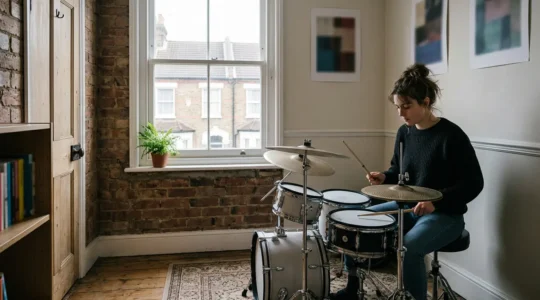
How to Practice Drums in a Terraced House Without Eviction?
In summary: The key to silent practice isn’t just reducing volume, but separating airborne sound (cymbals) from structure-borne vibration (kick drum). A DIY tennis ball riser is the single most effective tool to stop kick drum thud travelling through the…
Lire la suite
Unlock Longer Flute Phrases: A Physiological Guide to Breath Control
In summary: Effective breath control is not about lung capacity, but about physiological efficiency and muscular control. Mastering diaphragmatic breathing with 360-degree expansion is the foundation for powerful, tension-free support. Long tones are essential for training the embouchure to manage…
Lire la suite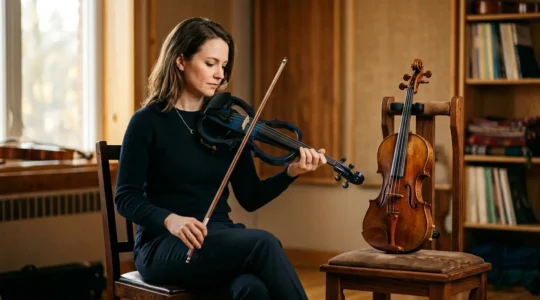
Your First Electric Violin: A Classically-Trained Player’s Guide
The key to a successful transition from acoustic to electric violin is not just buying gear, but choosing components that translate your classical technique and tonal expectations into the electronic world. Your biggest enemy is « impedance mismatch, » which makes a…
Lire la suite
How to Record Acoustic Instruments at Home Without Professional Soundproofing?
The key to professional home recordings isn’t eliminating noise, but mastering acoustic control through precise engineering techniques. Effective acoustic treatment relies on managing the micro-environment around the microphone, not soundproofing the entire room. Proper gain staging and subtractive EQ have…
Lire la suite