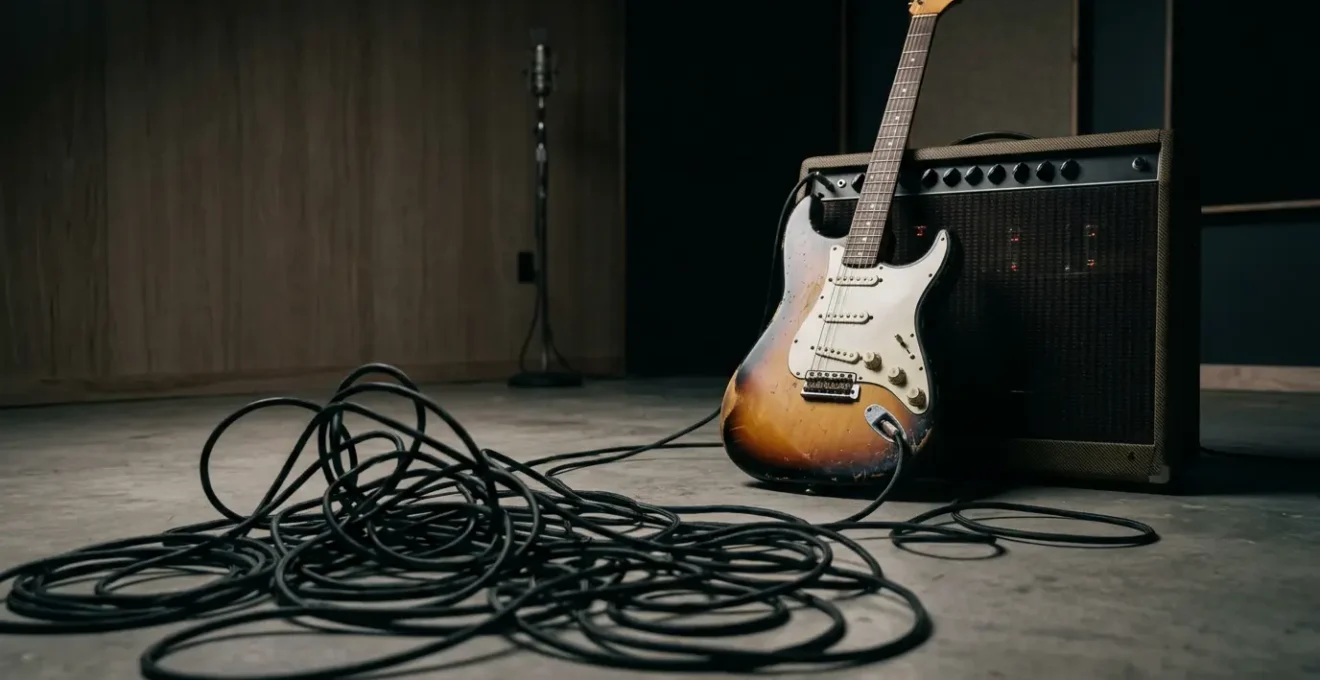
Your guitar tone is a predictable electrical circuit, not magic. A ‘muddy’ or lifeless sound from a high-end instrument is almost always a symptom of signal degradation, not a fault in the guitar itself.
- Cheap, long cables act as filters, bleeding high frequencies due to a physical property called capacitance.
- Improperly maintained valve amps and « scooped » midrange EQ settings make your guitar inaudible in a band context.
- A weak preamp or a mismatch between your instrument and amplifier can strangle your sound before it even has a chance.
Recommendation: Stop chasing expensive gear and start analyzing your signal path. By understanding the electrical principles at play, you can diagnose and fix your tone issues methodically and affordably.
You’ve done it. You saved up and bought the guitar of your dreams—a £2000 masterpiece of wood and wire. You plug it into your rig, hit a chord, and the sound that comes out is… underwhelming. It’s dull, lacks clarity, and feels buried under a blanket of mud. The immediate, frustrating thought is that something is wrong with the guitar. But in almost every case, the instrument is the last place you should look. Your tone is not a single entity; it’s the result of a chain of electrical events, and a single weak link can compromise the entire signal.
Most advice focuses on generic tips like changing strings or buying more pedals. While not wrong, this approach ignores the fundamental physics at play. The real culprits are often invisible and misunderstood: electrical properties like capacitance and impedance, psychoacoustic phenomena that alter your perception of frequencies at different volumes, and the simple-but-critical maintenance of your amplifier’s core components. Your perfect tone is being lost in translation somewhere between the pickup and the speaker.
But what if the key wasn’t spending more money, but understanding the science? This guide abandons marketing myths and focuses on the electrical engineering principles that govern your sound. We will dissect the signal path piece by piece, from the cable to the speaker, to expose the common points of failure. By treating your rig like the circuit it is, you can diagnose problems with precision, make informed decisions, and finally unleash the true voice of your instrument.
This article will guide you through a systematic diagnosis of your entire signal chain, revealing the scientific reasons your tone suffers and providing the practical solutions to fix it. Let’s trace the signal and find where your clarity is getting lost.
Summary: Why Your High-End Guitar Sounds Lifeless
- Tone Suck: Why Long Cheap Cables Kill High Frequencies
- The Warmth Debate: Is Valve Maintenance Worth the Tone?
- Mid-Scoop Mistake: Why You Can’t Be Heard in the Mix
- Marketing Myth or Reality? The Truth About Jack Plugs
- One Amp to Rule Them All: Digital Amps for Cover Bands
- Preamp Quality: Does a £100 Interface Kill Your Violin Sound?
- Guitar Amps vs Acoustic Amps: Avoiding the « Electric Mosquito » Sound
- How to Choose Your First Electric Violin If You’re Classically Trained?
Tone Suck: Why Long Cheap Cables Kill High Frequencies
The first and most overlooked tone killer in any rig is the cable. It’s not just a piece of wire; it’s an electronic component with a property called capacitance. Think of capacitance as a tiny sponge for high frequencies. The longer the cable and the lower its quality, the larger this sponge becomes, and the more of your treble it soaks up before the signal ever reaches your amp. This phenomenon, known as « tone suck, » is why a guitar can sound bright and articulate with a short cable in a shop but dull and muddy with your 20-foot stage cable.
This isn’t an opinion; it’s measurable physics. For instance, specific measurements show that a 35-foot cable can shift the high-frequency cutoff down by over 1,000Hz, effectively rolling off your tone knob. The high-impedance signal from passive guitar pickups is extremely vulnerable to this effect. The solution isn’t necessarily an expensive cable, but a low-capacitance one or, more effectively, a buffer. A buffer is a small circuit (often found in pedals like a Boss tuner) that converts your fragile, high-impedance signal into a robust, low-impedance one that is immune to the effects of cable capacitance.
It’s crucial to note that this issue primarily affects passive instruments. As the experts at Atlantic Quality Design point out, this problem vanishes with active electronics:
If your guitar or bass has active electronics, then the capacitance of your cable (large or small) has practically zero effect on your sound. This is because the active electronics contain an amplifier that converts the high impedance of the pickups to a low impedance, and this low impedance can drive capacitive cables without any high frequency signal loss.
– Atlantic Quality Design, The Effect of Cable Capacitance on Guitar Tone
By understanding capacitance, you move from blaming your guitar to correctly identifying your first point of signal loss. The cable isn’t just a connection; it’s the first filter in your signal chain.
The Warmth Debate: Is Valve Maintenance Worth the Tone?
For many guitarists, the « warmth » of a valve amplifier is the holy grail of tone. Those glowing glass tubes aren’t just for show; they add compression, subtle harmonic distortion, and a dynamic response that many players find musically inspiring. However, this organic tone comes at a cost: valves are perishable components with a finite lifespan, and their performance degrades over time, often taking your tone with them. A poorly maintained valve amp won’t just sound less warm; it will sound weak, fizzy, and undefined.
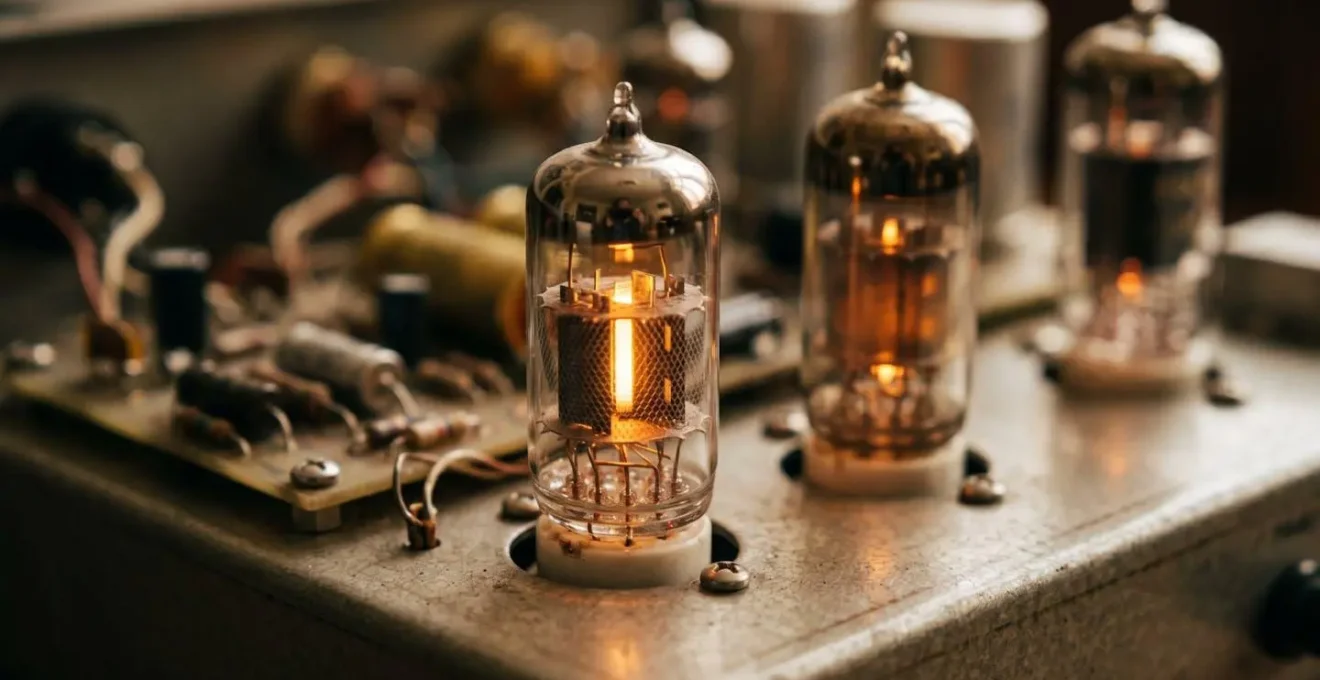
The most critical aspect of valve maintenance is biasing. Bias is a small, constant voltage applied to the power tubes that sets their idle current—essentially, how « hot » they run. If the bias is set too cold, the amp sounds thin and sterile. If it’s too hot, the tubes wear out incredibly fast, leading to a compressed, powerless sound. According to amp maintenance experts, properly biased power tubes can last 1-3 years, but gigging musicians might need replacements every 6-12 months. Ignoring this is like never changing the oil in a high-performance car.
The danger of improper biasing is more than just poor tone. As amp expert Nick Bowcott explains, it can physically damage your amplifier:
If the bias voltage isn’t negative enough, then the tubes will run hot. This is sometimes referred to as ‘biased hot,’ ‘red plating,’ or ‘running hot,’ and it not only significantly shortens tube life but can also result in a lack of output power and punch.
– Nick Bowcott, What Is Tube Amp Biasing? – Sweetwater InSync
The « warmth » you crave is a direct result of these delicate components operating within their optimal electrical window. When your amp starts sounding muddy, the first question shouldn’t be about your guitar, but « When was the last time my valves were checked and biased? »
Mid-Scoop Mistake: Why You Can’t Be Heard in the Mix
One of the most common EQ mistakes guitarists make is the « mid-scoop. » In isolation, a tone with boosted bass and treble and cut midrange can sound powerful and heavy. However, in the context of a full band, this is a recipe for sonic invisibility. The bass guitar and kick drum dominate the low frequencies, while cymbals and vocals occupy the high end. The midrange is the electric guitar’s home. By scooping it out, you are essentially erasing your own instrument from the sonic space where it’s meant to be heard.
This problem is amplified by a psychoacoustic phenomenon known as the Fletcher-Munson curves. These curves describe how the human ear perceives frequencies differently at various volumes. As Nail The Mix explains, « At lower listening levels, our ears are way less sensitive to low and high frequencies compared to the midrange. » This means the aggressive mid-scoop you dialed in at bedroom volume will sound disproportionately boomy and harsh when turned up to stage levels, as your ears suddenly become more sensitive to the bass and treble you boosted.
To craft a tone that works both alone and in a mix, you need to set your EQs at a realistic listening volume. Audio engineering wisdom suggests that the ideal mixing level is somewhere between 80 and 85 dB SPL, as this is the range where our hearing perceives the frequency spectrum most flatly. Instead of scooping the mids, try boosting the upper midrange (around 800Hz to 2.5kHz) to give your guitar presence and bite that cuts through the mix without fighting the other instruments. Your goal isn’t to sound huge in isolation; it’s to fit perfectly into the collective sound of the band.
Marketing Myth or Reality? The Truth About Jack Plugs
The world of guitar accessories is filled with marketing claims that prey on a musician’s quest for better tone. Gold-plated connectors are a prime example. While gold is an excellent conductor and resists corrosion, it offers no audible improvement over a standard nickel-plated plug in a well-maintained signal chain. The resistance of that tiny plating layer is infinitesimally small compared to the overall impedance of your pickups and the capacitance of your cable. The « mud » in your tone isn’t coming from the metal on your jack plug.
The real, measurable factor that affects your tone is, once again, cable capacitance. Marketing often conflates features like thick shielding or gold connectors with low capacitance, but they are entirely separate properties. As Z String Music clarifies, » A cable with excellent shielding or gold-plated connectors is not necessarily low in capacitance. » Focusing on a gold plug while ignoring the electrical properties of the cable itself is a classic case of missing the forest for the trees.
This disconnect between price, marketing, and actual performance has been demonstrated in objective tests. Your ears can be tricked, but a frequency analyzer cannot.
Case Study: Cable Price vs. Performance Frequency Analysis
An objective frequency analysis conducted by SF Guitar Works compared four different 20-foot cables, with prices ranging from a $9 Musician’s Gear cable to a $159 Analysis Plus cable. When a consistent pink noise signal was sent through each, the spectral analysis revealed absolutely no audible difference between any of the cables. The boutique $159 cable did not perform any better than the budget $9 one. This proves that high price tags and marketing buzzwords about exotic materials or gold plating often have no correlation with measurable, real-world sonic performance. The critical factor remains the cable’s capacitance, a specification often absent from the marketing hype.
Instead of being swayed by buzzwords, look for the technical specifications. A manufacturer that proudly lists their cable’s capacitance in picofarads (pF) per foot or meter is giving you far more useful information than one that just advertises gold-plated ends. Your wallet and your tone will thank you.
One Amp to Rule Them All: Digital Amps for Cover Bands
For the gigging musician in a cover band, versatility is king. One moment you need a sparkling clean tone for a pop song, the next a high-gain crunch for a rock anthem. Lugging multiple valve amps is impractical, and this is where modern digital modeling amplifiers and profilers shine. They offer a vast library of tones in a single, reliable, and lightweight package. However, the same principles of tone-shaping that apply to valve amps are even more critical here, especially regarding the Fletcher-Munson curve.
The biggest mistake users make is creating patches at low, at-home volumes. As the support team at Line 6 explains, this leads to a predictable problem on stage:
Sounds you tweak up in your living room will have the low and high end boosted substantially… When you take those sounds designed at around 60-70 dB and turn them up to the average 90dB+ stage levels, those same high and low frequencies will suddenly seem overly exaggerated making everything sound simultaneously painfully bright, yet woofy.
– Line 6 Support, Studio Tone vs. Live Tone and the Fletcher Munson Curve
To build a versatile and gig-ready rig, you must create and level your patches at a consistent, stage-like volume (around 85dB SPL). This ensures that the perceived EQ balance remains consistent when you’re playing live. A solid framework involves creating a core set of sounds—a pristine clean, an edge-of-breakup rhythm, a classic crunch, a cutting lead, and perhaps an ambient patch—all volume-matched to one another. The goal is consistency, ensuring that when you switch from your rhythm to lead patch, you get a boost in the right midrange frequencies, not a jarring jump in volume or fizz.
A digital amp’s strength is its precision and recall. By building a framework of volume-matched, mix-conscious patches, you can harness that power to deliver consistent, professional-quality tone for any song the setlist throws at you.
Preamp Quality: Does a £100 Interface Kill Your Violin Sound?
While this article has focused on guitars, the principles of signal integrity are universal. For instruments like an electric violin, especially one with a passive piezo pickup, the first stage of amplification—the preamp—is arguably the most critical link in the entire chain. A passive pickup, whether magnetic (guitar) or piezo (violin), produces a very weak, high-impedance signal. This signal is incredibly fragile and susceptible to both noise and frequency loss. Plugging it directly into a cheap, low-quality preamp in an inexpensive audio interface can be disastrous for your tone.
A good preamp does two things: it provides clean gain to boost the weak signal to a usable line level, and it provides a high-impedance input that correctly matches the pickup. A cheap interface’s preamp often fails on both counts. It may not offer enough headroom, causing the signal to clip and distort unpleasantly, and it can introduce a significant amount of noise (a poor signal-to-noise ratio), adding an audible hiss or hum underneath your playing. More importantly, a low-quality input can « load » the pickup, altering its frequency response and killing the nuance and harmonic richness of the violin’s sound.
The difference in signal integrity between instrument types highlights why this is so important. As the experts at Sweetwater note, the high-impedance nature of instrument pickups is what makes them so sensitive. They explain that while low-impedance devices like keyboards can drive long cables without issue, » a guitar will often sound noticeably ‘muddier’ when run through a 40-foot cable. » An electric violin with a passive pickup is in the same vulnerable category.
So, does a £100 interface kill your sound? It absolutely can. If you’re serious about your tone, investing in a dedicated external preamp or a higher-quality interface with a dedicated « instrument » input designed for high-impedance sources is not a luxury; it’s a necessity to preserve the fundamental character of your instrument.
Guitar Amps vs Acoustic Amps: Avoiding the « Electric Mosquito » Sound
Plugging an acoustic instrument, like an electric violin or acoustic-electric guitar, into an amplifier designed for an electric guitar is a common mistake that often yields a thin, nasal, and unpleasant tone—the « electric mosquito » sound. The reason for this is fundamental to the design of the amplifiers themselves. An electric guitar amplifier is not a high-fidelity reproduction device; it is an integral part of the instrument itself. Its speaker and cabinet are intentionally « colored, » typically with a pronounced midrange hump and a steep roll-off in the very low and very high frequencies.
This frequency response is perfect for a magnetic pickup on an electric guitar, giving it warmth and presence. However, for an acoustic instrument, whose sound is defined by its complex harmonic overtones and full-range frequency response, this same EQ shaping is disastrous. The amp filters out the delicate « air » of the high frequencies and the resonant body of the low frequencies, leaving only a honky, unnatural midrange.
In contrast, an acoustic amplifier is designed more like a small PA system. It aims for a full-range, flat-response (FRFR), meaning it tries to reproduce the sound of the input signal as accurately as possible, without adding its own color. This is why they often include tweeters to handle the high frequencies that a guitar speaker simply cannot. Using the right amp for the job is about respecting the fundamental nature of the instrument’s sound source.
Creative Rule-Breaking: Kurt Cobain’s MTV Unplugged Tone
While generally a bad idea, using an electric guitar amp for an acoustic instrument can be done for intentional creative effect. A famous example is Kurt Cobain’s sound during Nirvana’s MTV Unplugged performance. His acoustic guitar was run through a Fender amplifier, contributing to the gritty, lo-fi, and iconic tone of that recording. This demonstrates how the inherent coloration of an electric guitar amp can be used as a textural tool. However, it’s a deliberate choice for a specific aesthetic, not a path to transparent, natural acoustic amplification. It highlights that the « wrong » tool can sometimes be creatively « right, » but only if you understand the rules you are breaking.
Unless you are specifically chasing a lo-fi or experimental sound, an acoustic instrument belongs with an acoustic amplifier. Matching the instrument to a reproduction system designed for its specific frequency range is essential for a natural and pleasing tone.
Key Takeaways
- Your signal path is an electrical circuit; tone loss is often due to physics (capacitance, impedance), not magic.
- Long, high-capacitance cables filter out high frequencies. A buffer pedal is the most effective solution.
- The Fletcher-Munson curve explains why a tone dialed in at low volume sounds bad on stage; create patches at a consistent, loud volume (80-85 dB).
- The midrange is where the guitar lives in a band mix. Scooping it out will make you disappear.
How to Choose Your First Electric Violin If You’re Classically Trained?
For a classically trained violinist, transitioning to an electric instrument can be a daunting experience. The lack of a resonant acoustic body and the alien world of amplification can feel disorienting. The key to a successful transition lies in choosing an instrument that minimizes the physical retraining required while offering the right electronic options for your goals. The two primary considerations are ergonomics and output type.
Ergonomically, the goal is to find an electric violin that feels as close as possible to your acoustic instrument. Your years of training have built precise muscle memory based on specific reference points. Look for an electric violin that maintains the standard scale length, neck profile, and, most importantly, the key contact points for your shoulder, chin, and rib cage. A solid-body instrument might feel strange, but many are designed with frames that mimic the outline of a traditional violin to provide these familiar tactile cues. Maintaining your posture and bowing technique is paramount.
Electronically, you need to understand the different output types, as this will determine what other gear you need. The three main categories are passive, active, and MIDI. A passive pickup is the simplest but requires an external preamp to sound its best. An active system includes a built-in preamp (usually powered by a battery), offering a strong, consistent signal that can be plugged directly into an amp or interface. MIDI is the most adventurous, converting your playing into digital data to control synthesizers, but it has the steepest learning curve.
This comparison table breaks down the essential differences in output technology to help you decide which path aligns with your technical comfort and sonic ambitions.
| Output Type | Signal Strength | Impedance | Best For | Requires External Power |
|---|---|---|---|---|
| Passive Pickup | Weak, requires external preamp | High impedance | Players wanting full control over preamp/pedal chain | No |
| Active Pickup | Strong, consistent signal | Low impedance (buffered) | Plug-and-play simplicity, direct to amp/interface | Yes (battery) |
| MIDI Output | Digital control data | N/A (digital protocol) | Adventurous players exploring synthesizers and sound design | Yes (battery or phantom power) |
Your Ergonomic Transition Checklist: Points to Verify
- Neck Profile: Does the thickness and shape of the neck match your acoustic violin to minimize retraining muscle memory?
- Scale Length: Is the distance from the nut to the bridge the standard 325-330mm, matching your current instrument?
- Shoulder Contact Point: Does the shoulder rest or body frame align with your established shoulder and clavicle reference point?
- Chin Rest Placement: Can the chin rest be positioned at a height and angle that matches your acoustic setup to maintain head position?
- Rib Cage Contact: For instruments with a partial frame, do any body contact points interfere with your established posture or bowing motion?
By prioritizing familiar ergonomics and making a conscious choice about the electronic output, a classically trained player can make the leap to an electric instrument feel like a natural extension of their skills, rather than starting over from scratch.
The journey to great tone is one of methodical analysis, not expensive guesswork. By applying these electrical and acoustic principles, you can transform your rig from a source of frustration into a predictable, reliable tool for musical expression. Start listening critically to each component in your signal chain today, and you will finally unlock the true sound of your instrument.