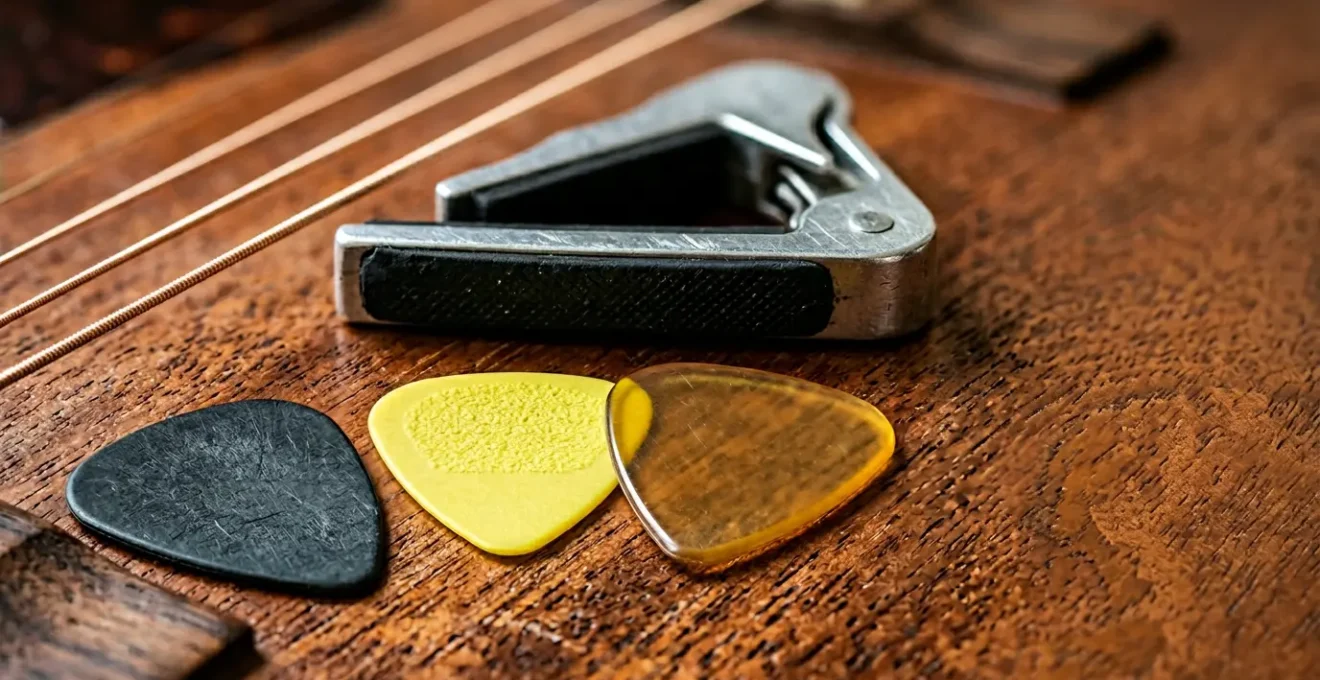
The secret to a massive tonal shift isn’t a new guitar or expensive pedals; it’s in the accessories you already own but treat as an afterthought.
- Your guitar pick is an active EQ: its material and thickness fundamentally shape your sound’s attack and brightness before it ever hits an amp.
- Your capo is more than a key-changer: it’s a tool for creating instant alternate tunings and drones that can redefine your songwriting.
Recommendation: Stop thinking of picks and capos as functional items and start treating them as your primary, most cost-effective tone-sculpting tools.
Every guitarist gets the itch. That relentless desire for a new sound, a different voice from our instrument. The search usually leads down a rabbit hole of expensive pedals, boutique pickups, or even lusting after a brand-new guitar. We convince ourselves that the key to a fresh tone is a significant investment. We read about different tonewoods, fretboard materials, and hardware upgrades, believing these are the only paths to sonic evolution. This common approach overlooks the most powerful, immediate, and affordable tone-shaping tools at your disposal.
But what if the most dramatic changes to your sound don’t come from a four-figure purchase, but from a 50-cent piece of plastic? The premise of this guide is simple yet transformative: your pick and capo are not passive accessories. They are your first, and most hands-on, form of equalization and creative modulation. Understanding the physics of how a pick strikes a string or how a capo frets it is the key to unlocking a universe of timbral possibilities. By treating these simple items with the same intention as a complex effects pedal, you can fundamentally alter your guitar’s voice.
This article will deconstruct these humble tools. We’ll explore how different pick materials and gauges act as an « acoustic EQ, » shaping your attack and harmonic content. We will then dive into the mechanics of capos, moving beyond simple key changes to see how they can maintain tuning integrity and even create complex, drone-based tunings on the fly. It’s time to stop overlooking the obvious and start sculpting your sound from the very first point of contact.
To guide you through this journey of sonic discovery, we have structured this article to cover every crucial aspect of these essential accessories. Below is a summary of the tonal territories we are about to explore.
Summary: The Complete Guide to Tone Shaping with Guitar Picks and Capos
- Nylon vs Tortex vs Ultex: How Plastic Changes Attack
- Trigger vs Screw: Which Capo Doesn’t Pull You Out of Tune?
- Open Tunings without Retuning: The Magic of Cut Capos
- Thin for Strumming, Thick for Picking: Choosing the Right Gauge
- Travis Picking: Transitioning from Flatpick to Thumbpick
- XY vs Spaced Pair: Which Mic Technique Fits Your Small Room?
- Gold vs Chrome: Upgrading Hardware for a Custom Vibe
- Customizing Your Instrument: Aesthetics vs Value
Nylon vs Tortex vs Ultex: How Plastic Changes Attack
The pick is the very beginning of your signal chain. Before your guitar’s wood resonates, before the pickup translates vibration into electricity, the pick’s material defines the initial character of the note. Thinking of this choice as your first EQ setting is a game-changer. Each type of plastic has a unique timbral DNA that imparts a distinct color to your sound. Nylon, one of the earliest materials, is known for its warmth and flexibility, producing a softer, more compressed attack with very little pick noise, making it a studio favorite for smooth rhythm tracks.
Then came Tortex, designed to mimic the feel and tone of classic tortoiseshell. It offers a more balanced and familiar sound, with a clear midrange and a slightly gritty texture that many players love for rock and pop. It’s the reliable workhorse. But for those chasing ultimate clarity and brightness, Ultex is the modern contender. This stiff, durable material creates a sharp, articulate attack. In fact, testing reveals that Ultex picks produce a brighter, crisper tone compared to the smoother midrange of Tortex. This makes Ultex ideal for lead lines that need to cut through a dense mix or for articulate, fast-picked passages.
The choice is a conscious act of sonic design. Do you want the warm, vintage compression of nylon, the balanced grit of Tortex, or the high-fidelity snap of Ultex? As one guitarist on a forum insightfully put it:
Your pick is your first EQ choice. The shape, tip and material make a huge difference in the sound.
– Anonymous guitarist, Rig-Talk Forum Discussion
This isn’t just about feel; it’s about deliberately shaping your sound from the source. Experimenting with these three core materials is the fastest way to understand how profoundly your initial sonic attack can be modified. Instead of reaching for a treble boost pedal, try switching to an Ultex pick. The result might be more organic and exactly what your track needs.
Trigger vs Screw: Which Capo Doesn’t Pull You Out of Tune?
A capo seems simple: it clamps the strings, raising the pitch. Yet, the mechanism it uses to apply that pressure is critical for maintaining your guitar’s intonation. The two dominant designs, trigger and screw, represent a classic trade-off between speed and precision. Understanding this difference is key to achieving what we can call tensional integrity—the perfect balance of firm fretting without stretching the strings sharp.
This illustration highlights the mechanical differences between the two main types.
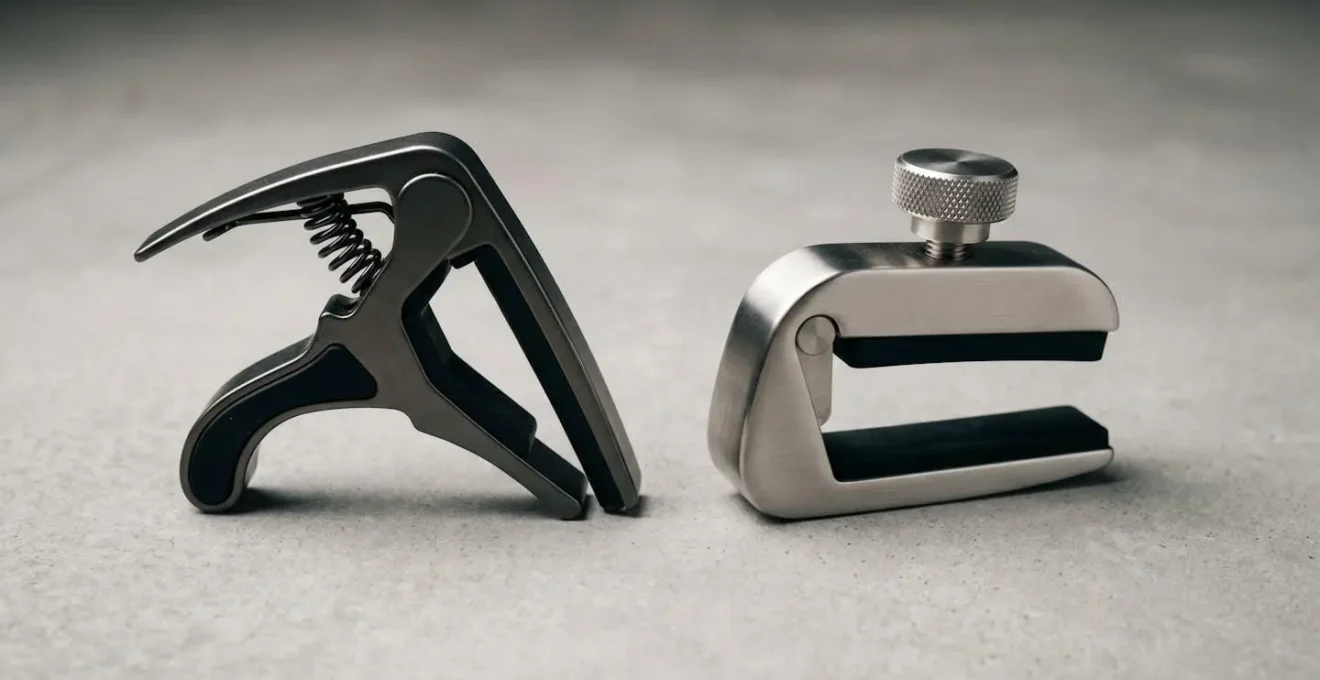
The spring-loaded trigger capo is built for speed. Its one-handed operation is a lifesaver on a dark stage between songs. However, its spring provides a fixed, non-adjustable tension. If that tension is too high for your guitar’s setup (string gauge and neck radius), it will inevitably pull the strings slightly sharp, forcing you to retune. The screw-style capo, by contrast, is a tool of precision. It allows you to dial in the absolute minimum pressure required to get a clean, buzz-free note. This meticulous control makes it the superior choice for recording sessions or any situation where perfect intonation is non-negotiable.
This distinction is perfectly summarized by a recording engineer’s practical advice:
Trigger capos are for rapid, mid-set key changes. Screw capos are studio tools for dialing in the absolute minimum tension needed.
– Guitar recording engineer, Best Guitar Capo Guide
The choice depends on your context. Are you a performing songwriter who needs to switch keys instantly? A trigger capo is your ally. Are you a studio musician or a discerning player who can’t tolerate even the slightest tuning discrepancy? The screw capo is your instrument. For the tone chaser, having both is not redundant; it’s having the right tool for the right job, ensuring your tone is never compromised by convenience.
Open Tunings without Retuning: The Magic of Cut Capos
For many guitarists, alternate tunings like DADGAD or Open G are a source of endless inspiration, but the hassle of constant retuning between songs can be a creative roadblock. This is where the partial capo, or « cut capo, » transforms from a simple accessory into a magical creative tool. By fretting only some of the strings, a partial capo allows you to create a new harmonic matrix of open-string drones and intervallic relationships, effectively giving you the sound of an open tuning while leaving your standard-tuned chord shapes mostly intact.
A common 3-string partial capo, covering the A, D, and G strings at the second fret, instantly puts you in a « fake » DADGAD-style tuning (technically Esus). This opens up a world of Celtic-inspired drones and rich, suspended voicings that are nearly impossible to achieve in standard tuning. Similarly, a 5-string capo that leaves the low E string open while fretting the other five at the second fret simulates a Drop-D tuning raised a whole step. This allows for powerful, resonant bass notes against standard chord fingerings. These techniques are not just tricks; they are compositional tools used by professionals to expand their sonic palette.
Case Study: Jimmy Page and the Partial Capo Sound
One of the most iconic uses of this concept is found in Jimmy Page’s arrangement of « Black Mountain Side. » By using DADGAD tuning, which can be effectively simulated with a partial capo setup, Page created intervallic relationships that produce authentic Celtic folk sounds without traditional retuning. This technique allows guitarists to access the characteristics of an Open G tuning by covering strings 2-4 at the second fret, which instantly enables Keith Richards-style riffs and bluegrass licks, but in the key of B, especially when combined with a full capo higher up the neck.
The beauty of the partial capo is its ability to inspire new melodic and harmonic ideas. It forces you to discover new chord voicings and rethink familiar patterns, all without the need for a tuner. It’s a key to unlocking instant creativity and a must-have for any experimental acoustic player.
Thin for Strumming, Thick for Picking: Choosing the Right Gauge
Beyond material, a pick’s thickness, or gauge, is the next crucial variable in your acoustic EQ. The common wisdom— »thin for strumming, thick for picking »—is a decent starting point, but it oversimplifies the profound tonal impact of gauge. A thin pick (under 0.60mm) has a lot of flex. When it strikes the strings, especially during vigorous strumming, it bends, creating a bright, shimmering sound with less low-end. The flex produces a natural, light compression and a percussive « click » that can be perfect for rhythmic acoustic parts that need to sit well in a mix without being boomy.
As you move to a medium gauge (around 0.73mm to 1.0mm), you get a more balanced response—a good blend of flexibility for chords and enough stiffness for single-note lines. This is the versatile middle ground. However, the real tonal sculpting happens with thick picks (1.14mm and above). A thick, stiff pick has almost no give. It transfers the full energy of your hand directly to the string, resulting in a louder, fuller, and warmer tone with a pronounced bass and midrange response. The attack is bold and immediate, making them ideal for articulate lead playing or for giving an acoustic guitar a powerful, « boomy » voice.
Thick picks are incredibly stiff which adds a lot to bass and midrange tones. Try strumming chords on an acoustic guitar with a thick pick and you’ll get a loud and boomy sound.
– Guitar Gear Finder, Ultimate Guide to Guitar Picks
Scientific analysis confirms this experience. One of the few studies on the topic found that thin picks (0.46mm) produce a brighter, thinner sound on wound strings compared to their thick (2.00mm) counterparts. The takeaway is to think of gauge as a volume and EQ knob. Need more bass and power? Go thicker. Need more percussive shimmer and less low-end mud? Go thinner. Owning a variety of gauges isn’t indecisiveness; it’s having a full tonal palette at your fingertips.
Travis Picking: Transitioning from Flatpick to Thumbpick
Travis picking is a cornerstone of acoustic folk, blues, and country music, defined by its syncopated rhythm created by an alternating bass line played with the thumb and melody notes played with the fingers. For guitarists accustomed to using a standard flatpick, transitioning to this style presents a unique challenge and a significant tonal opportunity. The most common solution is adopting a thumbpick, a small change in accessory that completely redefines your acoustic EQ and playing dynamics.
Using a flatpick for this style, a technique known as hybrid picking, produces a sharp, defined attack on the bass notes. This can be desirable for cutting through a band mix. However, the true, traditional sound of Travis picking comes from the softer, warmer thump of a thumb. A thumbpick is the perfect bridge between these two worlds. It provides more definition and volume than a bare thumb but retains a rounder, mellower attack than a flatpick. This creates a beautiful sonic separation between the warm, consistent bass notes and the crisp, articulate melody notes played by the bare fingers.
The transition requires practice. Your hand position changes, and you must develop independence between your thumb and fingers. But the payoff is immense. You gain access to a rich, layered sound that makes a single guitar sound like two instruments playing in perfect sync. The choice of thumbpick material and gauge follows the same principles as flatpicks: a thicker, stiffer thumbpick will deliver a more powerful and defined bass response, while a thinner, more flexible one will offer a lighter touch. This simple accessory is the gateway to mastering one of the most expressive and timeless acoustic techniques.
XY vs Spaced Pair: Which Mic Technique Fits Your Small Room?
In the world of audio recording, microphone techniques like « XY » and « Spaced Pair » are used to capture a stereo image. XY provides a focused, mono-compatible center, while a spaced pair creates a wide, immersive soundscape. While this might seem disconnected from our topic, it serves as a powerful metaphor for how your picking technique itself can create a sense of sonic width from a single acoustic guitar, long before a microphone is even involved.
Think of your picking hand as a stereo mixing console. Playing everything with a single flatpick is like recording in mono or using an XY mic setup—all the sound originates from one focused point. It’s punchy and direct. But when you begin to integrate fingerstyle or hybrid techniques, like using a thumbpick for the bass strings and your bare fingers for the treble strings, you are essentially creating a « spaced pair » with your own hand. The thumb becomes one « mic » responsible for the low-end foundation, and your fingers become another « mic » handling the melodic details and shimmer.

This separation in technique translates directly to a perceived separation in sound. The bass notes, attacked with the thumbpick, have a distinct timbre—often warmer and rounder. The melody notes, plucked with fingertips or nails, have a different, often crisper, attack. This timbral contrast creates a natural, built-in stereo field. Your brain processes these different textures as distinct layers, giving the performance a richness and breadth that’s difficult to achieve with a flatpick alone. You are creating a wide sonic image without moving an inch.
So, while the choice between a real XY and Spaced Pair setup depends on your room and recording goals, the principle applies directly to your hands. By varying your attack across the strings—thumb vs. fingers, pick vs. flesh—you can control the perceived width and dimension of your acoustic tone at its source.
Gold vs Chrome: Upgrading Hardware for a Custom Vibe
When the desire for personalization strikes, many guitarists look to visible hardware. Swapping standard chrome tuners for gold ones or installing a new bridge are common ways to give an instrument a « custom » look. These can be satisfying aesthetic upgrades, but they are often expensive and have a negligible impact on the tone of an acoustic guitar. The irony is that players will spend hundreds on visual flair while overlooking the tools that provide both a custom vibe and a profound tonal shift: their picks.
The real « custom vibe » isn’t just about how your guitar looks on a stand; it’s about how it feels and sounds in your hands. Choosing a specific pick is a deeply personal statement. It dictates your connection to the instrument. Using a premium, boutique, or even just a visually interesting pick can have a significant psychological effect, boosting confidence and inspiring you to play differently. This is not just superficial; confidence directly translates into better, more committed performances.
This idea is echoed by professional players who find that a reliable, high-quality pick becomes part of their signature.
The Ultex material is incredibly durable, and I find I can often play an entire gig on just one pick. The tone and attack provide good note clarity, and I find this pick works well for everything: acoustic, electric, lead, or rhythm.
– Professional session guitarist, Premier Guitar
This testimony reveals a crucial point: a great pick becomes a reliable partner. The « vibe » comes from the trust you have in your tool to consistently deliver the tone and feel you want. Instead of chasing the purely aesthetic appeal of gold hardware, a tone chaser invests in an arsenal of picks. Finding that one Ultex or Tortex pick that feels like an extension of your hand provides a far more meaningful and sonically impactful customization than any cosmetic hardware ever could.
Key Takeaways
- Your pick’s material and gauge are your first and most powerful EQ controls, defining brightness and bass response.
- Capo choice is a trade-off: trigger capos offer speed for live use, while screw capos provide precision for perfect studio intonation.
- Partial capos are creative tools that unlock the sounds of alternate tunings without the need to retune your guitar.
Customizing Your Instrument: Aesthetics vs Value
In the final analysis, the pursuit of a new tone is a question of value. Where can you get the most significant sonic change for the least investment? While aesthetic customizations like new hardware have their place, they offer a poor return on investment for the tone-obsessed guitarist. The true value lies in the small, inexpensive tools that directly interface with the strings. The entire philosophy of this guide is built on a simple economic and sonic reality: nothing else in the guitar world offers so much tonal variation for so little cost.
Consider the numbers. A set of premium tuning machines can cost upwards of $100. A pickup installation can run into several hundred. In stark contrast, guitar picks range from $0.40 to $1.50 each, and a variety pack giving you a dozen different tonal options can be had for under $10. A high-quality capo, even a precision screw model or a creative partial capo, rarely exceeds $30. For the price of a single effects pedal, you can build a comprehensive « acoustic EQ toolkit » of picks and capos that provides a near-infinite combination of textures, attacks, and harmonic possibilities.
This is not about being cheap; it’s about being smart. It’s about understanding the physics of sound production and manipulating it at the source. Before you save up for that expensive upgrade, have you truly exhausted the possibilities within your pick case? Have you explored the harmonic landscapes a partial capo can unlock? True customization isn’t just about making your instrument look unique; it’s about making it sound uniquely *yours*.
Your Essential Tone Toolkit Action Plan
- Nylon Pick (0.73mm): Acquire for warm acoustic strumming and rhythm playing with a soft attack.
- Tortex Pick (0.88mm): Add for balanced rock/pop rhythm work, offering reliable grip and durability.
- Ultex Pick (1.14mm): Secure for articulate lead playing and fast picking, delivering a bright, defined tone.
- Standard Trigger Capo: Obtain for quick live key changes and simple chord transposition.
- Partial/Cut Capo (3-string): Invest in to explore alternate tuning sounds and expand creative possibilities without retuning.
Start your experimentation today. Spend a few dollars on a variety of picks and a new capo, and dedicate your practice time to truly listening. The new voice you’ve been searching for is likely already within reach, waiting to be unlocked by the simplest of tools.