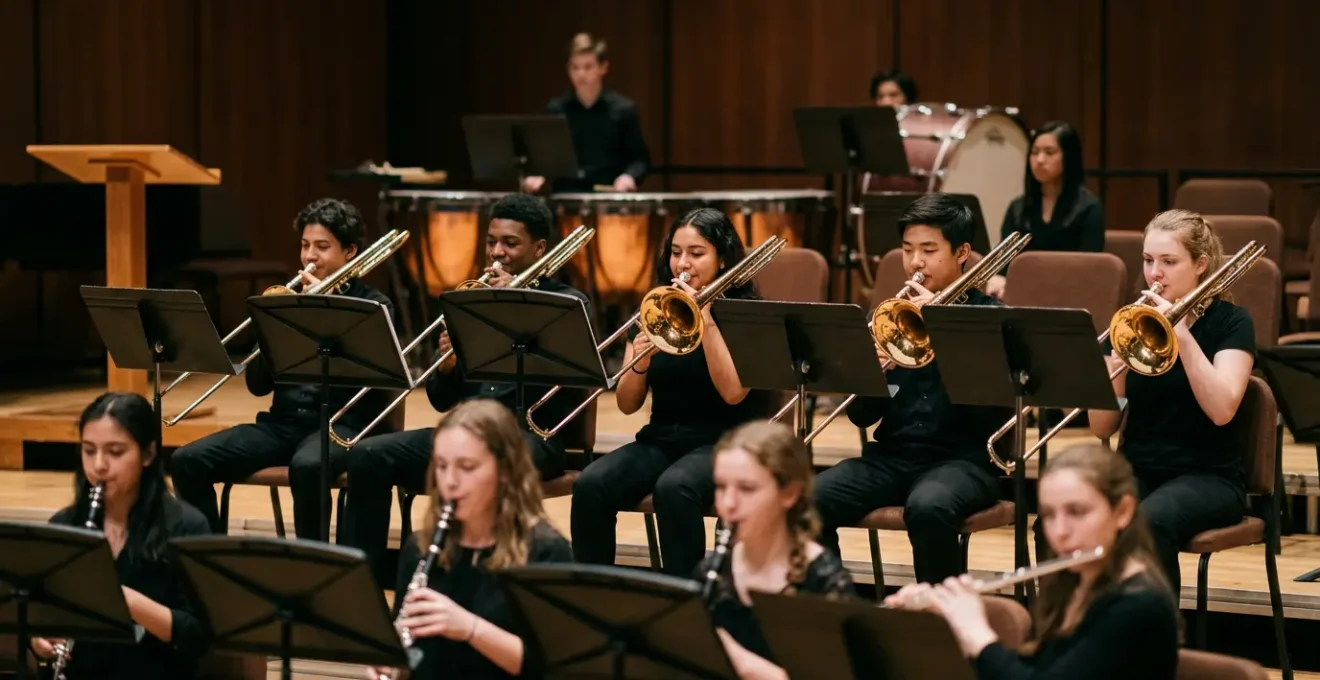
School band is your child’s first, low-stakes training ground for the high-pressure world of professional collaboration.
- It teaches tangible project management skills by forcing a diverse group to meet a non-negotiable deadline—the concert.
- It develops nuanced peer leadership and ego suppression, skills that are critical in modern team-based workplaces.
Recommendation: View the instrument rental and time commitment not as a cost for a hobby, but as a strategic investment in your child’s future career readiness.
As a parent, you’ve likely seen the flyer for the school band program and felt a familiar mix of excitement and hesitation. On one hand, the image of your child playing an instrument is a proud one. On the other, the logistics loom large: the cost of renting an instrument, the early morning rehearsals, the commitment. You ask yourself, « Is it really worth it? » The standard answers often feel like platitudes—it teaches discipline, they’ll make new friends, it looks good on college applications. While true, these points barely scratch the surface of the profound transformation that happens in the band room.
The real value of band isn’t just about learning scales or making friends. It’s about simulating the modern workplace in a structured, safe environment. Forget the abstract talk of « teamwork. » Think of it as a hands-on laboratory for developing the specific, high-demand collaborative skills that employers are desperate for. But what if the true key to unlocking your child’s future success isn’t found in another coding camp or sports league, but in the chaotic, collaborative symphony of a school band rehearsal? What if learning to blend their sound with fifty other musicians is the best possible training for navigating a team project at Google?
This article will deconstruct the band experience, moving beyond the usual benefits to reveal how each aspect of band life—from deadlines and leadership to practice and social dynamics—is a direct lesson in professional collaboration. We will explore how the band room becomes a crucible for forging the resilient, adaptable, and team-oriented individuals that the future demands. You will see that investing in band is an investment in a set of critical, real-world competencies.
To understand the full scope of these benefits, this guide breaks down the specific social and collaborative scenarios your child will master. Each section explores a different facet of the band experience, translating it into a tangible life skill that extends far beyond the concert hall.
Summary: Why Joining the School Band Teaches More Than Just Music
- The Concert Deadline: Learning to Deliver as a Group
- Section Leader: Managing Peers Without Being Bossy
- Blending the Sound: Why Your Part Isn’t Always the Most Important
- The Empty Chair: Understanding Your Importance to the Whole
- Band Camp Memories: Building Friendships That Last a Lifetime
- Learning the Songs: Why « Jamming » Doesn’t Mean « Learning on the Spot »
- The Leader Dilemma: Who Decides the Setlist?
- Joining a Band: How to Survive Your First Rehearsal
The Concert Deadline: Learning to Deliver as a Group
In the professional world, the ability to collaborate effectively under pressure is not a bonus; it’s a baseline expectation. A school band’s concert is your child’s first real taste of a high-stakes group project with an immovable deadline. It’s not an individual assignment where they can get an extension. The date is set, the audience has tickets, and the entire group succeeds or fails together. This experience is a direct simulation of a product launch, a client presentation, or a campaign deadline, teaching skills that are in incredibly high demand. In fact, a recent survey found that more than 80% of employers look for collaboration skills in new hires.
Students learn to manage their time not just for themselves, but in relation to the group’s progress. They discover that their individual practice is a contribution to a shared resource pool. They learn to break down a large, intimidating goal (learning an entire concert program) into smaller, manageable tasks (mastering one difficult passage at a time). This is project management in its purest form. They aren’t just learning notes; they are learning resource allocation, progress tracking, and collective accountability—all before they even know the business jargon for it.
This process of working toward a shared, public-facing goal builds a unique form of collaborative pressure. It fosters an understanding that personal effort directly impacts group success and that letting the team down has real consequences. This is a far more powerful lesson in responsibility than any solo homework assignment could ever be.
Section Leader: Managing Peers Without Being Bossy
One of the most unique opportunities in band is the chance to lead without formal authority. When a student becomes a section leader—for the trumpets, clarinets, or percussion—they are tasked with guiding, mentoring, and correcting their own friends and classmates. This isn’t a top-down management role; it’s a delicate exercise in peer leadership. They can’t command respect; they must earn it through competence, patience, and diplomacy. They learn to give constructive feedback without causing offense and to motivate their peers without being overbearing.
This role is a masterclass in what modern workplaces call « influencing without authority. » The section leader has to figure out how to help a struggling peer without embarrassing them, how to organize extra practice sessions that people actually want to attend, and how to represent their section’s concerns to the band director. These are complex social micro-negotiations that build immense emotional intelligence. They learn to listen, to build consensus, and to understand that true leadership is about service and empowerment, not control.
The illustration below captures this exact dynamic: a moment of quiet mentorship, where guidance is shared between equals, fostering growth and mutual respect.
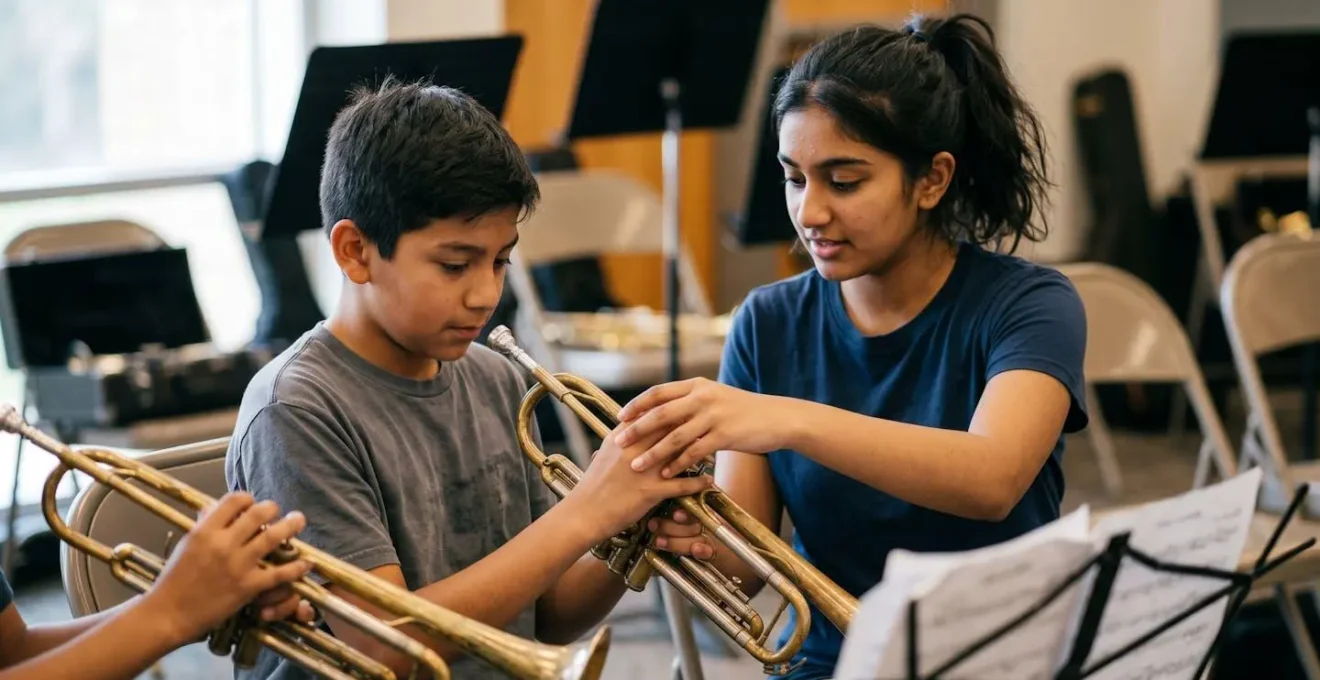
As you can see, the focus is on collaboration, not command. This is where students learn the fundamental difference between being a boss and being a leader. This hands-on experience in lateral leadership is invaluable and rarely found in other school activities. As the Cherokee Bluff Band Program wisely advises its own student leaders, this role requires a special kind of maturity.
Successful leadership only results from respecting others and having their respect. Finally, lead from within the band, not from above the band; you are still a student who has to go to class with these individuals.
– Cherokee Bluff Band Program, Student Leadership Guidelines
Blending the Sound: Why Your Part Isn’t Always the Most Important
In a society that often celebrates individual achievement, the band room teaches a powerful counter-lesson: the group’s success is more important than individual glory. Every musician is given a part, and often, a student’s first instinct is to make sure their part is heard. The band director’s constant refrain, however, is « blend. » This isn’t just a musical instruction; it’s a profound lesson in ego suppression. Your child learns that sometimes, their role is to be a quiet, foundational support for another section. They learn that being a star trumpet player means knowing when *not* to play at full volume.
This requires a sophisticated form of listening—not just to their own instrument, but to the entire ensemble. They must constantly adjust their pitch, timing, and volume in response to dozens of other musicians around them. This « embodied listening » builds a deep sense of situational awareness and empathy. It’s the musical equivalent of a great team member knowing when to speak up in a meeting and when to quietly listen and support a colleague’s idea. It’s about understanding that your contribution is only valuable in the context of the whole.
This concept of a collective identity over individual stardom is a crucial lesson for any collaborative field. In science, engineering, or business, the greatest breakthroughs come from teams where members are willing to sublimate their own egos for the good of the project. The band room is where that habit of mind is first practiced and perfected, note by painful, out-of-tune note, until a beautiful, unified chord emerges.
The Empty Chair: Understanding Your Importance to the Whole
In many school activities, one person’s absence is easily absorbed. If a player misses a soccer practice, the team can still scrimmage. But in a band, every single member is crucial. If the third-chair clarinet player is absent, their unique harmony is gone. There is a literal and audible hole in the music. This creates a powerful and tangible sense of individual accountability. Your child quickly learns that their presence matters, not just to the director, but to every other student in the room who is relying on them to play their part.
This isn’t an abstract concept; it’s a daily reality. The « empty chair » becomes a silent testament to a broken commitment. This lesson in reliability is one of the most transferable skills a young person can learn. It’s the foundation of being a dependable employee, a trustworthy colleague, and a responsible adult. As one writer eloquently put it when reflecting on their time in marching band:
There’s a hole in the formation on the field when you’re out. You never want to be called out for that. This is great training for a world that often demands we do things ‘because.’ What better preparation for that college class or job that requires you to be there, every day, because you’ve made that commitment.
– EdCircuit, Five Life Skills I Learned in Marching Band
The data backs this up. The commitment fostered by music programs creates a powerful incentive for students to show up, not just for band, but for school in general. The feeling of being an essential part of a team becomes a driving force for attendance and engagement.
Case Study: The Impact of Music Programs on School Attendance
Research consistently shows a strong correlation between music education and student attendance. According to an analysis by the National Association for Music Education, schools with robust music programs reported an average attendance rate of 93%, significantly higher than the 84.9% seen in schools without them. A targeted case study in Newark, New Jersey, further validated this. Schools where the Save The Music Foundation had implemented quality music programs saw a marked decrease in students being chronically absent, demonstrating that being a part of an ensemble provides a compelling and tangible reason for students to make a commitment to attending school every day.
Band Camp Memories: Building Friendships That Last a Lifetime
While the focus is often on the skills learned, we can’t ignore the powerful social bonds forged in band. Band camp, in particular, is an immersive experience that accelerates friendship in a way that little else can. It’s a « third place »—neither home nor school—where students from different social circles and grade levels are united by a common, intense purpose. They struggle together through long, hot days of marching practice and celebrate breakthroughs in late-night sectional rehearsals. This shared experience of overcoming adversity creates a unique and lasting camaraderie.
These aren’t just casual friendships. They are collaborative relationships built on trust and mutual reliance. A drummer learns to trust the tuba players to hold the tempo, and a flute player learns to rely on the saxophones for a cue. This interdependence builds a strong social fabric that supports students both inside and outside the band room. It teaches them how to form functional, positive relationships with a diverse group of people, a skill essential for navigating university and the professional world.
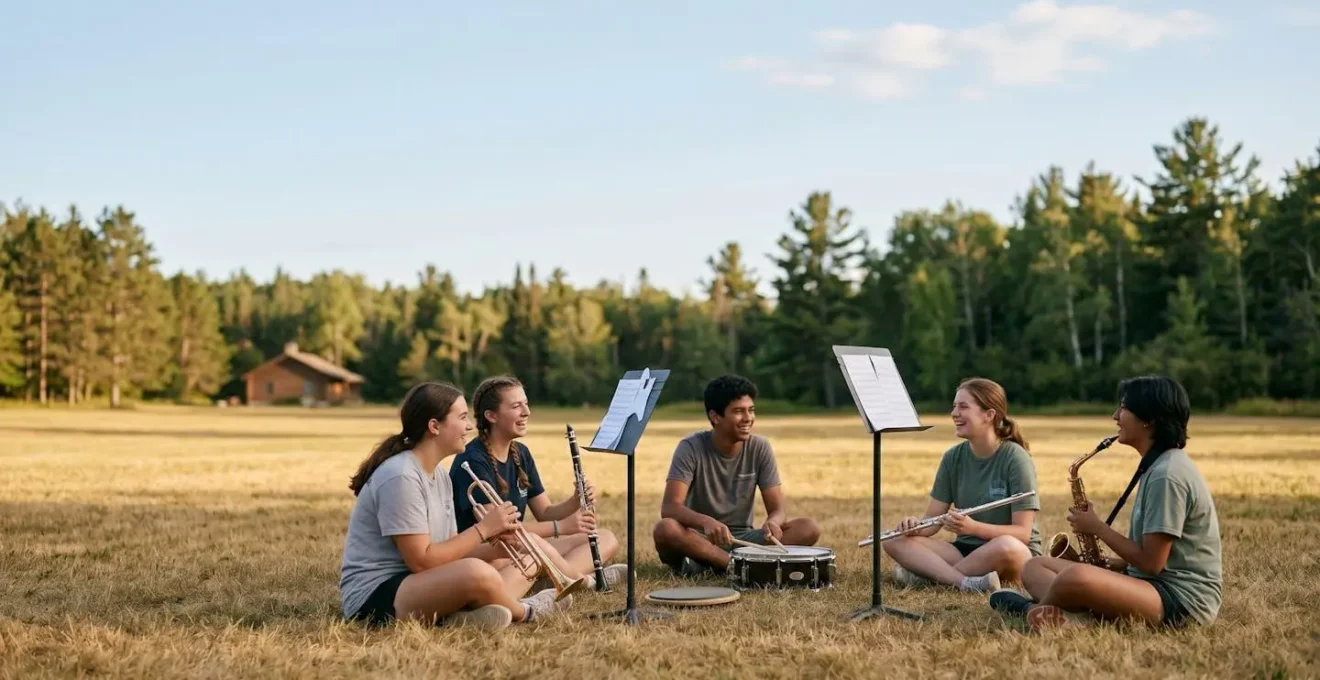
These bonds are a key source of social-emotional growth. Students learn resilience when they help a friend who is struggling with a piece of music, and they build confidence when they receive encouragement from their peers. A recent study confirmed the deep benefits of this environment, noting that participants reported that playing in an ensemble improved self-awareness, listening skills, resilience, self-confidence, and collective efficacy beliefs. This is where a group of individuals truly becomes a team.
Learning the Songs: Why « Jamming » Doesn’t Mean « Learning on the Spot »
From the outside, a band might seem like it’s just about « jamming. » But behind every effortless performance are hundreds of hours of structured, disciplined, and cognitively demanding work. Learning to play an instrument and read complex musical notation is an intense workout for the brain. It’s a multi-layered process that involves decoding symbols, translating them into precise physical actions, listening to the result, and adjusting in real-time. This isn’t mindless repetition; it’s a cycle of analysis, execution, and correction that builds powerful neural pathways.
This rigorous training has profound benefits that extend far beyond music. It enhances what psychologists call executive functions—the set of mental skills that include working memory, flexible thinking, and self-control. When your child learns to follow a conductor, ignore distractions, and remember a long sequence of notes, they are training their brain for focus and discipline. These are the same core skills needed to solve a complex math problem or write a coherent essay.
The link between music education and academic aptitude, particularly in STEM fields, is well-documented. The structured, logical nature of music theory mirrors the principles of mathematical and engineering thinking. Research from McGill University, for instance, revealed that grade-school kids who took music lessons scored higher on tests of general and spatial cognitive development—the very abilities that form the basis for high-level performance in math and engineering. So while it may look like fun, the act of learning a song is a deeply analytical and beneficial process.
The Leader Dilemma: Who Decides the Setlist?
A common point of confusion for students and parents alike is how decisions are made in a band. Who chooses the music? Who decides who gets the solo? From a student’s perspective, these decisions can sometimes feel arbitrary or unfair. This experience, however, is an invaluable early lesson in organizational dynamics. Your child learns that in any large group, there is a hierarchy and a strategic reason for decisions that may not be immediately apparent.
The band director, much like a CEO or a project manager, has a « balcony view. » They aren’t just picking songs they like; they are making a series of strategic choices based on numerous factors the students can’t see. These include:
- Pedagogical Goals: Is the piece chosen to teach a specific rhythm, key signature, or style?
- Skill Balancing: Does the music challenge the stronger players while still being accessible to the developing ones?
- Logistical Constraints: Is the sheet music available and within the school’s budget? Does the instrumentation match the band’s current roster of players?
- Audience and Event: Is the music appropriate for a formal concert, a football game, or a community parade?
Effective band programs often use a distributed leadership model to manage this complexity. As the National Federation of State High School Associations highlights, directors delegate specific responsibilities to student leaders, creating a multi-tiered structure. This system teaches students that decisions from the top are not random but are based on a complex web of constraints and strategic goals. By learning to trust the director’s strategic vision, even when they don’t fully understand it, students gain an early and crucial insight into how successful organizations function.
Key Takeaways
- Band is a project management simulator where the concert is the non-negotiable deadline, teaching real-world delivery skills.
- It provides a unique training ground for peer leadership, forcing students to influence and mentor equals without formal authority.
- Individual accountability is non-negotiable; the « empty chair » makes a student’s importance to the group tangible and immediate.
Joining a Band: How to Survive Your First Rehearsal
For any new member, the first rehearsal can be intimidating. It’s a whirlwind of new faces, unfamiliar music, and unwritten rules. But this initial experience is also the gateway to all the collaborative benefits we’ve discussed. Surviving and thriving in this environment comes down to quickly learning the culture of the ensemble. It’s less about playing every note perfectly and more about demonstrating that you are ready to be a contributing member of the team. It’s about showing you understand that rehearsal is not practice; it’s collaborative construction.
The most successful new members are those who are observant, prepared, and humble. They understand that their role is to listen more than they play, at first. They watch the conductor’s hands, they mark their music when instructed, and they absorb the flow of the rehearsal without disrupting it. This is the first test of ego suppression—the willingness to learn and adapt before asserting oneself. This initial period teaches a student how to integrate into an existing, high-functioning team, a skill they will use again and again in their academic and professional careers.
The transition from individual musician to ensemble member is a critical one. To help your child navigate this, it’s useful to understand the unspoken etiquette of the band room. These are the core principles that enable a large group of individuals to function as a cohesive unit and make progress efficiently.
Action Plan: Key Rules for a New Band Member
- Arrive early and be prepared: In the band world, « early is on time, and on time is late. » Your child should have their instrument assembled, music in order, and be in their seat ready to play before the official start time.
- Learn the rehearsal etiquette: Know when to play and when to be silent. The most important skill is listening to the conductor’s instructions and marking your music quietly and quickly.
- Interpret non-verbal communication: A huge part of rehearsal is visual. Teach your child to watch the conductor’s gestures for tempo, dynamics, cut-offs, and emotional expression. This is far more efficient than waiting for spoken words.
- Detach ego from performance: The conductor will give corrections. These are not personal criticisms; they are data for improvement. The faster a student learns to accept feedback gracefully, the faster they will grow.
- Take responsibility for your part: Use individual practice time at home to « build your tools » (learn the notes and rhythms). Group rehearsal is for « collaborative construction »—putting the parts together to build the final piece.
Ultimately, the decision to join the band is about more than music. It’s a commitment to a process that forges character, builds resilience, and teaches the art of collaboration in the most practical way possible. By equipping your child with these foundational skills, you are giving them a significant advantage for any future path they choose.