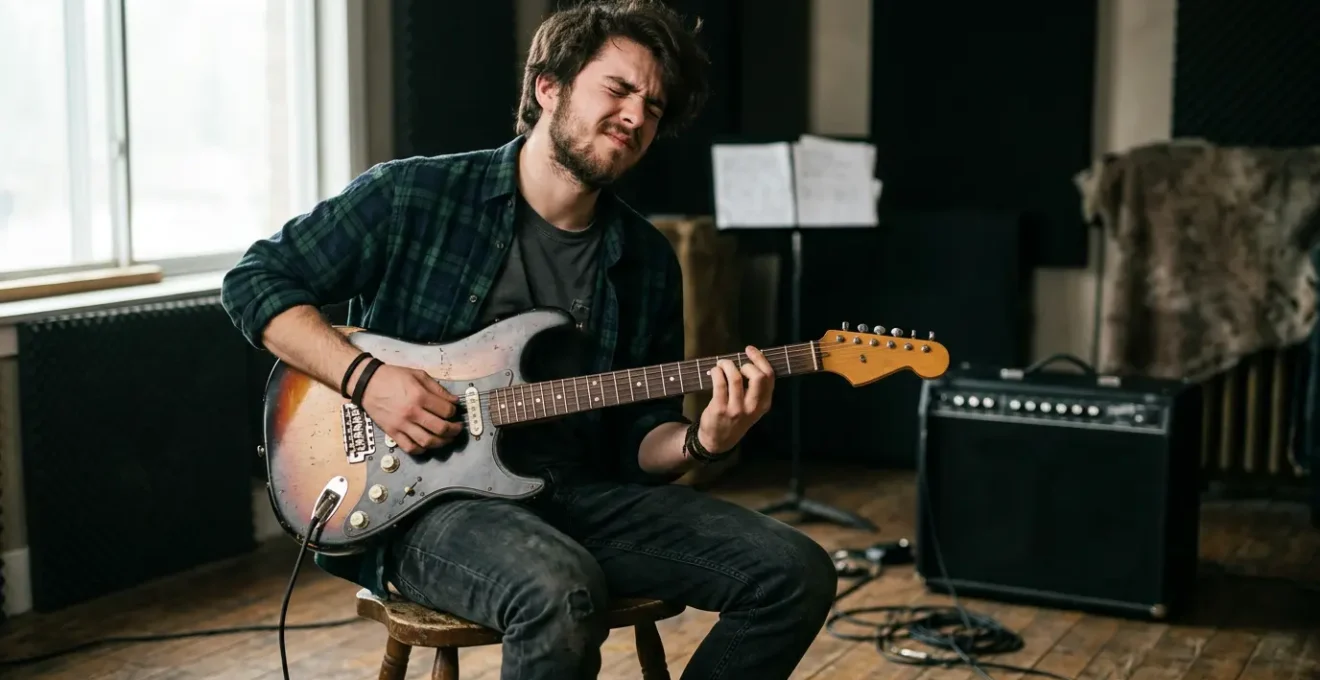
Contrary to the fear that loud, angry music is a sign of trouble, it’s often a sophisticated emotional tool. This article reveals that what sounds like chaos is actually your teen’s non-verbal way of processing pain, managing stress, and building their identity. It reframes their loud music not as a problem to be solved, but as a necessary psychological process for you to understand and support.
The bedroom door slams. Seconds later, a wall of sound—a furious guitar riff, a thundering drum beat, a voice filled with rage or despair—vibrates through the floor. For many parents, this scenario is a familiar and worrying one. Your first instinct might be to yell, « Turn it down! » Your mind races with concern: Is this music making them angry? Are they isolating themselves? Is this a cry for help or an act of rebellion?
It’s understandable to feel this way. Conventional wisdom often labels loud, intense music as a negative influence. You might be told to « just talk to them, » but find that words are the very thing they seem to be avoiding. This article proposes a different perspective, one rooted in adolescent psychology and music therapy. What if the noise isn’t the problem, but a non-verbal attempt at a solution? What if that cacophony is actually a highly functional, sophisticated coping mechanism?
We will explore the powerful role music plays as a necessary emotional outlet for teenagers. We will decode the psychological functions behind their listening habits, from using aggressive music to manage anxiety to the neuroscience of how playing an instrument calms the nervous system. By reframing this behavior, you can shift from a position of conflict to one of connection and support, learning to hear the message behind the music.
This guide will walk you through the essential therapeutic functions of music for adolescents, providing insights into their inner world and practical ways to support their journey. Explore the sections below to better understand the symphony of their emotions.
Summary: The Noise is the Signal: Why Your Teen’s Loud Music is a Healthy Emotional Outlet
- Playing the Pain: Why Instruments Speak When Words Fail
- Journaling in Verse: Turning Angst into Art safely
- Mood Management: How to Create a ‘Calm Down’ Playlist
- The Garage Band: Screaming Together to Feel Better
- I Listen Therefore I Am: Why Music Define the Teenage Self
- The Message: Rap as the CNN of the Inner City
- Amygdala and Harmony: Why Playing Music Reduces Cortisol Levels
- How Hip-Hop Became a Global Cultural Movement for Youth Identity?
Playing the Pain: Why Instruments Speak When Words Fail
When a teenager is overwhelmed, the part of their brain responsible for language can feel inaccessible. The emotions are too big, too complex, or too raw to be packaged into sentences. This is where music steps in, not as an escape, but as an alternative language. Research suggests that for adolescents, music is a primary tool for emotional regulation. In fact, for over 80% of teenagers, music is a key strategy for coping with stress and difficult feelings. An instrument becomes a direct line to their inner world, bypassing the need for verbal expression.
Think of a distorted guitar chord as the sound of frustration, a frantic drum solo as the feeling of anxiety, or a somber piano melody as the shape of sadness. By playing an instrument, your teen isn’t just making noise; they are externalizing their internal state. They are taking an intangible feeling and giving it a physical form—a process called « non-verbal journaling. » This act of translation is profoundly therapeutic. It allows them to confront, explore, and gain a sense of control over emotions that might otherwise be unmanageable. It provides a safe container to hold feelings that feel too dangerous to speak aloud.
So when your teen is locked in their room « playing the pain, » they are engaged in a vital psychological process. They are not shutting you out; they are trying to work things out. The volume and intensity are not necessarily signs of anger, but measures of the emotional weight they are trying to process.
Journaling in Verse: Turning Angst into Art safely
Beyond simply playing an instrument, the act of songwriting offers an even more structured form of emotional processing. It combines the expressive power of music with the narrative structure of lyrics, allowing a teenager to build a story around their feelings. This process transforms abstract angst into a tangible piece of art, creating distance and perspective. It’s the difference between being lost in a storm and describing the storm from a safe lighthouse. This is where psychological safety becomes paramount.
The image below captures this intimate and powerful process: the translation of chaotic internal feelings into the structured, safe format of a notebook, an essential step in creative emotional release.

A real-world example of this is the Rebel Song Academy in Kansas City. This program specifically helps teenagers grappling with depression and anxiety through collaborative songwriting. Participants found that musical metaphor allowed them to tackle subjects they could never address in a normal conversation. One teen noted that songwriting enabled them to approach difficult life experiences from a different angle, making them easier to process. By turning their pain into a song, they aren’t just venting; they are authoring a new narrative where they have control.
For a parent, seeing lyrics about pain or anger can be alarming. But from a therapeutic standpoint, it’s often a sign of health. The feelings were already there; writing them down is an act of confronting and organizing them, not creating them. It’s a sign that your teen is actively trying to make sense of their world.
Mood Management: How to Create a ‘Calm Down’ Playlist
A common but often ineffective piece of advice is to suggest a teen listen to « calming music » when they’re agitated. This well-meaning suggestion usually fails because it ignores a fundamental principle of music therapy: emotional matching. When a person is experiencing high-energy emotions like anger or anxiety, slow, quiet music can feel grating and invalidating. The first step to regulating an emotion with music is to meet it where it is. You don’t fight a fire with a gentle breeze; you meet its intensity and gradually guide it down.
The goal is to create a « sonic scaffold » that supports their current emotional state and then gently guides them toward a calmer one. This is achieved by sequencing songs to gradually decrease in tempo, volume, and complexity. It’s a purposeful journey, not an instant switch. Your teen is likely already doing this intuitively, but understanding the structure can help you appreciate the sophistication of their method. The following checklist, based on principles from music therapy, outlines how to build a playlist for controlled emotional release.
Action Plan: Building a Therapeutic ‘Entrainment’ Playlist
- Start by identifying the current emotional state (e.g., anger, anxiety) and find music that matches its energy and tempo.
- Select an opening track that fully mirrors this high-energy state; for anger or anxiety, this means a fast, complex, or loud song.
- Gradually sequence the next tracks with progressively decreasing tempo, complexity, and volume.
- Build a playlist of 6-8 songs that methodically guides the nervous system from a state of high activation toward calm.
- End the sequence with slower, often instrumental music that features soothing rhythms to facilitate a state of relaxation.
- Encourage the creation of multiple purpose-driven playlists for different goals: focus, building confidence, processing grief, or this kind of controlled release.
By using music to match and then shift their energy, teens are engaging in an advanced form of self-regulation. They are not just passively consuming music; they are actively using it as a tool to manage their nervous system.
The Garage Band: Screaming Together to Feel Better
While individual music practice is a powerful tool, making music with others—the classic « garage band » scenario—adds a crucial social and relational layer to the therapeutic process. It’s one thing to scream into the void alone; it’s another to scream in harmony with friends who feel the same way. This shared experience creates a powerful sense of validation and belonging, combating the isolation that often accompanies intense adolescent emotions. It tells a teen: « You are not alone in this feeling. »
The neuroscientific evidence supports this. Research on group songwriting workshops for teens has shown a 24% average decrease in stress-related brain activity after sessions. The collaborative act of creating music together literally calms the brain. This is because it moves the individual from solitary rumination into a state of shared, focused creation. The problems don’t vanish, but they are held and transformed by the group dynamic. As researchers from the University of Zurich noted when studying how teens use music to deal with emotions:
Collaborative music-making creates a shared environment for self-expression, facilitating a depth of connection that spoken language alone may not achieve.
– University of Zurich researchers, BOLD Science study on teenagers using music to deal with emotions
The garage band becomes a social microcosm where teens can practice collaboration, negotiation, and mutual support, all while processing their individual and collective angst. The noise they make together is the sound of community being forged in the face of adolescent turmoil.
When you hear that « racket » from the garage, remember that it’s more than just noise. It’s peer support, it’s collaborative problem-solving, and it’s a vital social lifeline for teenagers navigating a complex emotional world.
I Listen Therefore I Am: Why Music Define the Teenage Self
During adolescence, the fundamental question is « Who am I? » Teenagers are in the process of separating from their family identity and forging their own. Music is not just a background to this process; it is a primary building material. The bands they love, the lyrics they memorize, and the genres they champion become badges of identity, signaling to the world who they are and what they stand for. Choosing a musical tribe—punk, hip-hop, metal, indie—is a way of choosing an identity.
This connection is deeply wired in the brain. As neuroscience researchers have pointed out, the music you listen to during your teenage years becomes inextricably linked to your emotional and memory centers. The intense emotions of adolescence mean that the music present during those high-stakes moments gets « stamped » into your neural pathways. As one article explains:
The music that accompanied high-stakes moments of your youth is forever linked to the powerful emotions you experienced then, and deeply embedded in the brain.
– Neuroscience researchers, The Conversation
This is why the music of our youth holds such power over us for the rest of our lives. For your teen, the music they are listening to now is forming the soundtrack of their core self. When a parent criticizes their music, it’s often perceived not as a critique of a song, but as a rejection of their very identity. This is why their reactions can seem so disproportionate. They aren’t just defending a band; they are defending their emerging sense of self.
Understanding this helps shift the conversation. Instead of asking « Why do you listen to this garbage? », a more connecting question is « What do you love about this band? » This shows you are interested in them, not just their musical taste. It opens a door to understanding the identity they are so carefully constructing.
The Message: Rap as the CNN of the Inner City
For many parents, the aggressive posturing, explicit language, and confrontational themes in genres like rap and hip-hop can be particularly alarming. It’s easy to see it as a negative influence. However, from a cultural and psychological perspective, it’s essential to understand the genre’s roots as a form of social commentary and narrative empowerment—a function famously described by rapper Chuck D as « the CNN of the inner city. » For marginalized communities, hip-hop provided a platform to report on their own realities when mainstream media would not.
For a teenager, especially one who feels misunderstood, disenfranchised, or unheard, hip-hop can offer a powerful sense of voice and validation. The genre often tackles complex themes of social injustice, identity struggles, and resilience head-on. By listening to an artist who articulates their own unspoken feelings of anger or frustration, a teen feels seen and understood. It provides a framework and a language for their own experiences. As cultural identity researchers have noted:
Hip hop is unique in it’s requirement that participants actively contribute to defining and shaping the culture. …uniting with marginalized individuals from around the world who are challenging racism and advocating for immigrant rights.
– Cultural identity researchers, PMC study on global hip-hop cypher and youth identity
This active participation transforms listening from a passive act to an alliance. Your teen isn’t just absorbing lyrics; they are aligning with a culture of resilience. They are connecting their personal struggles to a larger social narrative, which can be an incredibly empowering and identity-affirming experience. It provides context and a sense of shared strength.
Even if the specifics of the lyrics don’t match your teen’s life, the underlying themes of overcoming adversity, demanding respect, and forging an identity against the odds are universal adolescent struggles. The music provides a powerful, ready-made script for their own journey of empowerment.
Amygdala and Harmony: Why Playing Music Reduces Cortisol Levels
The therapeutic benefits of music are not just psychological; they are deeply biological. When your teen picks up a guitar after a stressful day, they are initiating a cascade of neurochemical changes that actively combat the body’s stress response. The amygdala, the brain’s « fear center, » is a key player in anxiety and the release of the stress hormone cortisol. Music has a direct effect on this system.
Listening to music has been shown to have a profound impact on the endocrine system. A comprehensive review found that the simple act of listening to music can result in an up to 61% reduction in cortisol levels. However, the benefits are even more pronounced when a teen is *actively playing* an instrument. This is because playing music is a « full brain workout. » As neuroscience researchers explain, it engages multiple brain regions simultaneously: the motor cortex for the physical movements, the auditory centers for processing sound, and the prefrontal cortex for structure and planning. This intense, whole-brain engagement is incredibly effective at disrupting the rumination loops that fuel anxiety.
The superiority of active playing has been demonstrated in controlled studies. For example, research comparing the effects of different creative activities found that playing the piano led to significantly lower salivary C-reactive protein levels (a marker for stress and inflammation) compared to activities like calligraphy or working with clay. The combination of tactile feedback, auditory processing, and cognitive focus creates a uniquely powerful stress-reduction cocktail.
So, the next time you hear your teen practicing the same difficult passage over and over, understand that it’s more than just rehearsal. It’s a focused, meditative practice that is actively re-regulating their brain chemistry and bringing their nervous system back into harmony.
Key Takeaways
- Loud or intense music is often not a sign of defiance, but a sophisticated tool for emotional matching and regulation.
- Actively playing an instrument provides a « full brain workout » that is scientifically proven to disrupt anxiety loops and lower stress hormones like cortisol.
- Music, through songwriting or genre affiliation, creates psychological safety for teens to process complex feelings and construct a strong sense of personal identity.
How Hip-Hop Became a Global Cultural Movement for Youth Identity?
Ultimately, the journey of a teenager with music follows a powerful arc: from an intensely private coping mechanism to a public badge of identity and belonging. What begins as a solitary act in a bedroom—playing a sad melody on a piano or finding solace in an angry song—blossoms into a connection with a wider world. Hip-hop, which started as a local voice for the unheard, exemplifies this journey on a global scale. It is now arguably the world’s dominant youth culture, offering a shared language and identity to billions.
This movement is not just about music; it’s about a shared ethos. It provides a sense of community for those who feel on the margins, transforming personal pain into collective power. When your teen wears a band t-shirt or gets deep into the history of a musical subculture, they are doing more than just choosing entertainment. They are finding their place in a tribe. They are learning that their individual feelings are part of a much larger human experience, which is one of the most comforting and essential discoveries of adolescence.
The intense, personal connection to an instrument or a song is the first step. The realization that millions of others feel a connection to that same art form is the second. This transforms a solitary emotional outlet into a global cultural movement that reinforces their identity and tells them they belong. It’s a journey from « me » to « we, » facilitated entirely through sound.
The next time you hear the bass thumping from behind that closed door, take a moment. Instead of hearing noise, try to hear the signal. It might be a signal of stress being managed, an identity being forged, or a connection being made to a global community. Your next step isn’t to turn down the volume, but to turn up your curiosity. Ask them what they love about that song—not to judge it, but to truly understand them.