
The biggest fear about a first rehearsal isn’t being a bad player; it’s violating the unwritten social rules. Success hinges more on your ability to listen and collaborate than on technical perfection.
- Preparation is personal work; rehearsal is for collective refinement and communication.
- Your role is to fit into the « sonic space, » not to dominate it. Listening is more important than playing.
Recommendation: Shift your focus from « performing » to « conversing. » Treat your instrument as your voice in a dialogue with the other musicians.
The moment has arrived. You’ve spent years in your bedroom, honing your craft, mastering challenging solos, and dreaming of this day. Now, you’re about to step into a rehearsal room with other musicians for the first time. The excitement is palpable, but so is the terror. Your mind races with questions: Am I good enough? What if I mess up? What are the rules? This anxiety is universal, and it’s rarely about technical ability.
Many budding musicians assume the first practice is a technical audition where every note is scrutinized. They focus on bringing the right gear, tuning perfectly, and nailing their parts. While important, this misses the point. The real challenge, and the key to being asked back, lies in navigating the social dynamics and the unspoken language of a band. It’s not a test; it’s a conversation. Your goal isn’t to deliver a flawless monologue but to participate in a compelling dialogue.
This guide isn’t about what gear to bring. It’s about the social and collaborative skills that turn a group of individuals into a cohesive unit. We’ll dismantle the idea that rehearsal is just about playing songs correctly and instead frame it as a social skill. We will explore how to manage volume, communicate without words, give and receive feedback gracefully, and find your role within the group’s sound.
By shifting your mindset from a solo performance to a collective creation, you’ll not only survive your first rehearsal—you’ll thrive. You’ll learn that listening is your most powerful tool and that your contribution to the band’s chemistry is just as valuable as your musical chops. Let’s get you ready to be a great bandmate.
This article will guide you through the essential, often unspoken, rules of ensemble etiquette. From pre-rehearsal preparation to finding your place in the local music scene, you’ll find a clear roadmap to becoming a valued member of any band.
Summary: Your Roadmap to Becoming a Great Bandmate
- Learning the Songs: Why « Jamming » Doesn’t Mean « Learning on the Spot »
- The Volume War: Why You Are Probably Too Loud
- Eye Contact: How to Know When the Solo Ends
- Feedback vs Attack: Not Taking Musical Corrections Personally
- Skill Level Match: Why Being the Worst Player in the Room Is Good
- Warm-Up and Focus: Creating a Bubble Before the Curtain Rises
- Blending the Sound: Why Your Part Isn’t Always the Most Important
- Support Your Local Scene: How to Join or Start a Local Band
Learning the Songs: Why « Jamming » Doesn’t Mean « Learning on the Spot »
The single biggest mistake a new band member can make is showing up unprepared. There’s a romantic notion that rehearsals are spontaneous « jams » where songs magically come together. This is a myth. The creative, collaborative magic you’re hoping for can only happen when a solid foundation is already in place. That foundation is your personal preparation. Your bandmates are not your teachers; they are your collaborators. Wasting their time by trying to learn your part during the rehearsal is the quickest way to ensure you don’t get a second one.
The distinction is critical, as worship leader and coach Jon Nicol puts it, « Practice is personal. Rehearsal is collective. » Your individual practice time is for learning notes, memorizing structures, and working through difficult passages. Rehearsal is for weaving those individual parts together. It’s where you focus on dynamics, transitions, and the overall feel of the song. If you’re busy trying to remember a chord progression, you have zero mental capacity left to listen to the drummer’s groove or the singer’s phrasing. You are no longer part of the musical conversation; you are a problem to be solved.
Action Plan: Pre-Rehearsal Preparation
- Listen to, practice, and know your own parts of the songs independently before rehearsal day.
- Focus on details like timing, dynamics, and transitions rather than learning from scratch.
- Come fully prepared so rehearsal time is spent on collaborative refinement, not individual learning.
- Confirm with your bandmates that everyone has invested time in personal practice beforehand.
- Identify any specific problem areas in your parts to ask for targeted help, not a full lesson.
Arriving with your parts down cold is a sign of respect for everyone’s time and a declaration that you’re ready to build something together, not just figure out your own piece of the puzzle.
The Volume War: Why You Are Probably Too Loud
Once the music starts, the first social test begins: the battle for volume. In the isolated world of the bedroom, you are the producer, mixer, and star. Every frequency is yours to command. In a band, you are one instrument in a complex sonic tapestry. The most common mistake for inexperienced players is failing to understand this shift. Driven by a desire to be heard (and a good dose of adrenaline), they turn their amps up, hit their drums harder, and sing louder, inadvertently starting a « volume war. » This is a war no one wins. The result is a muddy, painful wall of noise where no one can hear anything clearly.
The goal is not to be the loudest; it’s to find your « sonic space. » Every instrument has a specific frequency range where it lives. The bass and kick drum own the low end, cymbals and vocals occupy the high end, and guitars and keyboards live in the crowded midrange. Your job is to listen and fit your part into the gaps, not to bulldoze over everyone else. Start with your volume lower than you think you need. If you can’t hear yourself, it might not be because you’re too quiet, but because your tone is clashing with someone else’s. A slight tweak to your EQ could be more effective than a blast of volume.
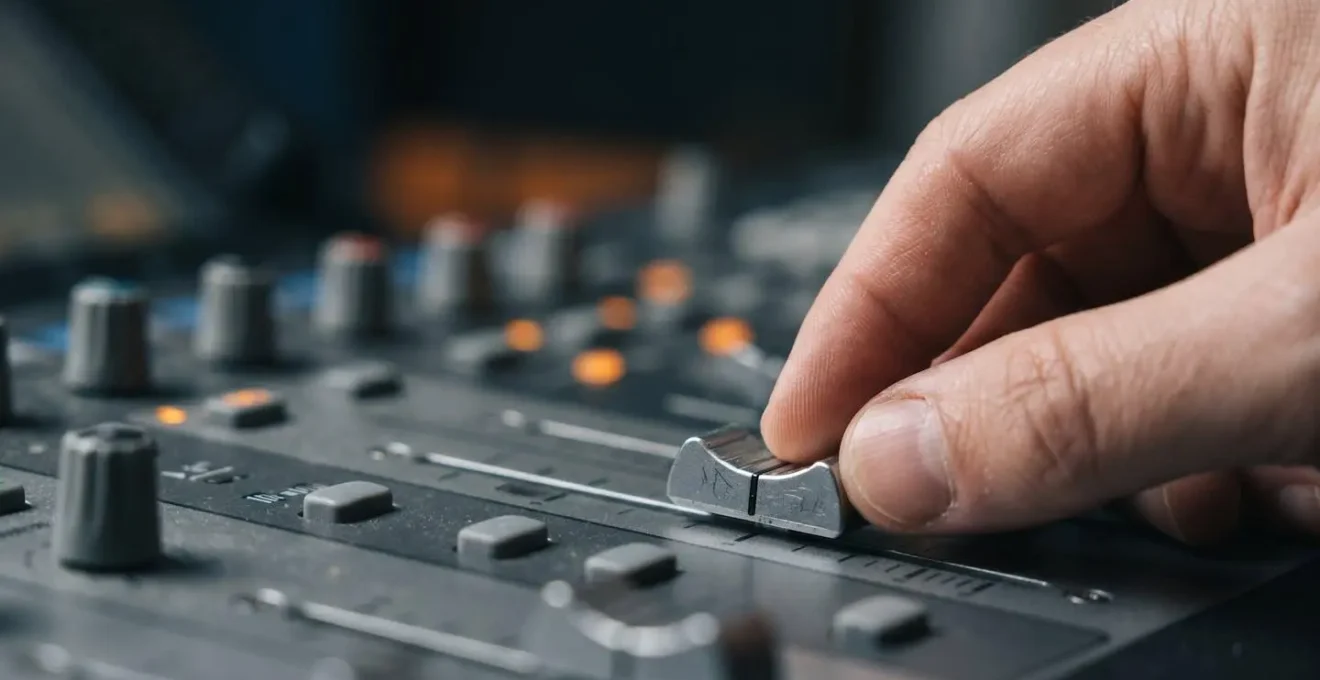
This image perfectly illustrates the goal: careful, deliberate adjustment for balance, not a race to the top. While you may not have a mixing desk at practice, the principle is the same. As a general guide, some experienced musicians recommend maintaining 80 dB on peaks for rehearsals to protect hearing and maintain clarity. This forces everyone to play with more control and, most importantly, to listen to each other.
Eye Contact: How to Know When the Solo Ends
In a band, the most important communication doesn’t happen with words. It happens with a nod, a glance, or a raised guitar neck. Bedroom musicians, accustomed to staring at their fretboards or a computer screen, are often shocked by how much information is exchanged visually in a rehearsal. That awkward moment when a solo ends and the whole band misses the cue to come back in? It’s almost always because someone wasn’t looking up. Relying solely on your ears is only half the battle; you have to use your eyes.
As one guide on band practice notes, eye contact is a critical technique because it allows everyone to see what’s happening. Setting up in a circle or a semi-circle, rather than a straight line facing one direction, is non-negotiable. This allows you to see everyone’s hands, faces, and instruments. This visual connection is how you coordinate dynamics, nail tight transitions, and fix mistakes on the fly. The drummer might give a slight head nod before a chorus hits. The singer might look directly at you to signal it’s your turn for a solo. The bassist might raise their headstock to indicate the song is about to end. These are the non-verbal cues that separate a sloppy garage band from a tight, professional-sounding unit.
Your job is to identify the musical anchor—often the drummer or singer—and keep them in your line of sight. Practice specific visual signals for common changes. A simple, agreed-upon gesture for « let’s do that part again » or « let’s end it here » can save minutes of frustrated conversation. Making eye contact isn’t just practical; it builds chemistry and trust. It says, « I’m with you. I’m paying attention. » It transforms the experience from a group of individuals playing in the same room to a single, communicating organism.
Feedback vs Attack: Not Taking Musical Corrections Personally
Sooner or later, it will happen. The bassist will turn to you and say, « Hey, can you try playing that part a little simpler? It’s clashing with the vocal line. » For a musician whose identity is deeply tied to their playing, this can feel like a personal attack. This is perhaps the most difficult hurdle for a bedroom musician to overcome: separating their personal worth from their musical part. The feedback is not about you; it’s about the song. The song is the patient on the operating table, and the band members are the surgeons trying to make it healthy. Every suggestion is a clinical attempt to serve the greater good of the music.
The psychological reason this is so hard is that, for many, music is not just something they do; it’s who they are. As one article on the topic explains, this is a common trait. According to a piece on the musician’s ego by Stefaan van den Putte, » Musicians tend not to separate who they are as a musician from who they are as a person. They gain their dignity and self-esteem from being a musician. » When that identity is challenged, even constructively, the natural reaction is defensiveness. Learning to override this impulse is a sign of maturity.
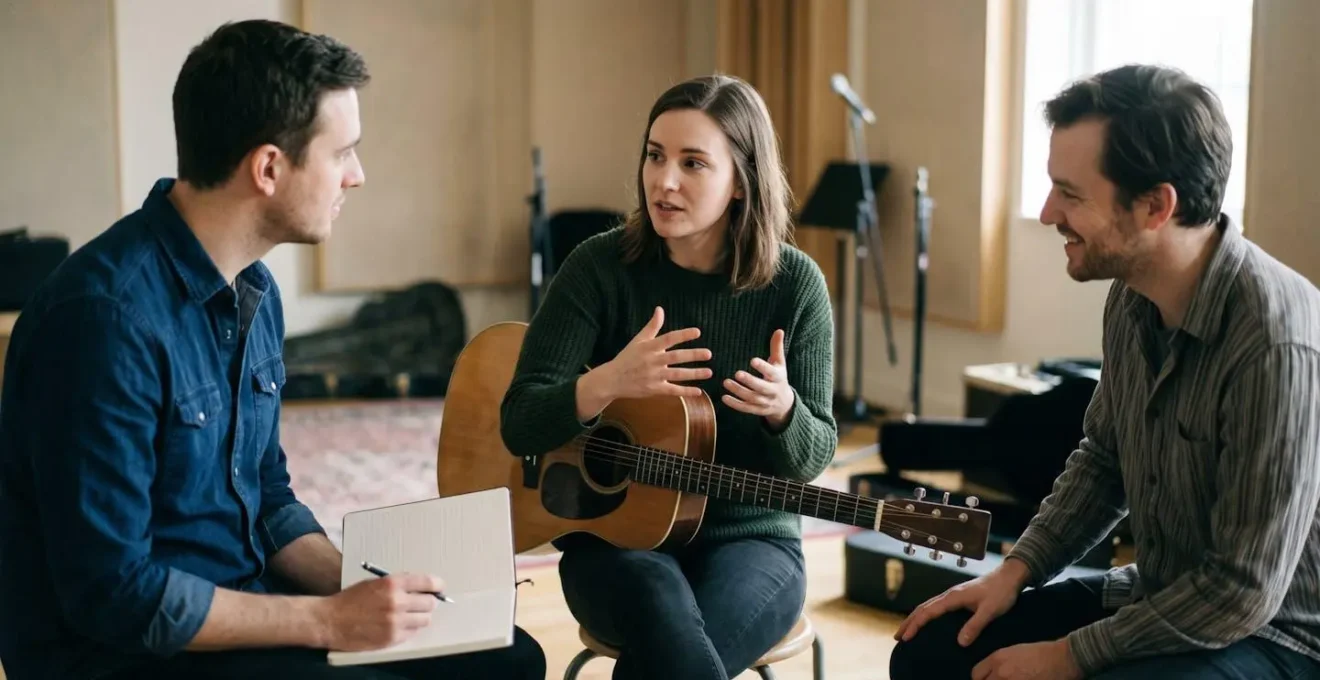
The key is to adopt a mindset of curiosity. When someone suggests a change, don’t hear « You’re wrong. » Instead, hear « What if we tried this? » Your response should be to try it. More often than not, the person making the suggestion is hearing the song from a different perspective and has noticed something you’ve missed. Similarly, when you have to give feedback, frame it as a question or a team-oriented goal. Instead of « You’re playing the wrong chords, » try « I’m a little lost in that section. Can we confirm the chord progression together? » This fosters a collaborative and safe environment where everyone feels comfortable contributing to the song’s improvement.
Skill Level Match: Why Being the Worst Player in the Room Is Good
It’s a common fear: what if you’re the least experienced or skilled musician in the room? The instinct is to feel intimidated, inadequate, and to apologize for your very existence. But here’s a counter-intuitive truth: being the « worst » player in the room is one of the fastest ways to grow as a musician. It’s an incredible opportunity, not a reason for shame. Playing with people who are better than you forces you to listen more intently, practice more diligently, and rise to their level. It’s a masterclass you get to attend every week.
Your value in this scenario is not defined by your technical fireworks. It’s defined by your attitude, reliability, and your ability to be a solid foundation. You can be an incredibly valuable member by focusing on a few key things. First, be over-prepared. Know your parts inside and out, even if they are simple. Second, listen more than you play. Your job is to understand how your part serves the song and supports the other players. Third, play perfectly in time. A simple part played with a great feel is infinitely more valuable than a complex part played sloppily. Finally, have a positive attitude. Be the person who shows up on time, helps carry gear, and is enthusiastic and open to feedback.
As one musician shared about their early experiences, the first rehearsal is fundamentally a learning opportunity. The initial nerves will eventually fade, replaced by the cohesive sound of a group that has learned to blend its talents. When you’re the beginner, you’re not expected to be the star. Embrace the role of the student. Ask intelligent questions. Watch how the more experienced players interact. Absorb everything. Your clear improvement between rehearsals will be noticed and appreciated far more than any flashy solo you could have played.
Warm-Up and Focus: Creating a Bubble Before the Curtain Rises
How a rehearsal begins often determines how it will end. If members straggle in, spend twenty minutes setting up, noodle on their instruments aimlessly, and then stumble into the first song, the session is likely doomed to be unproductive. A great rehearsal starts before the first note is played. It starts with creating a collective bubble of focus. This isn’t just about warming up your fingers or voice; it’s about shifting your mental state from the chaos of the outside world to the collaborative task at hand.
Veteran music educator Wendy Higdon discovered over a 25-year career that the first part of a rehearsal is best used for focusing students’ minds, not just their instruments. She implemented a predictable routine that had a calming effect, helping students leave the day’s stress behind and settle into a musical headspace. This might include breathing exercises or playing simple, fundamental patterns together. The goal is to get everyone listening and connecting from the very beginning. You can create a similar ritual for your band.
The most professional approach is for each member to do their individual physical warm-up *before* arriving. Rehearsal time is precious and shouldn’t be spent on one person’s scale exercises. A great band-focused warm-up could be spending three to five minutes jamming on a simple two-chord progression or a 12-bar blues. The point isn’t the complexity of the music, but the act of locking in together. It forces everyone to listen to the rhythm section, feel the groove, and start communicating non-verbally. This short, focused exercise acts as a bridge, guiding the band from individuals into a single, focused entity ready to work.
Blending the Sound: Why Your Part Isn’t Always the Most Important
In a band, your part is just one ingredient in a recipe. A cake with too much salt is ruined, no matter how high-quality the salt. Similarly, a song where one instrument dominates is unbalanced and unpleasant, no matter how well that part is played. The goal is to blend, to serve the song. This requires a shift in thinking, beautifully captured in a popular analogy: « You can’t have a team of 11 strikers. Sometimes your job is to be the solid defender to allow the striker to shine. » In music, the « striker » might be the lead vocal, a guitar solo, or a poignant lyric. Your job, in that moment, might be to play a simple, repetitive line that provides a solid foundation and doesn’t distract from the main event.
This concept of layering and role-playing is a technique used by professionals. Instead of everyone jumping in at once, they build the song from the ground up. This process often starts with the drummer and bassist locking in their groove, creating the unshakable foundation of the song. Only when that foundation is solid are other instruments, like rhythm guitar and keyboards, layered on top. This method allows the band to hear how each part interacts and to iron out any clashes or mistakes that would be inaudible in a full-band cacophony. The lead vocal is often the last element to be added, sitting on top of the fully formed musical bed.
This approach requires patience and musical humility. It means you might spend five minutes listening and not playing a single note while the rhythm section works out a transition. This is not wasted time. This is active, critical listening. You are learning the song’s structure, internalizing its dynamics, and figuring out precisely where your part will have the most impact. When it’s your turn to play, you’re not just adding another layer of noise; you are adding a thoughtful, intentional element that makes the whole song better.
Key Takeaways
- Your first rehearsal is a social audition, not just a technical one; listening and communication are paramount.
- Preparation is an individual responsibility. Rehearsal is for collaboration and refinement.
- Embrace feedback as a tool for improving the song, not as a personal attack.
Support Your Local Scene: How to Join or Start a Local Band
You’ve absorbed the theory, you’ve adjusted your mindset, and you’re ready to be a great bandmate. But there’s one final piece of the puzzle: finding the right people to play with. Your future bandmates are not going to magically appear in your living room. You have to go out and find them, and the best place to do that is within your local music scene. Becoming an active, supportive member of your community is the most effective strategy for making the connections that lead to great musical projects.
This process can be broken down into stages. First, become a regular presence. Attend local shows, even for genres you don’t play. Talk to the musicians after their sets. Compliment the sound engineer. Buy merch from the bands. When venue owners and promoters see you consistently supporting the scene, they start to view you as a collaborative partner. Second, level up your skills in a social setting by joining music lessons or band programs designed to connect players. Finally, be proactive. Volunteer to help a band load in their gear, or offer your skills for sound or lighting. This visibility makes you a known and trusted entity.
Of course, the digital world offers powerful tools as well. Websites are designed specifically to connect musicians. For example, platforms like BandMix connects thousands of musicians in your area, allowing you to browse profiles and find players with similar tastes and goals. Creating a compelling profile that clearly states your influences, skill level, and what you’re looking for is essential. But don’t rely solely on online tools. The real connections are often forged in the shared experience of a live show. As one musician’s guide to networking notes, consistency in both online activity and real-world participation is the key to long-term success. You are building a reputation as someone who contributes to the scene’s success.
Now that you have the tools and the mindset, it’s time to take action. Start by exploring your local venues, updating your online profiles, and initiating conversations. The band you’re dreaming of is out there looking for a great bandmate just like you.