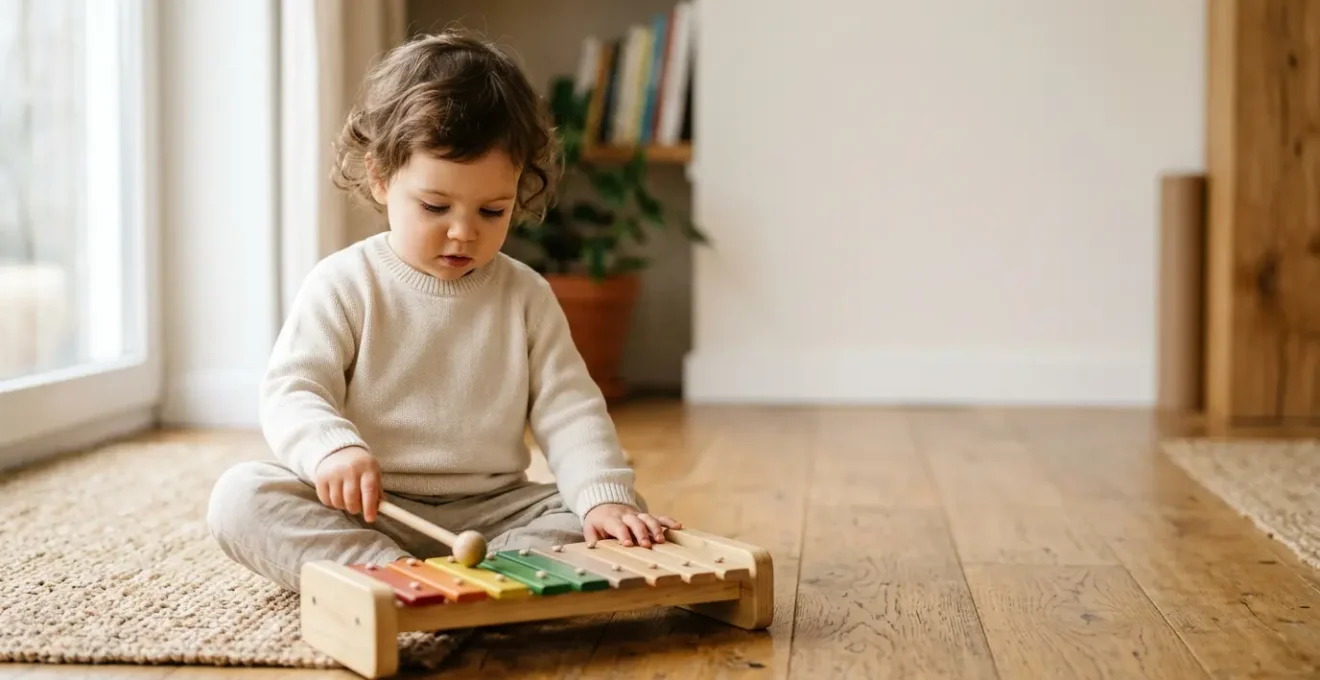
Contrary to the belief that toddler music classes are just ‘fun and games,’ they are actually one of an infant’s first and most critical lessons in cognitive architecture.
- Musical interaction builds the brain’s foundation for language by teaching rhythm and pattern recognition before words have meaning.
- Simple rhythmic games are not just play; they are targeted exercises that build the neural scaffolding for executive functions like impulse control.
Recommendation: Shift from passive listening (like playing Mozart in the background) to active, interactive musical play with your child to directly fuel their neurological and emotional growth.
As a parent, you’ve likely found yourself humming a tune to soothe your crying baby or seen your toddler instinctively bounce to a beat. It feels natural, almost primal. Many parents wonder if enrolling their little one in a music class is a worthwhile investment or simply a structured way to play. The common wisdom suggests music is « good » for children, helping them with everything from memory to mood. But this view dramatically understates the reality.
From a child development perspective, early musical engagement is not a mere enrichment activity. It is a fundamental architectural tool. We are not just entertaining our children with songs; we are providing the raw materials and the very blueprint for their brain’s cognitive and emotional structures. While most advice focuses on the outcomes—better language, improved math skills—it often misses the foundational « why. » The true power of music in early childhood lies in its ability to actively construct the neural pathways for language, emotional regulation, and logical thinking, all before a child might fully understand the words you’re saying.
But if the real key isn’t just listening to music, but *interacting* with it, how does this process actually work inside a developing brain? This article moves beyond the platitudes to reveal the neurological mechanisms at play. We will explore how a simple lullaby forges biochemical bonds, how rhythmic clapping games build the foundation for self-control, and why the noisy, improvised banging on a toy drum is a masterclass in creative thinking. It’s time to see music not as a pleasant accessory to childhood, but as one of its most essential building blocks.
This guide will explore the scientific underpinnings of music’s role in development. We will unpack exactly how these seemingly simple activities translate into profound cognitive benefits, giving you the evidence-based understanding to turn everyday play into a powerful tool for your child’s growth.
Summary: The Science Behind Music and Early Brain Development
- Singing and Speaking: How Rhythm Helps Babies Learn Words
- The Lullaby Effect: Attachment Theory and Musical Interaction
- Math in Music: How Beats Teach Sequences and Numbers
- Stop and Go: Games That Teach Impulse Control
- Improvised Noise: Encouraging Divergent Thinking with Instruments
- Bridging Hemispheres: Why Musicians Multitask Better Than Non-Musicians
- Pat-a-Cake to Polyrhythm: Building Hand-Eye Coordination Step-by-Step
- Why Simple Rhythmic Activities Are Vital for Early Motor Development?
Singing and Speaking: How Rhythm Helps Babies Learn Words
Before an infant can understand a single word, their brain is already a sophisticated pattern-detection machine. Language is, at its core, a collection of rhythmic patterns, sounds, and cadences. Music, therefore, is not a separate skill but the very first language the brain learns to decode. When you sing « Twinkle, Twinkle, Little Star, » you are doing more than teaching a melody; you are providing a predictable, rhythmic framework that trains the brain’s auditory system to identify patterns, segment sounds, and anticipate what comes next. This is the foundational skill for parsing spoken language.
The brain doesn’t differentiate between processing musical rhythm and language rhythm in these early stages. The same neural circuits are being primed. This is why a strong sense of beat and rhythm in infancy is a powerful predictor of later phonological awareness, which is crucial for learning to read. The structured repetition in songs helps a baby’s brain create a mental map of sound structures. This process is so fundamental that a USC Brain and Creativity Institute study found that within 2 years of musical training, children’s auditory systems mature faster than those of their non-musical peers, accelerating their ability to process sound and, by extension, language.
This isn’t just a theory; it’s a measurable neurological process. The brain is literally being built to understand speech through musical exposure. The melodic contours of songs mimic the intonation of speech (the rising and falling pitch of questions versus statements), providing a vital and simplified model for the child to grasp the emotional and structural components of communication. Engaging in musical activities is an investment in the very cognitive architecture needed for a lifetime of effective communication.
The Lullaby Effect: Attachment Theory and Musical Interaction
The act of singing a lullaby is one of the most universal parenting behaviors, and for good reason. It’s a powerful demonstration of music’s dual role in both emotional regulation and biological bonding. When a parent sings to their infant, it’s not just the sound that is soothing; it’s a multi-sensory experience of presence, shared rhythm, and emotional attunement. This interaction is a cornerstone of attachment theory, where the consistent, responsive care of a parent builds a secure emotional foundation for the child.
On a biological level, this interaction triggers a profound hormonal response. Shared musical activities, especially those involving close physical contact, can lead to what scientists call biological synchronization. This process involves the alignment of physiological rhythms, such as heart rate, and even the release of hormones like oxytocin—often called the « love hormone » for its role in social bonding. Concurrently, research on parent-infant bonding reveals that salivary cortisol (the stress hormone) was lower during skin-to-skin contact, which often accompanies intimate singing.
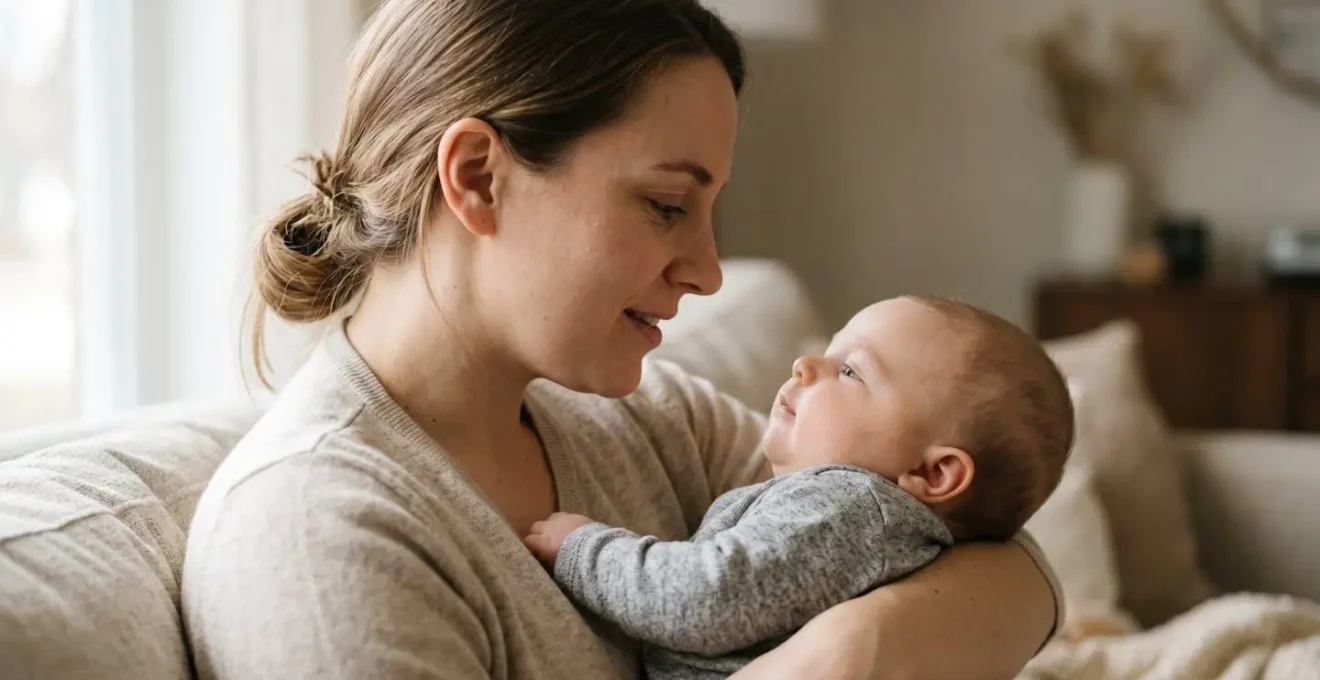
This biochemical dance is not a one-way street. The parent’s calm, rhythmic singing regulates the infant’s nervous system, while the infant’s response (calming, cooing, or gazing) reinforces the parent’s behavior, creating a positive feedback loop of connection. This shared emotional space is crucial for developing a child’s capacity for empathy and social understanding. They are learning, through music, that their emotional state can be understood and influenced by another, a foundational lesson in human connection. This isn’t just about feeling good; it’s about building a secure attachment that will influence relationships for the rest of their life.
Case Study: Musical Interaction Synchronizes Parent and Infant Oxytocin Levels
A 2012 study examined infants’ salivary oxytocin levels following parent-infant interaction. It found that parent and infant oxytocin levels were significantly correlated both before and after the interaction. Under conditions of high behavioral synchrony, infants whose parents had high oxytocin levels had significantly higher oxytocin levels themselves. This demonstrates that an activity as simple as singing together can create a tangible, measurable biological synchronization, providing concrete evidence of musical bonding.
Math in Music: How Beats Teach Sequences and Numbers
Long before a child can count to ten, they can feel a beat. This innate ability to recognize and replicate rhythmic patterns is the human brain’s first encounter with mathematics. Music is, fundamentally, a system of patterns, ratios, and sequences. A simple 4/4 time signature is a lesson in counting. A chorus that repeats after a verse teaches the concept of a sequence (A-B-A-B). These are not just musical ideas; they are the abstract, foundational principles of logical and mathematical thought, presented in a format that is intuitive and engaging for a young mind.
This concept of pre-verbal patterning is critical. When a toddler claps along to a song, they are internalizing a repeating sequence. When they learn the difference between a fast song and a slow song, they are engaging with the concept of relative values (tempo). These activities build the neural pathways for understanding fractions (dividing a whole note into half notes), geometry (recognizing recurring shapes in musical structure), and algebra (understanding variables in a melodic pattern). The impact is measurable, as research on music and mathematics shows that a group receiving rhythm instruction scored significantly higher on arithmetic and mathematical reasoning tasks.
As child development experts Geist, Geist, and Kuznik noted, this is a form of learning that flies under the radar for both parent and child.
Music is children’s first patterning experience and helps engage them in mathematics even when they don’t recognize the activities as mathematics.
– Geist, Geist & Kuznik, The Patterns of Music
This is why active participation is so much more powerful than passive listening. It’s the *doing*—the clapping, stomping, and singing—that forges the connection between a physical action and an abstract mathematical concept. You are not just teaching a song; you are laying the groundwork for a future where numbers and formulas make intuitive sense, because the brain has been practicing these patterns since infancy.
Stop and Go: Games That Teach Impulse Control
One of the most challenging and crucial tasks of early childhood is the development of executive functions—the set of mental skills that includes self-control, working memory, and cognitive flexibility. A simple musical game like « Freeze Dance » or « Musical Statues » might seem like pure fun, but it is actually a highly effective, targeted workout for a child’s burgeoning executive functions. The instruction is simple: dance when the music plays, stop when it stops. But the neurological task is complex.
To succeed, a child must: 1. Pay attention and listen for a cue (the music stopping). 2. Inhibit a prepotent response (the desire to keep moving). 3. Exercise motor control to freeze their body on command. This « stop and go » mechanism is a direct exercise for the prefrontal cortex, the part of the brain responsible for impulse control and decision-making. Each round of the game is a repetition that strengthens the neural circuits for self-regulation. This is the very definition of neural scaffolding: using a simple, enjoyable activity to build a complex cognitive structure that will be essential for later success in school and in life—from waiting your turn in line to resisting the urge to shout out an answer in class.
The beauty of musical games is that they provide immediate, non-punitive feedback. If you don’t stop in time, you’re just « out » for a round, and you get to try again in a minute. This low-stakes environment makes it safe to practice a difficult skill. Research has shown that this kind of training has a tangible impact on brain structure.
Case Study: Music Training Strengthens Prefrontal Cortex Activation
A longitudinal study compared children with music training to control groups. After two years, the music group showed stronger neural activation during a cognitive inhibition task in brain regions involved in response inhibition. Interestingly, this was observed even without differences in behavioral performance, demonstrating that musical training creates an executive function blueprint, or neural scaffolding for self-regulation, even before the behavioral improvements become measurable.
These games are far more than just a way to burn off energy. They are a playful, powerful method for building the neurological foundation of self-discipline, one dance party at a time.
Improvised Noise: Encouraging Divergent Thinking with Instruments
Hand a toddler a shaker, a small drum, or a set of bells, and what often follows is not a recognizable melody, but « noise. » As parents, our first instinct might be to guide them toward a « correct » way to play. However, from a developmental psychology perspective, this period of free, unstructured musical exploration is profoundly important. It is a masterclass in divergent thinking—the ability to generate multiple, unique solutions to a problem. This is the very root of creativity and innovation.
When a child experiments with an instrument, they are asking and answering a series of questions: What happens if I hit it softly? What if I hit it hard? What sound does it make if I shake it instead of tapping it? What if I use two instruments at once? This is the scientific method in its purest form: hypothesis, experimentation, and observation. There are no « wrong » answers, only different outcomes. This process encourages a flexible, curious mindset, teaching a child that there isn’t always a single correct path. It builds cognitive flexibility, a key component of executive function.
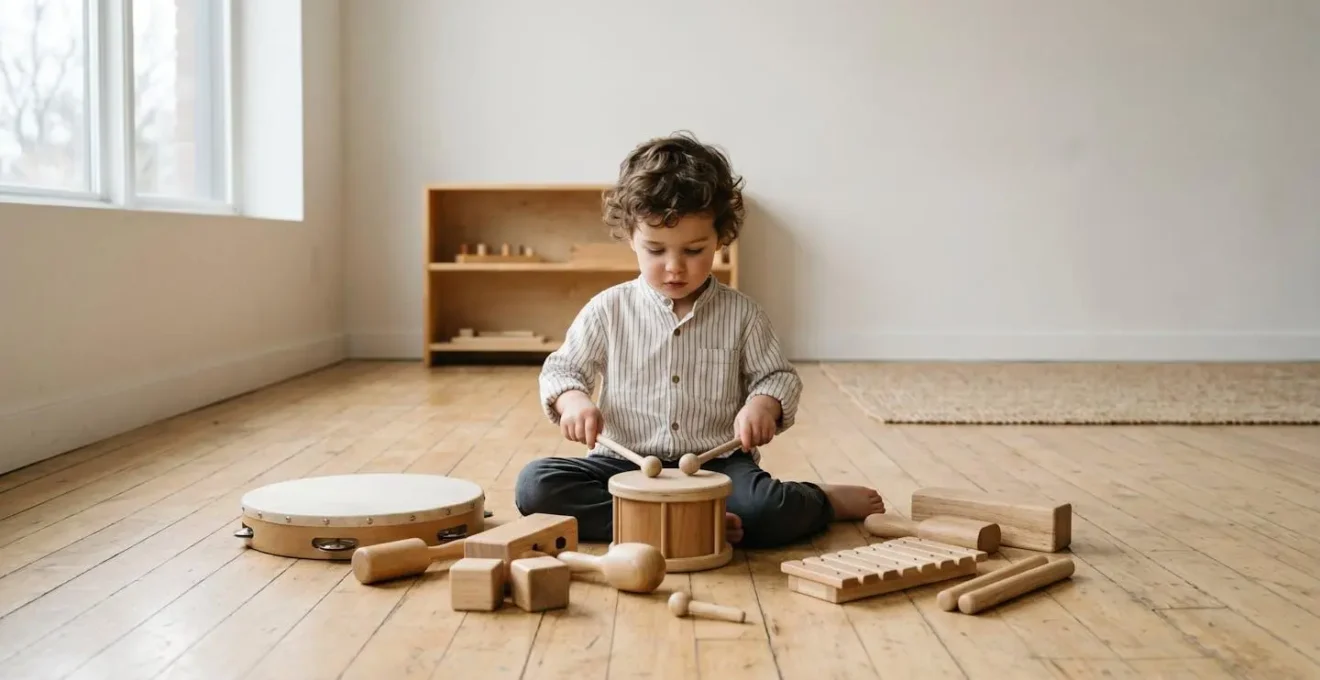
This is a crucial counterpoint to the more structured aspects of musical learning like rhythm and melody. While learning a song teaches convergent thinking (following a set pattern to arrive at a known outcome), improvised play teaches the opposite. It fosters the confidence to experiment without fear of failure. Many parents worry they can’t help their child with music if they aren’t musicians themselves. The reality is, for fostering creativity, your role is not to be a teacher, but a facilitator. Your job is simply to provide the tools—the shakers, the pots, the pans—and the safe space for your child to make their own glorious, wonderfully creative noise.
Bridging Hemispheres: Why Musicians Multitask Better Than Non-Musicians
Playing a musical instrument is one of the most complex, whole-brain activities a human can undertake. It requires the left hemisphere (responsible for logic, sequencing, and language) to work in seamless coordination with the right hemisphere (governing creativity, emotion, and spatial awareness). Both hands are often doing different, intricate tasks while the brain is simultaneously reading music, listening for pitch, and emotionally interpreting the piece. This constant, high-speed communication between the brain’s two hemispheres is facilitated by the corpus callosum, a thick bundle of nerve fibers.
Scientific evidence overwhelmingly shows that early and sustained musical training physically alters the structure of the brain, most notably by strengthening this inter-hemispheric bridge. This enhanced connectivity is a core component of the brain’s cognitive architecture, leading to more efficient information processing and improved multitasking abilities that extend far beyond music. A person with a more robust corpus callosum can integrate logical and creative information more effectively, solve problems more holistically, and switch between tasks more fluidly.
The timing of this training is critical. A landmark 2013 neuroscience study found that early-trained musicians (who started before age 7) had significantly greater connectivity in the corpus callosum compared to those who started later or not at all. This suggests a sensitive period in early childhood when music acts as a powerful catalyst for structural brain development. Further longitudinal research has confirmed this, showing that these changes are not pre-existing but are induced by the musical experience itself. The brain of a young musician is not just learning music; it is physically rebuilding itself to be a more integrated and efficient processing unit.
Pat-a-Cake to Polyrhythm: Building Hand-Eye Coordination Step-by-Step
Simple clapping games like « Pat-a-Cake » are more than just a way to pass the time; they are a foundational exercise in developing fine motor skills and hand-eye coordination. For a toddler, the act of bringing two hands together to meet in the middle of their body (crossing the midline) is a significant neurological achievement. When they progress to clapping games with a partner, the complexity skyrockets. They must now track a moving target (the partner’s hands), time their own movements precisely, and coordinate their actions with another person. This is a sophisticated dance of perception, prediction, and motor execution.
This process of learning to control the body in time with a beat directly translates to other skills. The ability to time a clap is related to the ability to time the swing of a bat or the kick of a ball. Research on music and motor development demonstrates that instrumental training in early childhood not only enhances fine motor skills but also results in measurable structural brain changes. The rhythmic precision required in music hones the brain’s ability to plan and execute movements.
As children grow, these simple claps can evolve into more complex polyrhythms—performing two different rhythms at the same time, such as tapping a steady beat with their feet while clapping a more complex pattern with their hands. This is an advanced form of motor planning and cognitive control. Each stage, from the simplest clap to a complex rhythm, builds upon the last, progressively refining the brain’s motor cortex. It’s a step-by-step curriculum for physical literacy, disguised as play.
Action Plan: Integrating Rhythmic Motor Skills at Home
- Identify Rhythmic Opportunities: List all the moments in your day where you can add a simple rhythm: diaper changes, mealtimes, bath time songs.
- Gather Your « Instruments »: Inventory household items that can be used for rhythm: wooden spoons, plastic containers, shakers made from rice in a bottle.
- Check for Engagement: Observe your child. Are they watching your hands? Are they trying to mimic the beat? Adjust the tempo and complexity based on their cues.
- Assess Coordination vs. Fun: Is the focus on perfect timing or joyful interaction? Prioritize connection first. The coordination will follow naturally.
- Create a « Next Step » Plan: If they’ve mastered clapping, introduce stomping. If they’ve mastered stomping, try clapping and stomping at the same time. Always have a slightly more complex challenge ready.
Key takeaways
- Music is not an accessory to development; it is a structural tool that builds the brain’s architecture for language, logic, and emotional intelligence.
- Active, interactive musical play is neurologically superior to passive listening, as it engages the brain’s motor and social circuits to create lasting change.
- The benefits of music are not just behavioral but physical, measurably enhancing connectivity in the brain and accelerating the maturation of key neural pathways.
Why Simple Rhythmic Activities Are Vital for Early Motor Development?
The first few years of life represent a period of explosive neurological growth. At its peak, neuroscience research reveals that the human brain forms one million new neural connections every second. During this critical window, the brain is exceptionally plastic, meaning it is highly responsive to experience. Simple rhythmic activities—bouncing, clapping, swaying—are not just motor actions; they are rich, multi-sensory experiences that feed this developing brain exactly what it needs: patterned, predictable, and repetitive input.
These activities are vital because they integrate multiple sensory systems simultaneously. When a child bounces to a beat, they are engaging their vestibular system (sense of balance), their proprioceptive system (sense of body position in space), and their auditory system (processing the rhythm). This integration is the bedrock of all coordinated movement. The brain is learning to create a unified « map » of the body and its relationship to the external world. A strong internal sense of rhythm helps to organize motor output, making movements smoother, more efficient, and more controlled.
Ultimately, this motor development is inextricably linked to cognitive development. The ability to perceive and produce a rhythm is a form of temporal processing—understanding and organizing events in time. This skill is foundational not only for motor tasks but also for cognitive ones, like following the sequence of a story or, as research shows, learning to read. The message from developmental science is clear: to build a sophisticated brain, you must first build a body that understands rhythm. The simplest activities are often the most profound, providing the essential input that wires the brain for a lifetime of learning and movement.
Now that you understand the profound neurological impact of early musical interaction, the next step is to consciously integrate these principles into your daily life. It’s not about becoming a professional musician; it’s about becoming an intentional musical partner for your child, using these simple, powerful tools to help build their incredible brain.