Many producers believe unique sound design requires expensive synthesizers and vast sample libraries. The truth is that the most original sonic palette imaginable is already waiting in your kitchen. The real art isn’t in acquiring more gear, but in learning how to listen differently. This guide is about sonic alchemy: a playful process of revealing the hidden acoustic soul of mundane objects and transforming them into extraordinary musical elements.
The blinking cursor on a blank project. The endless scroll through folders of sterile, overused sample packs. Every experimental musician knows the feeling: a creative block built from the sheer monotony of stock sounds. We’re told to be original, yet we’re handed the same box of sonic crayons as everyone else. The common advice for breaking out is often to « sample household objects, » which usually translates to banging on a few pots and pans to replace a standard drum kit. It’s a fun exercise, but it barely scratches the surface of what’s possible.
This approach misses the entire philosophy of Musique Concrète, the revolutionary art form that treated all sound—from a train whistle to a door creak—as potential musical material. It’s not about finding a substitute for a snare drum; it’s about discovering a sound that could never be a snare drum, a sound with its own unique story and textural DNA. This is the practice of sonic alchemy: transforming the mundane into the magical. It requires a shift in perspective, from merely recording objects to actively listening for their hidden potential, their unique acoustic fingerprint.
The goal is not to make a fork sound like a synth, but to make a fork sound like the most interesting version of itself. This involves capturing its micro-sonics—the scrape, the resonance, the subtle harmonic shimmer—and magnifying them into something entirely new. It’s a playful exploration of texture, rhythm, and narrative that can permanently change the way you hear the world around you.
This article serves as your map for that exploration. We will delve into the practical techniques and the artistic mindset needed to turn your kitchen into an endless source of inspiration, moving from the philosophical to the deeply practical.
Summary: From Kitchen Clatter to Sonic Canvases
- Capturing Texture: How to Record Rain Without Wrecking Your Mic
- Turning a Wine Glass Ping into a Lush Pad with Granular Synthesis
- Glitch Beats: Sequencing Percussion from Door Slams
- Copyright on the Street: Can You Sample a Tube Announcement Legally?
- Distortion and Reverb: Making a Radiator Sound Massive
- The Dilla Feel: Quantizing Off-Grid for Human Groove
- Character Themes: Telling a Story Without Words
- Sampling vs Synthesis: Crafting the Perfect Hip-Hop Beat
Capturing Texture: How to Record Rain Without Wrecking Your Mic
The first act of sonic alchemy is capturing the raw material. But a great field recording is not about pointing a microphone at a sound; it’s about capturing an atmosphere. Recording rain is a classic example. The challenge isn’t hearing the rain, but recording its delicate textures without the clumsy thuds of drops hitting your equipment. It’s an exercise in focused listening, a principle that applies to every object you’ll sample. As the experts at Mindful Audio put it when describing this exact challenge:
What I want is to completely avoid the thump sound that raindrops make when hitting the blimp. The only thing I want to record is rain falling on natural surfaces like leaves, wood, dirt, puddles, undergrowth.
– Mindful Audio, Recording clean rain sounds field recording guide
This mindset is crucial. You are hunting for the pure texture of the event, not the artifacts of the recording process. This often requires creative, do-it-yourself solutions to protect your gear while remaining acoustically transparent. For instance, instead of a standard plastic cover that creates unwanted noise, you can build a shield that absorbs the raindrop impact silently or use the environment itself as part of your setup.
Here are some practical steps inspired by field recording professionals to capture pristine rain textures:
- Build a natural-sounding shield using reticulated foam glued to a waterproof board, positioned above your microphones to absorb raindrop impact silently.
- Use contact microphones (piezos) attached to different surfaces like metal buckets, large leaves, or windowpanes to capture unique rain vibrations while keeping your main mics protected.
- Gather broad leaves from the environment and position them 30cm above your microphones using bungee cables for realistic rainfall protection that adds natural splatter sounds.
- Cover your recorder’s dry bag with moss or leaves to prevent artificial plastic-hit sounds from raindrops.
- Record a short percussive sound (like a twig snap) in the rainy environment to create a custom impulse response for convolution reverb, allowing you to place any sound in that exact rainy space later.
Turning a Wine Glass Ping into a Lush Pad with Granular Synthesis
Once you have a clean recording, the transformation begins. A simple, resonant « ping » from a wine glass holds a universe of sonic potential, and granular synthesis is the microscope that lets us explore it. This technique doesn’t play the sample back linearly; instead, it chops the recording into thousands of tiny fragments, or « grains, » and reassembles them into a continuous texture. This is where the Textural DNA of the sound is truly revealed.

By manipulating the size, pitch, and position of these grains, a short, percussive sound can be stretched into an evolving, shimmering pad that retains the original harmonic character of the glass. The magic happens when you focus on the microscopic details. According to industry-standard synthesis practices, these grains are often between 1 and 100 milliseconds long, allowing you to freeze a moment of the sound’s decay and turn it into a sustained note. Imagine taking just the metallic attack of the spoon hitting the glass and looping it into a sharp, rhythmic pulse, while the resonant decay becomes a soft, ethereal drone underneath.
The process is painterly. You can introduce randomization to the grain selection, creating a sound that flutters and shifts unpredictably. By modulating the grain’s starting point within the sample over time, you can create a pad that sweeps through the entire sonic event, from the initial bright attack to the final dark hum of the glass’s resonance. This isn’t just processing; it’s recomposition at the molecular level of sound.
Glitch Beats: Sequencing Percussion from Door Slams
Percussion is often the most intuitive entry point for sampling kitchen objects, but we can move beyond simple pot-and-pan drum kits. By deconstructing a single, complex sound event like a door slam, you can build an entire glitch percussion kit with a unified, cohesive acoustic fingerprint. A heavy wooden door closing doesn’t produce one sound; it produces a sequence of micro-events: the faint whoosh of air displacement, the solid thump of the wood hitting the frame, the sharp click of the latch, and the subtle rattle of the handle. Each of these components is a potential drum hit.
The trick is to isolate these moments. Using a transient shaper or careful editing in your DAW, you can chop that single slam into four or five distinct sounds. The « thump » becomes your kick drum. The « click » of the latch becomes your snare or sidestick. The « rattle » can be used as a hi-hat or a shaker. Because all these sounds originated from the same recording, they share a common acoustic space and harmonic character, giving your beat a uniquely organic and coherent feel that is impossible to achieve with disparate samples from a stock library.
Case Study: The Household Object Philosophy
Producer Francesco Pellegrin, known as Look Mum No Drums, has built his entire creative approach around this very concept. His methodology demonstrates how everyday closure sounds—from kitchen cupboards to microwave doors—can be deconstructed into distinct sonic components (whoosh, thump, rattle) and sequenced independently. By doing so, he builds complex glitch percussion kits that are entirely unique to his sonic environment, proving that a compelling rhythm section can be found in the most mundane of household interactions.
This method allows for incredible creativity. Sequence the sounds tightly for a sharp, mechanical groove, or spread them out for a loose, syncopated rhythm. Pan the « whoosh » to the left and the « rattle » to the right to create a wide stereo image. This isn’t just about finding sounds; it’s about composing with the inherent rhythm and texture of everyday physics.
Copyright on the Street: Can You Sample a Tube Announcement Legally?
As your sonic explorations move from the kitchen to the outside world, you’ll inevitably encounter sounds that feel loaded with narrative power: a distant train horn, a snippet of a street performer’s song, or the iconic « Mind the gap » announcement on the London Underground. This is where the creative impulse collides with a legitimate question: is this legal? The answer, like most things in copyright law, is complex and hinges on the doctrine of « Fair Use. »
Fair use is not a license to steal; it’s a legal framework that allows for the limited use of copyrighted material without permission under specific circumstances. The core principle is transformation. As the U.S. Copyright Office states, the goal is to create something new.
Transformative uses are those that add something new, with a further purpose or different character, and do not substitute for the original use of the work.
– U.S. Copyright Office, Fair Use Index – Section 107 Framework
The legal landscape for sampling was drastically altered in 1991, when the strict decision against rapper Biz Markie’s appropriation in Grand Upright Music, Ltd. v. Warner Bros. Records Inc. changed practices overnight, making sample clearance a major industry concern. To navigate this, courts generally weigh four factors to determine if a use is fair. Thinking through these factors before you release your track is a crucial part of the creative process.
Your Fair Use Evaluation Checklist
- Purpose & Character: Ensure your use is transformative (it adds new expression or meaning) rather than merely copying. Educational and non-profit uses are more favored than commercial ones. Are you commenting on the announcement, or just using it because it sounds cool?
- Nature of Work: Sampling factual works (like an automated public announcement) is more defensible than sampling highly creative works (like a melody from a song). The tube announcement is more factual than it is artistic.
- Amount Used: Use only the minimum portion necessary for your new work. The « 2-second rule » is a myth; even a tiny, recognizable snippet can be infringing if it’s the core « heart » of the original work.
- Market Effect: Your track should not harm the copyright holder’s ability to profit from their original work. It’s highly unlikely your glitch track will substitute for the transport authority’s need for public announcements.
While this isn’t legal advice, using a short, functional phrase like a tube announcement and transforming it through heavy processing into a rhythmic or textural element in a non-commercial project is far more likely to be considered fair use than looping a recognizable musical hook from a famous song.
Distortion and Reverb: Making a Radiator Sound Massive
Some of the most exciting moments in sonic alchemy come from a mismatch of scale: making a tiny sound feel enormous, or a huge sound feel intimate. Let’s take a humble radiator. A single « clank » or « hiss » recorded up close is small and thin. But with the right application of distortion and reverb, that same radiator can sound like a colossal, industrial machine in a vast, cavernous space.
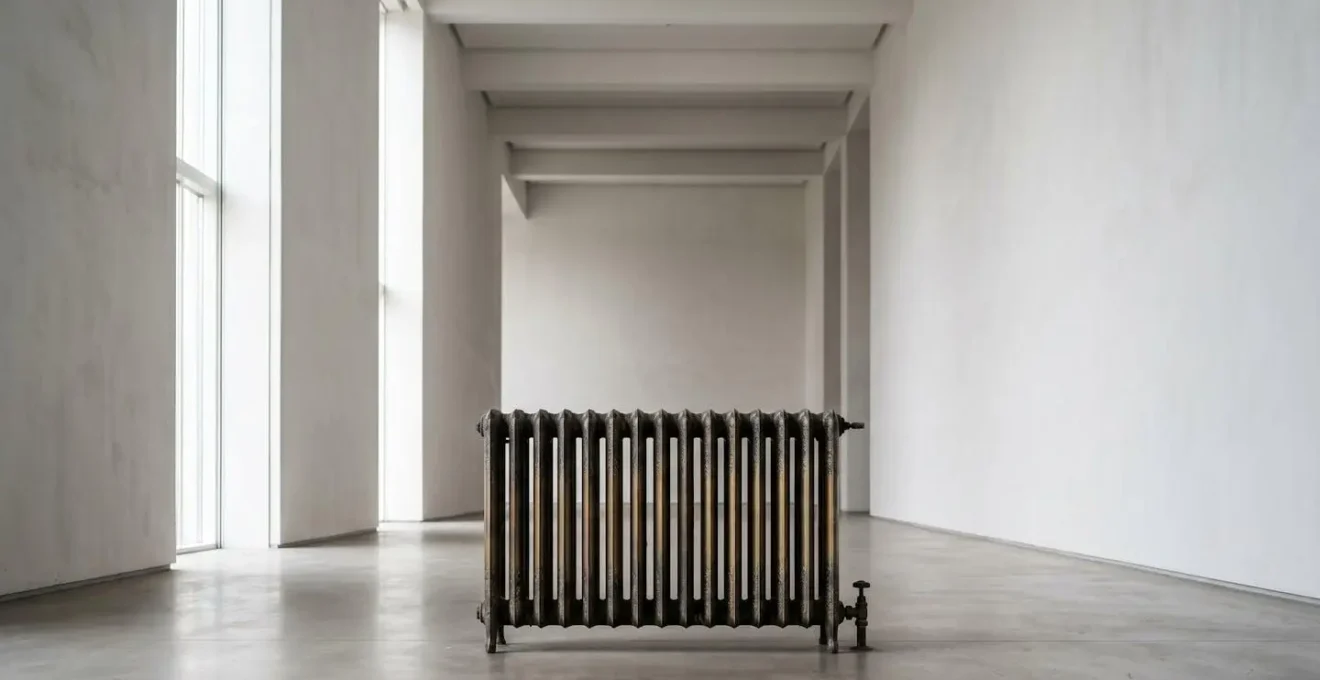
Distortion is the key to adding weight and harmonics. By applying saturation or overdrive, you introduce new frequencies that weren’t in the original recording. A gentle saturation can add warmth and body, making the radiator sound fuller. Heavy, aggressive distortion can completely reshape the sound, turning a metallic « ping » into a gritty, roaring blast. This process magnifies the hidden harmonic content of the original sound, making it feel larger and more complex.
After adding weight with distortion, you can create a sense of massive scale with reverb. But instead of a standard plate or hall reverb, consider using convolution reverb. This type of reverb uses an impulse response—a recording of a real space—to place your sound in that exact environment. Use an impulse response from a massive warehouse, a cathedral, or a cave. Now, your distorted radiator clank isn’t just a sound; it’s a sonic event happening in a huge, tangible space. The long, decaying reverb tail will give the listener the psychoacoustic cues of immense scale, transforming a simple kitchen object into a cinematic sound effect.
The Dilla Feel: Quantizing Off-Grid for Human Groove
So far, we’ve focused on the source of the sound. But sonic art is just as much about *when* the sound is played as *what* the sound is. In the age of digital audio workstations, it’s easy to snap every beat perfectly to the grid. This creates tight, mechanical rhythms, but it often lacks the vital, living element of human feel. The legendary producer J Dilla was a master of breaking free from this rigidity, creating a signature « drunken » or « lazy » groove that felt profoundly human.
Dilla’s magic wasn’t just a single « swing » setting. While there is still debate over his exact methods, analysis reveals that his signature feel often came from a specific range, applying around 53%-56% swing on eighth notes. However, his genius lay in how he combined different rhythmic feels within the same beat. He would often disable quantization entirely and play his drum parts by hand, introducing the subtle, natural timing variations that even the best musicians have. He would then selectively quantize certain elements while leaving others loose, creating a complex rhythmic push and pull.
Dilla didn’t just rely on machine settings. His beat-making genius lay in blending swung and straight notes in unexpected ways. His hi-hats might be played freehand, while his snares are slightly early and his kicks delayed, creating a complex interplay of rhythms that no preset swing setting could replicate.
– Big Noise Radio, Dilla Time Simple Complex Revolutionary Beat Maker Techniques
You can apply this philosophy to your kitchen-object beats. After sequencing your door-slam percussion, try manually nudging the « snare » (the latch click) a few milliseconds early. Delay the « kick » (the thump) slightly. Turn off the grid and tap in a hi-hat pattern using the sound of sizzling bacon. By combining the rigid timing of the machine with the organic imperfection of human performance, you create a groove that breathes. This is the rhythmic equivalent of sonic alchemy, transforming a sterile sequence into a living, breathing performance.
Character Themes: Telling a Story Without Words
The most advanced form of sonic alchemy transcends sound design and enters the realm of storytelling. Every sound you sample can be imbued with meaning and used to represent a character, an emotion, or a place. This is the art of narrative sampling, where your choice of sounds is driven by the story you want to tell, not just their sonic coolness. The kitchen, a place of transformation and nourishment, is a perfect stage for this.

Imagine you are scoring a short film about a tense family dinner. A sharp, metallic chop from a knife on a wooden board could become the theme for an aggressive, critical character. Every time they speak, a heavily processed version of that chop appears in the score. In contrast, the gentle, bubbling sound of a simmering pot could represent a peaceful, mediating character. The nervous, repetitive clicking of a gas stove ignitor could symbolize rising anxiety in the room. These aren’t just background sounds; they are leitmotifs that tell the audience how to feel on a subconscious level.
Your job as a sonic artist is to cast these objects in their roles. Record a collection of sounds that feel related to a specific theme or character. The sound of a cork popping could be celebration or release. The slow, melancholic drip of a faucet could be loneliness or the passage of time. By building a sonic library around narrative concepts, you move from being a beat-maker to being a storyteller. Your kitchen isn’t just a source of sounds; it’s a cast of characters waiting for their story to be told.
Key Takeaways
- Listen for Texture, Not Just Hits: The most interesting part of a sound is often in its decay, resonance, or the subtle noises before the main impact. Capture the entire sonic event.
- Transformation Is the Goal: Don’t just replicate instruments. Use tools like granular synthesis, distortion, and creative reverb to turn a mundane sound into something entirely new and unrecognizable.
- Embrace the Human Element: Perfect timing is boring. Use off-grid quantization, manual nudging, and live performance to give your found-sound beats a living, breathing groove.
Sampling vs Synthesis: Crafting the Perfect Hip-Hop Beat
Ultimately, the modern producer’s toolkit contains two powerful paths to sound creation: sampling, the art of manipulating recorded audio, and synthesis, the art of generating audio from scratch. In our journey of sonic alchemy, the lines between these two often blur. The question isn’t which one is better, but how they can be combined to serve the final track. A hybrid approach often yields the most compelling and unique results, especially in genres like hip-hop that have a rich history in both.
As EDMProd notes in their guide, sampling offers an authenticity that synthesis struggles to replicate. As they state, « It yields interesting and unique results that you can’t get with synthesis alone—beautiful layers of instruments, weaving in and out of each other, recorded in exact ways. » Synthesis, on the other hand, provides unparalleled control and cleanliness, particularly in the low end. By understanding the strengths of each, you can build a track that has both character and power. This table, based on an analysis of hybrid production techniques, breaks down how to combine these worlds.
| Aspect | Sampling Approach | Synthesis Approach | Hybrid Recommendation |
|---|---|---|---|
| Low-End Foundation | Organic thump with character but inconsistent frequency response | Clean, powerful sub-bass with precise frequency control | Synthesized sub-bass (for consistency) layered with a sampled kick thump (for texture) |
| Sound DNA | Authentic real-world textures impossible to recreate | Mathematically pure waveforms, predictable behavior | Load kitchen samples into a wavetable synth as the oscillator source |
| Workflow Speed | Requires sample hunting, chopping, and clearing | Instant sound generation from presets or programming | Use samples for the percussive core, and synths for melodic contrast |
| Creative Flexibility | Limited by source material characteristics | Unlimited parameter modulation and morphing | Process samples through synthesis engines (like granular or FM) |
| Authenticity | Grounds the beat in tangible, familiar reality | Creates futuristic, otherworldly contrast | Gritty kitchen samples for the drums, with synthesized pads for atmosphere |
The truest form of sonic alchemy happens here, at the intersection. Take your wine glass sample and load it into a wavetable synthesizer to create an oscillator that is both organic and infinitely malleable. Layer the « thump » of a closing cabinet with a clean, synthesized 808 sub-bass to get the perfect kick: one with real-world character and digitally precise power. The kitchen provides the soul; the synthesizer provides the control.
Your journey into sonic alchemy begins now. Grab a microphone, open your kitchen drawers, and start listening not for what an object is, but for what it could become. Record everything, play with everything, and transform the sounds of your daily life into your next piece of sonic art.