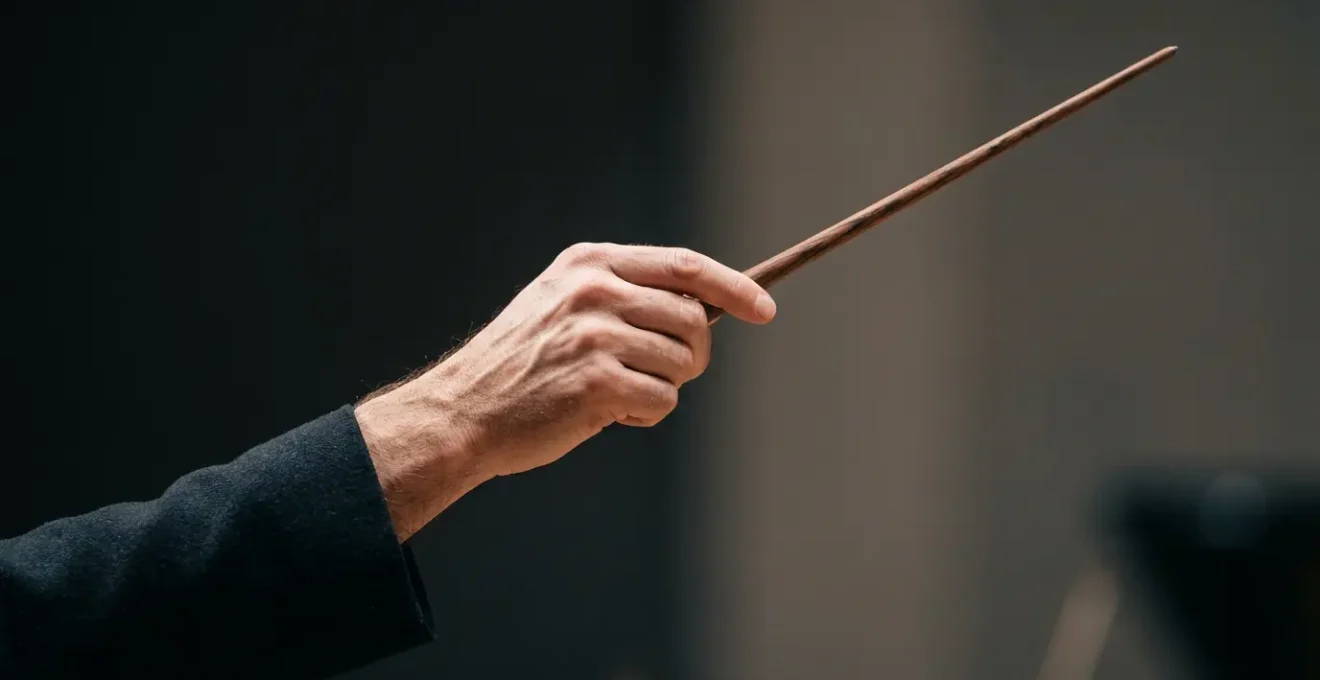
Effective conducting is not the art of time-keeping, but the science of shaping human response through silent, predictive leadership.
- A conductor’s primary role is to build a shared mental and emotional framework—a « cognitive architecture »—for the musicians before a note is even played.
- Gestures are a sophisticated language where the right hand manages structure (tempo) and the left hand manages soul (expression), creating a complete narrative.
Recommendation: Shift your focus from merely « showing the beat » to strategically communicating intent, emotion, and structure with every movement.
The concert hall falls silent. A single figure raises a baton, and in a moment of suspended energy, eighty individuals breathe as one, poised to unleash a torrent of coordinated sound. This is the singular power of the conductor, a leader who commands immense complexity, inspires emotional depth, and ensures technical precision without uttering a single word. For the aspiring conductor, the mystery is profound. How is this silent authority achieved? What information is encoded in the subtle arc of a hand or the intensity of a gaze?
Many believe the conductor’s role is simply to beat time, a human metronome ensuring no one gets lost. While rhythmic integrity is foundational, it is merely the canvas. True conducting transcends mechanics. It is a deep exercise in non-verbal communication and psychological influence. The real work lies in making the music’s performance an inevitability, not a reaction. It involves building a complete interpretive world in the minds of the players long before the downbeat falls. This requires a profound understanding of the score, the people in the ensemble, and the very space in which the music will live.
But if the secret isn’t just in mastering beat patterns, where does it lie? The answer is in viewing the role not as a director, but as a cognitive architect. The conductor’s responsibility is to construct the entire emotional and structural blueprint of the piece for the orchestra. This guide will deconstruct that silent language. We will explore how a conductor unifies a large group, uses each hand for a distinct purpose, internalizes the music’s narrative, and manages the delicate human dynamics of a high-performance team. It is a journey from simple gesture to profound leadership.
This article explores the core facets of this silent leadership, breaking down the techniques and philosophies that transform a time-beater into a true maestro. The following sections will guide you through the essential skills required to lead from the podium.
Summary: The Conductor’s Baton: Leading Without Speaking a Word
- The Breath Before: How to Start 80 People Together
- Right for Tempo, Left for Expression: Splitting the Brain
- Memorizing the Map: How to Learn a Symphony Before the Rehearsal
- Managing Egos: Correcting the First Chair Violin Without Conflict
- Small Box vs Big Box: Adjusting Gestures for the Room Size
- Theme A vs Theme B: Identifying the Characters of the Story
- Section Leader: Managing Peers Without Being Bossy
- Why Joining the School Band Teaches More Than Just Music?
The Breath Before: How to Start 80 People Together
The single most challenging and defining act for a conductor is the very first note. Uniting dozens of musicians into a single, cohesive attack is not a matter of a sudden downbeat. It is a process of creating anticipatory synchronization. The gesture that precedes the sound—the preparation—is everything. This preparatory beat doesn’t just say « get ready »; it communicates the exact tempo, dynamic level, and emotional character of the music that is about to happen. The musicians don’t react to the downbeat; they arrive at it with the conductor because the preparation has already given them all the necessary information.
This is more than just a learned technique; it’s a deep neurological phenomenon. As conductor Kentaro Ono notes, « Orchestra musicians have developed an advanced ability to predict conductor’s next action from the gestures. » This predictive ability is a form of shared consciousness, built through rehearsal and intense focus. The conductor’s initial gesture—often a simple, unified breath mirrored by the ensemble—creates a common mental space. It establishes a shared pulse and intention, making the unified start feel less like a command and more like a collective exhale. The silence *before* the note is where the true leadership begins, filled with potent, predictive information.
This process of mental alignment is observable in the brain. Neuroscience research reveals that musicians show stronger brain activity in specific regions when synchronizing with conductors, demonstrating a capacity to mentally simulate and predict the conductor’s intentions. It’s not magic; it is a highly developed skill of non-verbal communication where the conductor builds a consensus on « when » and « how » before the moment arrives. The first note is merely the confirmation of an agreement already made in silence.
Right for Tempo, Left for Expression: Splitting the Brain
Once the music is underway, the conductor’s hands become a dynamic, dual-channel communication system. A common, though slightly simplified, paradigm is that the right hand (typically holding the baton) is the architect of time and structure, while the left hand is the painter of emotion and color. This division of labor allows for a remarkable density of information to be transmitted simultaneously. The right hand is the seat of rhythmic integrity. It carves the beat patterns in space, defining the tempo, meter, and crucial rhythmic articulations like accents or staccatos. Its clarity is paramount; the crisp point at the bottom of the beat, known as the ictus, is the anchor for the entire ensemble.
In contrast, the left hand operates with a greater degree of freedom. It is the poetic, persuasive voice of the conductor. As conductor Ming Luke explains in an interview:
The left hand oftentimes is considered to be the artistic side and it shows dynamic, shows entrances, and is much more fluid and is not tied down to the rhythmic integrity of the work.
– Ming Luke, People Who Read People Podcast interview
This hand signals for crescendos by rising, calls for quiet with a gentle lowering, cues a specific section with an inviting gesture, or shapes a lyrical phrase with a smooth, horizontal arc. It is where the conductor moves from being a timekeeper to an interpreter, molding the sound in real time.
The image below visualizes this fundamental contrast, embodying the conductor’s dual role as both a precise architect and an expressive artist.
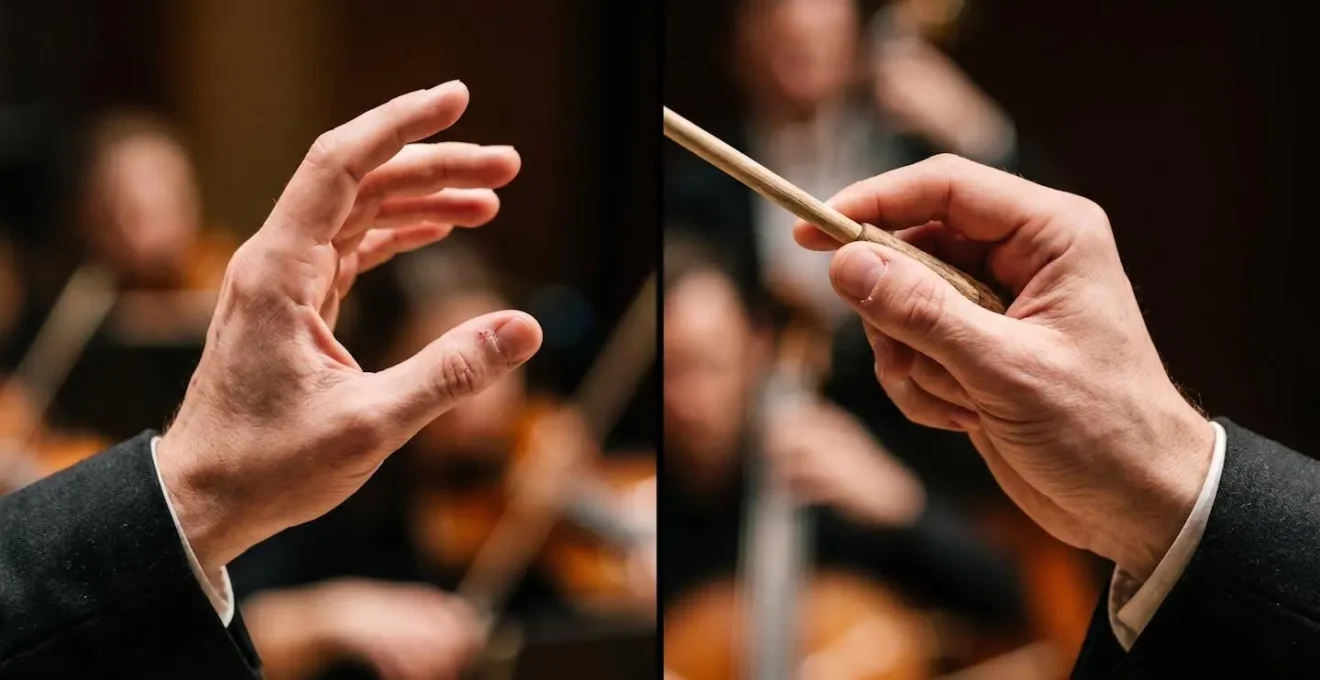
Mastering this « split brain » approach is a core challenge. It requires the conductor to maintain an unwavering structural foundation with one hand while simultaneously layering in nuanced, expressive instructions with the other. It is this combination of the metronomic and the poetic that brings a musical score to life with both precision and soul.
Memorizing the Map: How to Learn a Symphony Before the Rehearsal
A conductor steps onto the podium not to discover the music with the orchestra, but to guide them through a landscape they have already intimately mapped. The immense work of conducting happens alone, in quiet study, long before the first rehearsal. Learning a symphony is not about rote memorization of notes; it is about building the cognitive architecture of the entire work. This means understanding its form, its harmonic language, its thematic development, and its emotional journey from beginning to end. The score is a blueprint, and the conductor must become its master architect.
This deep study involves several layers. First is the structural analysis: identifying the major sections, key changes, and transitional passages. Next is the harmonic analysis: understanding the chord progressions that create tension and release. Then comes the most crucial part for interpretation: the thematic analysis. The conductor must identify the main melodic ideas—the « characters » of the story—and trace their evolution throughout the piece. How does a theme change when it reappears? Is it triumphant, tragic, or fragmented? Answering these questions informs every gestural choice.
Only after this intellectual work is complete can the conductor begin to plan the gestural narrative. This involves choreographing the physical movements that will communicate the architectural and emotional map to the musicians. Where will a crescendo peak? What kind of gesture will elicit the right articulation for a playful passage? How will the transition to the slow movement be handled to shift the mood? The conductor pre-visualizes the entire performance, so that in rehearsal, their energy is dedicated to listening and refining, not deciphering the map.
Action Plan: Your 5-Step Score Study Framework
- Macro-Structural Analysis: Before playing a note, map out the large-scale form (e.g., Sonata Form: Exposition, Development, Recapitulation). Mark these sections directly in your score to create a high-level roadmap.
- Harmonic & Thematic Inventory: Identify the primary and secondary themes (Theme A, Theme B). Analyze the key harmonic areas and cadences that define the musical journey. Color-code these themes for easy visual tracking.
- Character & Narrative Plotting: For each theme, assign descriptive words (e.g., « heroic, » « lyrical, » « menacing »). Write a one-sentence story of what happens to these themes throughout the piece.
- Gesture Pre-visualization: At critical moments (climaxes, transitions, solos), decide on the specific gesture you will use. Practice these gestures away from the score until they are second nature.
- Section-Specific Check-in: Go through the score from the perspective of each major section (e.g., first violins, low brass). Identify their most challenging passages and moments where they will need a particularly clear cue.
Managing Egos: Correcting the First Chair Violin Without Conflict
An orchestra is a collection of highly skilled, dedicated professionals, many of whom are soloists in their own right. Correcting an error, especially from a principal player like the first chair violin, is one of the most delicate tasks a conductor faces. Yelling or singling out a player is a mark of an amateur; a maestro achieves correction through subtlety, respect, and the power of non-verbal suggestion. The key is to depersonalize the feedback, making it about the music, not the musician. This requires creating a small amount of psychological distance while simultaneously offering a clear, positive solution.
Instead of stopping and verbally correcting, an effective conductor might use a more expressive gesture on the second attempt of a passage. By slightly exaggerating the desired articulation or dynamic with their left hand, or by making their beat pattern more lyrical or more marcato, they offer a physical model of the solution. This respects the musician’s expertise by assuming they can see and interpret the refined instruction without needing it spelled out. A simple, encouraging smile or nod after the corrected passage is played successfully closes the feedback loop positively, reinforcing the collaborative spirit.
The power of these gestures is not just perceived by the musicians; it’s tangible to the audience as well. Fascinatingly, research published in Frontiers in Psychology demonstrates that listener evaluations of a performance change based on the conductor’s visual gestures, even when the audio is identical. An expressive, clear conductor leads listeners to perceive the music as having better tone quality and being more expressive. This proves that the conductor’s physical communication is not just for the players—it shapes the entire experience. When correcting a player, a clear, positive gesture not only fixes the issue but also projects confidence and musical integrity to everyone in the hall.
Small Box vs Big Box: Adjusting Gestures for the Room Size
A conductor’s gestures do not exist in a vacuum; they inhabit and define a physical space. The size and nature of these gestures must be meticulously calibrated to the performance venue, the size of the ensemble, and the character of the music. This concept of volumetric influence dictates that the conductor’s physical presence must psychologically fill the room. A gesture that is perfectly clear in a small rehearsal studio can feel timid and lost in a 2,000-seat concert hall. Conversely, a grand, sweeping motion appropriate for a Mahler symphony would feel chaotic and overbearing in an intimate performance of a Mozart string quartet.
The « box » is a common pedagogical tool referring to the area in front of the conductor where the beat pattern is executed. A « small box » gesture, kept close to the body with minimal arm extension, is ideal for soft passages, smaller ensembles, or music requiring extreme precision and delicacy. It draws the musicians’ focus inward, fostering a sense of intimacy and control. The baton, if used, acts as a fine-tipped pen, its sharp point defining the ictus with surgical precision for just a few players to see.
In contrast, a « big box » gesture is used for loud dynamics, large orchestral forces, and moments of epic emotional scale. The arms extend wider and higher, engaging the back and torso to project energy throughout the entire space. The gesture needs to be legible to a percussionist fifty feet away, not just the concertmaster at arm’s length. Here, the baton acts as a powerful focal point, extending the conductor’s reach and making the beat visible from the back of the stage. The art lies in seamlessly transitioning between these scales, matching the physical volume of the gesture to the acoustic volume of the music, and ensuring that every movement is perfectly proportional to its musical and environmental context.
Theme A vs Theme B: Identifying the Characters of the Story
Beyond the technical layers of harmony and rhythm, a piece of music is fundamentally a narrative. It has characters, conflicts, and resolutions. The conductor’s highest calling is to be a storyteller, and the « characters » in this story are the musical themes. In many classical forms, especially Sonata Form, the entire structure is built on the interplay between a primary theme (Theme A) and a secondary theme (Theme B). Identifying and personifying these themes is the first step toward crafting a compelling gestural narrative. Is Theme A bold and heroic? Is Theme B gentle and lyrical? Is their interaction a dialogue, a conflict, or a transformation?
The conductor must embody the character of each theme in their physicality. A strong, martial theme might be conducted with sharp, angular gestures and an intense posture. A flowing, romantic theme would call for smooth, circular motions and a more fluid, open stance. When these themes are in counterpoint, playing simultaneously, the conductor must show this tension in their body, perhaps by directing a sharp gesture with the right hand to the brass section playing Theme A, while cueing the strings playing Theme B with a soft, legato gesture from the left. This physical storytelling makes the abstract structure of the music visible and emotionally resonant.
This visual component of performance is not merely decorative; it is integral to how meaning is communicated and perceived. As a meta-analysis by Platz and Kopiez concluded, « The visual component is not a marginal phenomenon in music perception, but an important factor in the communication of meaning. » The audience, just like the musicians, reads this gestural story. The conductor’s ability to physically differentiate the musical characters is what elevates a performance from a technically accurate recitation of notes to a living, breathing drama.

By treating the score as a script and the themes as characters, the conductor unlocks a deeper level of interpretation, transforming the podium into a stage for silent opera.
Section Leader: Managing Peers Without Being Bossy
The conductor is the ultimate authority, but they do not lead alone. The orchestra’s leadership structure is layered, with section leaders (or principals) acting as crucial middle managers. The principal of the first violins, the lead trumpet, or the principal clarinet is responsible for their section’s unity, intonation, and articulation. They are player-coaches, tasked with the difficult job of leading their peers. A conductor’s communication is often directed at the section leader, who is then responsible for disseminating that information throughout their section, often through their own playing or a subtle glance.
This dynamic requires a unique leadership style, one based on influence rather than formal authority. A section leader cannot be « bossy »; they must lead by example. Their role is to translate the conductor’s often abstract artistic vision into concrete, technical advice for their colleagues. As Cambridge Insights Leadership Research puts it:
The section leader’s critical role is translating the conductor’s abstract artistic vision into concrete technical advice, perfectly defining the value of middle management: translating high-level corporate strategy into actionable, specific tactics.
– Cambridge Insights Leadership Research, Leading like a conductor: the art of influence and direction
An effective conductor understands and empowers this structure. They build a strong rapport with their section leaders, trusting them to manage their teams. This allows the conductor to focus on the macro-level interpretation of the music, confident that the micro-level details are being handled by a capable and aligned leadership team within the orchestra.
Case Study: The League of American Orchestras’ Leadership Model
The challenge of peer leadership is so central to orchestral success that it has become a focus of formal training. The League of American Orchestras has developed comprehensive leadership programs designed for musicians and managers. Their ‘Essentials of Orchestra Management’ curriculum specifically addresses the skills needed to lead without direct authority—the core task of a section leader. The program focuses on building collaborative relationships and translating high-level artistic goals into actionable guidance, acknowledging that the « player-coach » is a critical and complex role that bridges the gap between the podium and the players.
Key takeaways
- Leadership is Predictive, Not Reactive: The most important work happens in the silence before the note, by creating a shared anticipation of tempo, character, and dynamics.
- Gestures are a Narrative Language: Conducting transcends time-keeping. It’s about telling the music’s story by embodying its characters and conflicts through physical expression.
- Influence Over Authority: Effective leadership in an ensemble relies on empowering section leaders and providing clear, non-verbal solutions rather than verbal criticism.
Why Joining the School Band Teaches More Than Just Music?
The discipline, focus, and non-verbal communication skills honed on the conductor’s podium and within the orchestra have applications that extend far beyond the concert hall. Participating in a school band or orchestra is a powerful incubator for essential life skills. It is an environment where individual accountability is inextricably linked to collective success. A single musician playing out of tune or out of time can compromise the entire group’s performance. This fosters a profound sense of personal responsibility and group awareness from a young age.
Furthermore, ensemble playing is a masterclass in collaboration and real-time problem-solving. Musicians learn to listen intently to those around them, adjusting their own pitch, volume, and timing to blend into a cohesive whole. They learn to follow a leader—the conductor—interpreting complex, non-verbal instructions and translating them into precise actions. They also learn to lead and be led by their peers within their section. This dynamic teaches resilience, adaptability, and the subtle art of communication in a high-stakes environment where there are no do-overs.
The cognitive benefits are also immense. Research consistently shows that musical training enhances executive functions like working memory, attention control, and cognitive flexibility. A 2024 study published in PLOS ONE found that young musicians in ensembles reported significant growth in cognitive, emotional, and social-relational skills. The complex task of reading music, interpreting it, executing it on an instrument, and synchronizing with dozens of others simultaneously is a formidable workout for the brain. It builds neural pathways that support learning in all academic fields, making music education not an extracurricular luxury, but a core component of developing a well-rounded, capable, and collaborative individual.
Therefore, stepping onto the podium or into the rehearsal room is not just an artistic pursuit; it’s a foundational experience in leadership, collaboration, and disciplined excellence. Begin today to view your musical practice not just as perfecting notes, but as cultivating the skills of a silent leader.