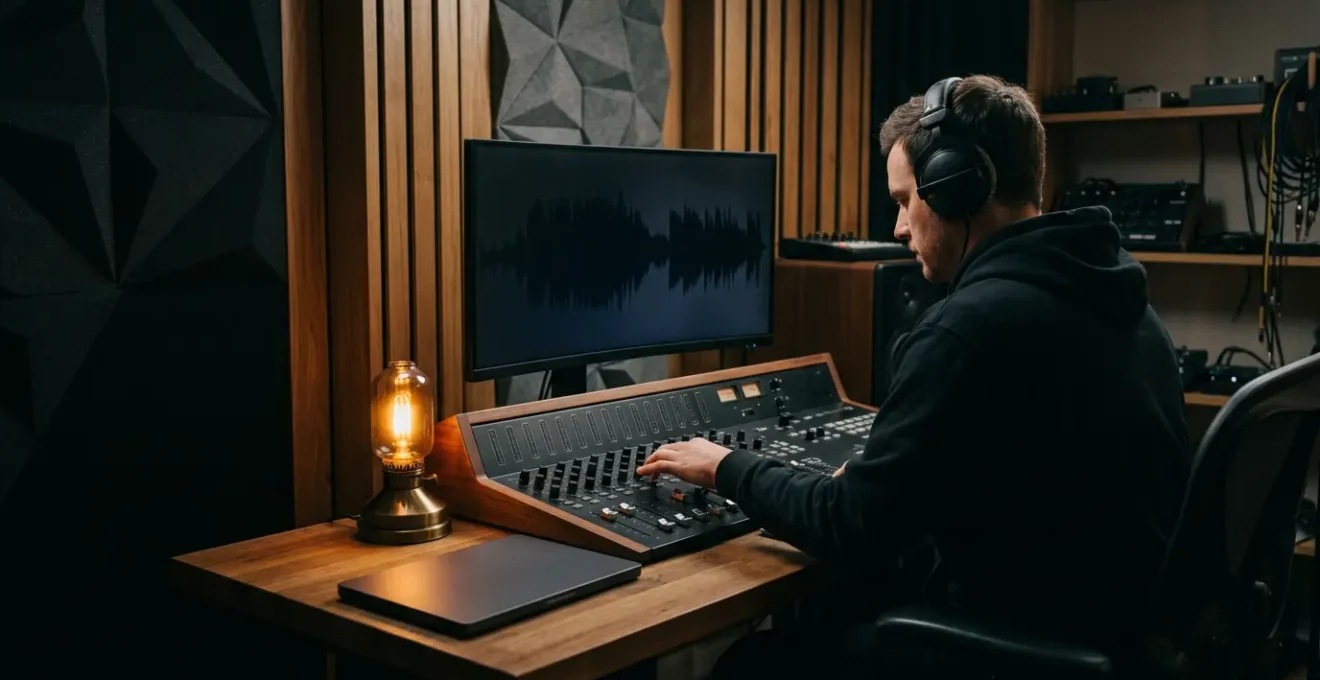
The common belief is that a producer’s job is to master the recording software, but the truth is that technology is the least important part of the role.
- A producer’s primary function is psychological and strategic: to unearth an artist’s core identity and build a sonic world around it.
- The biggest hits are determined by song selection and performance quality long before the final mix is even considered.
Recommendation: Stop thinking like a technician and start acting like an architect. Your true value lies in your vision, your taste, and your ability to guide an artist toward their most authentic self.
If you’re an aspiring producer, you’ve probably spent countless hours learning your DAW, collecting plugins, and perfecting your mixing techniques. The common wisdom tells you that technical mastery is the path to success. You’re taught to focus on making beats, achieving a « professional » sound, and networking to get your music in front of artists. This is the well-trodden path, the one that creates competent technicians.
But it’s a path that misses the point entirely. I’ve been in the rooms where platinum records were born, and I can tell you the magic rarely comes from a new compression technique or a clever EQ trick. The real work, the work that defines careers, is not technical—it’s visionary. What if the key to becoming a legendary producer wasn’t about what you do with your hands on a console, but what you build in the mind of the artist and the heart of the listener? The greatest producers are not just recorders of music; they are architects of sonic identity.
This guide isn’t about which plugins to use. It’s about the mindset that separates the beat-makers from the visionaries. We will explore the producer’s role as a strategist, a psychologist, and a ruthless editor. You will learn to identify a hit before it’s recorded, create the environment for a career-defining performance, and understand that sometimes, the most powerful tool in your arsenal is the mute button. This is about shaping an artist’s entire sonic universe.
To truly understand how a producer transforms from a technician into a visionary, we need to break down the core pillars of the craft. The following sections will guide you through the strategic decisions and psychological insights that shape an artist’s career, long before the audience hears a single note.
Summary: The Producer as Visionary: Shaping the Sonic Identity of an Artist
- Song Selection: Why the Hit is Decided Before Recording Starts
- Getting the Take: Psychology of Making a Singer Comfortable
- Kill Your Darlings: Knowing When to Mute the Guitar Solo
- Sonic Benchmarking: Using Hits to Guide the Mix Direction
- Time is Money: Finishing the Album Before the Cash Runs Out
- The Dilla Feel: Quantizing Off-Grid for Human Groove
- Talent Scout: What Does an A&R Actually Do in 2024?
- Beyond the Star: Understanding Career Roles Driving Musical Creation
Song Selection: Why the Hit is Decided Before Recording Starts
Let’s start with a sobering reality. In today’s saturated market, where industry data shows that over 103,500 new tracks are uploaded to streaming platforms every single day, a mediocre song with a great production is just more noise. Your first and most critical job as a producer isn’t to turn knobs; it’s to be a filter. You are the gatekeeper of quality, and the most important decision you will ever make happens before you press « record. » It’s the selection of the song itself. An A+ song with a B- production will always outperform a C-level song with an A+ production. Always.
This is the pre-production phase, and it’s where albums are made or broken. Your role is to sit with the artist and listen, not just to the demos, but to the stories behind them. What song best represents their sonic DNA? Which one has a melodic hook that you can’t shake after one listen? Which lyrics feel undeniably true? You have to be ruthless. You’re not there to be a friend who loves everything; you’re the visionary who can see the finished sculpture inside the block of marble. This means having the courage to say, « This isn’t the one, » or « This chorus needs a total rewrite. »
This early-stage curation is the highest-leverage activity you can perform. As the legendary producer Rick Rubin has noted, this foundational work is what separates good from great.
It’s the pre production time that really makes all the difference.
– Rick Rubin, Rick Rubin: In the Studio
By focusing intensely on the material before the clock starts ticking in an expensive studio, you are not only saving time and money, but you are also setting the project’s emotional north star. You are deciding what story you want to tell, and that clarity will guide every subsequent decision, from microphone choice to the final master.
Getting the Take: Psychology of Making a Singer Comfortable
Once you have a great song, the next challenge is capturing a great performance. A vocal take is not just a recording of a voice; it’s a recording of a feeling. The most technically perfect singer will sound hollow and uninspired if they are nervous, intimidated, or uncomfortable. Your role here shifts from strategist to psychologist. You must create an environment of profound psychological safety where the artist feels free to be vulnerable, to experiment, and to fail without judgment. This is where career-defining takes are born.
This process begins the moment the artist walks into the studio. It’s in the way you greet them, the lighting you choose, and the care you take during setup. Don’t just throw up a microphone and say « go. » Take the time to talk, to connect, and to build a rapport that has nothing to do with music. Make them feel like the most important person in the world, because for that session, they are.

The environment should be a sanctuary, free from distractions. That means no entourage hanging out on the couch, no phones buzzing, and no sense of a ticking clock. As a producer, you absorb the pressure so the artist doesn’t have to. You project calm, confidence, and unwavering belief in their ability. Your energy dictates the energy of the room.
Case Study: The Nashville Session
A producer working on a week-long vocal session in Nashville demonstrated this principle perfectly. Instead of rushing to record, he spent significant time building rapport with the singer during the microphone setup and soundcheck. He treated this relationship-building as an essential part of the recording process, not an optional extra. By establishing comfort and trust before the « real » recording began, he fostered an atmosphere where the vocalist could deliver raw, authentic performances. The result was a collection of takes that felt deeply personal and emotionally resonant, something that rushing the process would have made impossible.
Kill Your Darlings: Knowing When to Mute the Guitar Solo
You’ve got a great song and a stunning performance. Now comes the most painful, yet most powerful, part of production: editing. This is the art of strategic reduction. It’s the process of stripping a song down to its absolute essence, removing anything that doesn’t serve the core emotional message. This is often referred to as « killing your darlings »—that brilliant guitar solo, that clever synth pad, that intricate drum fill that you love, but the song doesn’t need. Your job is to serve the song, not the ego of any individual musician, including your own.
Every element in a track must have a purpose. If it doesn’t add to the story, it detracts from it. A cluttered mix is a sign of indecision. A sparse, impactful mix is the mark of a confident producer who knows what the song is about. Ask yourself for every single part: does this make the vocal hit harder? Does this amplify the feeling of the chorus? If the answer is no, or even a hesitant « maybe, » mute it. Listen again. If the song feels better without it, the decision is made. It has to go.
This philosophy of reduction over addition is a hallmark of many of the world’s greatest producers. It’s about creating space so the important elements can breathe and land with maximum impact.
Reduce something to the point that its identity is challenged.
– Rick Rubin, The Creative Act: A Way of Being
Case Study: The Creation of Kanye West’s ‘Yeezus’
During the production of Kanye West’s groundbreaking album *Yeezus*, Rick Rubin was brought in to apply his philosophy of radical reduction. The album originally consisted of 16 dense songs. As documented in a profile on the collaboration, Rubin’s breakthrough suggestion was not to add more, but to take away. He encouraged making the album more concise and focused. This led to a final 10-song tracklist. Throughout the process, the mantra was subtraction; removing layers to make the album feel more « edgy and minimal and hard. » This act of strategic reduction became the album’s defining sonic characteristic and its core identity.
Sonic Benchmarking: Using Hits to Guide the Mix Direction
While your goal is to help an artist find their unique sonic DNA, you are not creating in a vacuum. To ensure your production translates in the real world, you need a map. That map is created through sonic benchmarking: the process of using existing hit songs as reference points to guide your mixing and mastering decisions. This is not about copying; it’s about calibrating your ears and your creative choices against tracks that have already proven to connect with a wide audience.
The process is simple but disciplined. Before you start a mix, you and the artist should agree on a handful of reference tracks. As production experts recommend using 3 to 5 tracks, this allows for a triangulated approach. You aren’t trying to sound exactly like any single one, but rather to understand the professional standards for your genre. As Wisseloord Studios wisely points out, each reference can serve a different purpose:
One might have perfect vocal clarity, another might nail the low-end balance, and a third might showcase ideal stereo width.
– Wisseloord Studios, The Power of Reference Tracks in Production
By A/B testing your mix against these benchmarks, you can quickly identify where your track might be falling short. Is your low end muddy compared to the reference? Is your vocal getting lost? Is your mix as wide and exciting? This process keeps you honest and prevents you from getting lost in a creative bubble. It provides an objective « north star » for technical decisions, ensuring your final product is not only creative but also competitive.
Your Action Plan: Deconstructing a Reference Track
- Emotional North Star: Identify the core feeling. What emotion does the track evoke in the first 10 seconds? Is it aggressive, melancholic, joyful?
- Structural Blueprint: Map the song’s energy flow (verse, pre-chorus, chorus, bridge). Where are the peaks and valleys, and how are they created?
- Sonic Palette: List the key instruments and their roles. What element carries the rhythm, the harmony, and the core melody?
- Vocal Placement: Analyze the lead vocal. Is it dry and intimate, or drenched in reverb and atmospheric? Is it sitting on top of the mix or nestled inside it?
- Dynamic Range & Low-End: Check the overall loudness and the relationship between the kick and bass. Is it punchy and tight, or sustained and deep?
Time is Money: Finishing the Album Before the Cash Runs Out
Let’s talk about the least romantic, but most critical, aspect of production: the budget. Creativity doesn’t happen in a void; it happens within constraints. Time is money, and studio time is very expensive money. A visionary producer is also a project manager who understands how to steer an album to completion on time and on budget. Running out of cash before the album is finished is a catastrophic failure, and it’s your job to prevent it.
This responsibility influences every decision you make. It’s why ruthless song selection in pre-production is so vital. It’s why creating psychological safety for a quick, authentic take is a non-negotiable skill. Every hour spent chasing a bad idea or re-recording a nervous performance is an hour burned from the budget. In an industry where the music production industry reached a value of $41.46 billion, efficiency is not just a virtue; it’s a survival mechanism.
You must be the voice of reason. You have to know when to switch from an expensive analog workflow to a more budget-friendly digital one. You must have the authority to say, « We have the take, it’s time to move on, » even when the artist wants to do one more. This is a delicate balance. You can’t rush creativity, but you can’t let it meander aimlessly. A good producer sets a pace, maintains momentum, and keeps the entire team focused on the finish line. Your ability to deliver a finished, brilliant record within the agreed-upon constraints is a massive part of your professional value.

Ultimately, a budget is not a limitation on creativity; it’s a framework that forces decisive action. The best ideas often emerge when you’re forced to be resourceful. The pressure to finish can bring a clarity and focus that an endless timeline never will. Embrace the constraints. They will make you a better, more decisive producer.
The Dilla Feel: Quantizing Off-Grid for Human Groove
In a world of digital perfection, where every beat can be snapped to a flawless grid, the producer’s most visionary act can be the embrace of imperfection. The grid gives you precision, but the human soul lives in the space between the lines. This is the « Dilla Feel, » named after the legendary producer J Dilla, whose signature off-kilter, un-quantized beats felt more human, more alive, than anything else. Your role as a producer is to know when to abandon the grid and let the music breathe.
Quantization can be a useful tool, but over-reliance on it can suck the life out of a performance. A drummer who pushes the beat slightly ahead creates excitement; one who lays back creates a relaxed, heavy groove. A pianist who plays a chord with a slight « flam » gives it character. These are not mistakes; they are the essence of human expression. Your job is to recognize these moments of « flawed beauty » and protect them from the sterilizing force of digital perfection.
Case Study: Rick Rubin and the ‘Jagged Edges’ of Music
Rick Rubin’s philosophy consistently champions this idea. He believes that music is most emotionally resonant when it reflects the « jagged edges » of human experience. Rather than polishing every performance to a mirror shine, he intentionally preserves the organic nuances—the slight timing variations, the subtle pitch imperfections. This is exemplified in his work with Johnny Cash on the American Recordings series. By stripping the production down to just Cash’s raw, aging voice and a single guitar, every crack and waver in his performance became a source of profound emotional power. There was nothing in the way, allowing the listener to connect directly with the heart of the man and the song.
As Rubin’s work shows, imperfection is a wellspring of authenticity. Letting the kick drum be a little late or the snare a little early isn’t sloppy; it’s a conscious choice to create a groove that sways rather than marches. It’s about trusting the musician’s internal clock over the computer’s. This requires confidence and a deep understanding of what makes music feel good, not just what makes it technically « correct. »
Talent Scout: What Does an A&R Actually Do in 2024?
While a producer’s primary focus is the music, a visionary producer also thinks like an A&R (Artists and Repertoire) executive. The traditional A&R role was about discovering talent in smoky clubs and signing them to record deals. In 2024, that role has been radically transformed by data. An A&R executive today is a talent scout, a data analyst, and a cultural forecaster all in one. They are tasked with finding the signal in the overwhelming noise of the digital music landscape.
Understanding this role is crucial for you as a producer because it informs your own search for talent and your understanding of an artist’s potential market. Modern A&Rs use sophisticated data platforms to track streaming numbers, social media engagement, playlist adds, and audience demographics. They aren’t just looking for good music; they’re looking for signs of a developing story, a growing fanbase, and a unique brand identity. They are trying to answer the question: « Is there an audience for this artist, and can we grow it? »

As a producer, you can adopt this mindset. Before you commit to a project, do your own A&R work. Look at the artist’s online presence. Are they building a community? Is their message consistent? Does their existing music show a clear, if unpolished, vision? An artist with a small but fiercely dedicated following is often a much better bet than an artist with broad, passive appeal. You are looking for the seeds of a cult following that you can help nurture into a mainstream movement.
Ultimately, the A&R function is about risk management and potential forecasting. By thinking like an A&R, you move beyond just being a service provider and become a strategic partner in an artist’s career. You’re not just making a record; you’re making a calculated investment of your time and talent into a project you believe has a future.
Key Takeaways
- Your most crucial role is not technical, but psychological and strategic. You are the artist’s first and most important audience.
- A hit is born from a great song and an authentic performance. Your job is to curate the first and create the environment for the second.
- True power lies in reduction. Removing elements to amplify the core message is the ultimate mark of a confident producer.
Beyond the Star: Understanding Career Roles Driving Musical Creation
The journey from a raw demo to a finished master involves a constellation of dedicated professionals, each playing a vital role. As a producer, you are the central hub of this creative ecosystem, but a true visionary understands and respects the entire network of careers that drive musical creation. This includes the songwriter, the mixing engineer, the manager, the publicist, and the A&R scout. Your ability to collaborate effectively with this team is as important as your ability to dial in a compressor.
Your role is to be a career architect, not just an album producer. This means understanding the artist’s long-term goals. Where do they want to be in five years? What is the legacy they want to build? Your production choices should serve that larger vision. As Grammy-winning producer Mr. Sonic explains, this deep connection is paramount.
For me, it’s essential to understand the artist on a personal level—what they’re experiencing and what they want to convey.
– Mr. Sonic, Producer Philosophy
There are different philosophies on how to achieve this. One approach is that of the producer as a strong stylistic guide, like Rick Rubin, who shapes the artist’s sound through his minimalist lens. An equally valid, yet opposite, philosophy is that of the « invisible producer. »
Case Study: The ‘Invisible Producer’ Philosophy of Steve Albini
In stark contrast to producers who leave a distinct sonic fingerprint, visionaries like Steve Albini champion a philosophy of complete transparency. His goal is not to shape the sound, but to perfectly capture the reality of the artist performing in a room. For Albini, the ideal production is one where his own influence is entirely absent, allowing the artist’s authentic voice to be documented without intervention. This represents a powerful ethical stance: it prioritizes the artist’s vision above the producer’s brand, offering a different path to sonic authenticity by seeking to document reality rather than create a new one.
Ultimately, your role is to choose which philosophy best serves the artist in front of you. Are you there to impose a vision or to capture one? Understanding this distinction and mastering the full spectrum of creative roles is what elevates you from a producer to a true architect of an artist’s career.
By embracing the roles of strategist, psychologist, and editor, you transform your work from a technical service into a visionary partnership. Start today by shifting your focus from the software on your screen to the artist in your studio. That is where the real music is made.