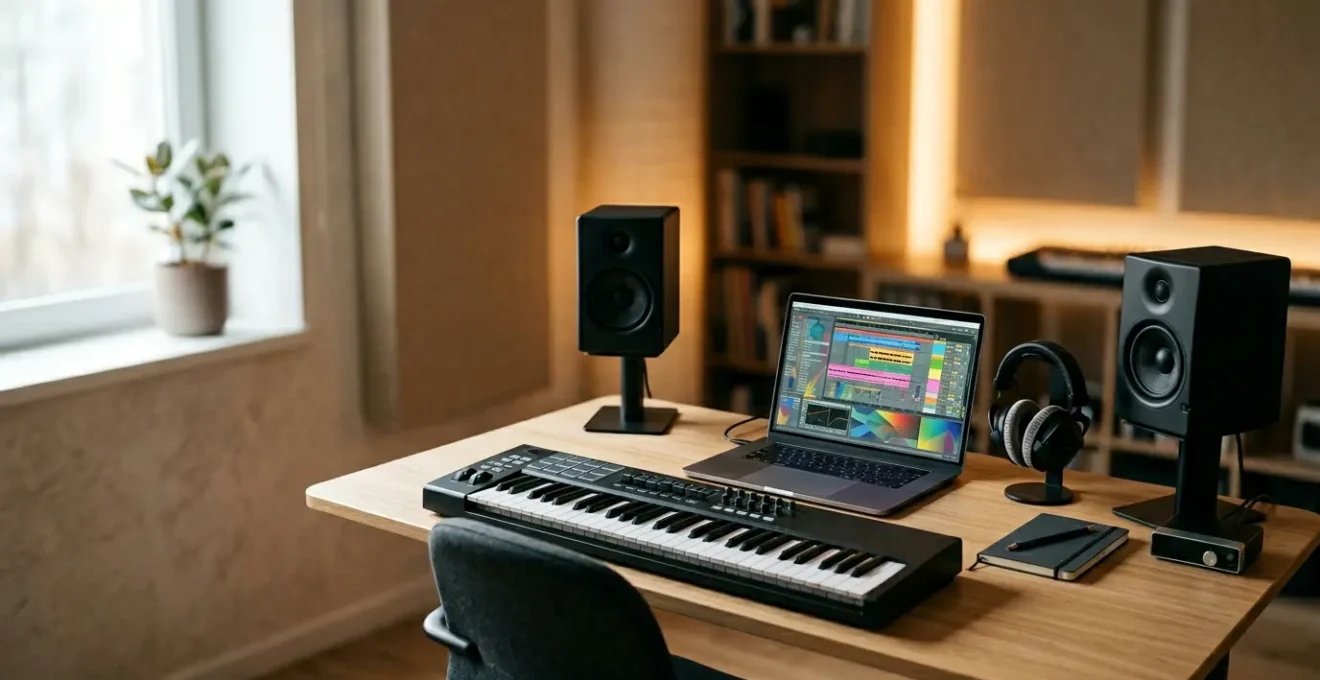
Modern composing isn’t about choosing between paper and pixels; it’s about mastering a hybrid workflow that blends timeless artistic principles with powerful digital tools.
- Develop narrative depth through thematic architecture, not just simple melodies.
- Select software (notation vs. DAW) based on its underlying compositional philosophy, not just its features.
- Overcome common industry hurdles like « temp track love » and technical mixing challenges with strategic thinking.
Recommendation: Integrate traditional voice leading and orchestration knowledge into your digital process to create scores that are not only realistic, but musically compelling and emotionally resonant.
The romantic image of a composer is often one of solitude: a genius hunched over a grand piano, pencil in hand, frantically capturing inspiration on sprawling sheets of staff paper. In contrast, the modern reality can seem sterile—a figure bathed in the blue light of multiple monitors, navigating complex software with a mouse and keyboard. For aspiring composers, this creates a daunting question: must one world replace the other? Many believe the path is to abandon tradition for technology or, conversely, that digital tools stifle true creativity.
The truth is more nuanced and far more exciting. The most effective film and game composers today are not just artists or technicians; they are hybrids. They possess the classical understanding of harmony, storytelling, and orchestration, but they apply it within a digital environment. They treat their Digital Audio Workstation (DAW) not as a simple recorder, but as their orchestra, and their sample libraries as their principal players. This isn’t about technology making composition easier; it’s about it raising the bar for what a single creator can achieve.
This shift requires a new mindset. It’s about seeing the entire process, from the first thematic idea sketched on paper to the final, hyper-realistic mockup delivered to a director, as a single, integrated creative act. It’s about understanding how a compositional choice in your notation software impacts the sonic reality in your DAW, and how to protect the intellectual property that results from this complex work.
This guide explores that hybrid path. We will deconstruct the essential skills and strategic decisions that define the modern composer’s journey, moving from the artistic core of musical storytelling to the practical realities of tools, techniques, and the industry itself.
Table of Contents: A Modern Composer’s Journey from Concept to Score
- Character Themes: Telling a Story Without Words
- Sibelius vs Dorico: Choosing the Right Notation Software
- The Blank Page: Compositional Games to Start a Piece
- The Temp Track Curse: How to Navigate Director Expectations
- Work for Hire vs Royalties: Protecting Your IP as a Composer
- Double Bass vs Cello: Creating Clarity in the Low End
- Avoid Parallel 5ths: Why Smooth Voice Leading Sounds Better
- How to Arrange for Orchestra Using Digital Libraries?
Character Themes: Telling a Story Without Words
Before a single note is entered into a DAW, the composer’s first task is that of a storyteller. A character’s theme, or leitmotif, is more than a catchy tune; it’s their musical DNA. It’s a sonic signature that can communicate their personality, their internal struggles, and their narrative arc without a single line of dialogue. The true power of this technique lies not in the initial theme itself, but in its capacity for thematic transformation. A hero’s theme might appear in a triumphant major key during a victory, but return in a fragmented, minor-key variation played by a solo cello during a moment of doubt. This is where the composer becomes a dramatist.
The goal is to build a thematic architecture for the entire story. This involves creating a web of interconnected musical ideas that represent not just characters, but places, objects, and concepts. As these narrative elements interact on screen, their corresponding musical themes can be combined, contrasted, and evolved to add a powerful subconscious layer to the audience’s experience. It’s a technique that elevates a score from mere accompaniment to an active participant in the storytelling.
Case Study: Howard Shore’s Thematic System in The Lord of the Rings
A masterful example of thematic architecture is Howard Shore’s work on The Lord of the Rings. Shore created over eighty interconnected leitmotifs, but his approach went beyond simple character themes. He crafted musical identities for places that also served as themes for the people from those places. The Rohan theme, for example, is not just a melody for its king or people; it is the sound of the land of Rohan itself. It plays during sweeping shots of Edoras but also returns, transformed, when the Rohirrim army arrives in Gondor. This demonstrates how a theme can evolve through harmonic changes, different modes, and new orchestrations to reflect complex narrative developments, creating a deeply cohesive and immersive world.
This level of narrative integration is the foundation of a great score. It’s the conceptual work done here, often with just a pencil and paper or a simple piano sketch, that gives the subsequent technological process its meaning and direction.
Sibelius vs Dorico: Choosing the Right Notation Software
Once you have a thematic idea, you need to notate it. For composers working with live musicians, a clean, readable, and professionally formatted score is non-negotiable. This is the domain of professional notation software. For decades, the landscape was dominated by two players: Finale and Sibelius. However, the arrival of Steinberg’s Dorico has fundamentally changed the conversation. The choice is no longer just about features, but about underlying compositional philosophy.
Sibelius, acquired by Avid, operates on a « digital paper » philosophy. It gives the user immense freedom to place any symbol anywhere, much like writing on a blank sheet. This can feel intuitive for beginners or those used to a traditional workflow, but it also means the software has little musical awareness; it’s up to the user to ensure everything is correct. Dorico, designed by much of the original Sibelius team, was built from the ground up with a « semantic model. » It understands musical rules. It knows a slur is different from a tie, and it automatically adjusts note spacing and layout based on musical context. This can have a steeper initial learning curve, but it often leads to a faster, more intelligent workflow for complex projects.
As Berklee Online notes, « Dorico’s ground-up design is refreshing and addresses some of the pain-points that they may have developed with Finale and/or Sibelius. » The decision between them often comes down to your personal workflow and the demands of your projects. You must decide if you prefer total manual control or a smart assistant that anticipates musical context.
This table, based on a comparative analysis of notation software, highlights the core philosophical differences:
| Feature | Sibelius | Dorico |
|---|---|---|
| Release Year | 1993 (Avid Technology) | 2016 (Steinberg) |
| Design Philosophy | Digital paper – total freedom, less guidance | Semantic model – understands musical rules, context-aware |
| Interface Approach | Ribbon interface (Microsoft Office-style), immediate visual cues | Multi-panel workflow, smaller visual cues, steeper learning curve |
| MIDI Import | Imports with typical MIDI mess requiring cleanup | Intelligent auto-formatting, cleaner import results |
| Learning Curve | More intuitive for beginners, familiar interface | Steep initially, but faster workflow once mastered |
| DAW Integration | MusicXML export, adequate MIDI integration | Integrated MIDI editors, piano roll window, Cubase audio engine |
| Best For | Quick MIDI input, familiar workflow, education | Complex notation, engraving quality, modern workflow |
The Blank Page: Compositional Games to Start a Piece
Every composer, from the novice to the seasoned professional, faces the same terrifying adversary: the blank page, or its modern equivalent, the empty DAW project. The sheer infinity of choices can be paralyzing. The key to overcoming this « composer’s block » is not to wait for a mythical bolt of inspiration, but to impose creative limitations. By turning composition into a game with a defined set of rules, you can transform paralysis into a focused creative exercise.
These « games » can take many forms. You could decide to write a piece using only three specific notes, or create a rhythm using the letters of someone’s name. Another powerful technique is to start not with melody, but with texture. Try building a soundscape using only long, sustained string sounds, or create a percussive bed from unconventional samples. The goal is to make a single decision that eliminates thousands of others, giving you a clear starting point to react to and build upon. The initial idea doesn’t have to be perfect; it just has to exist. The art of composition is often the art of refining that first, imperfect gesture.
One of the most effective starting games for media composers is reference analysis. Instead of trying to pull an idea from thin air, you can deconstruct existing pieces to build a framework for your own. This isn’t about plagiarism; it’s about understanding the musical language of a genre or mood.
- Gather References: Collect 3-5 pieces in a similar genre or mood, including any temp music a director has provided.
- Analyze Common Elements: Listen for recurring chord progressions, melodic shapes, key instrumentation, and rhythmic patterns. What is the musical DNA that makes these pieces feel cohesive?
- Extract the Framework: Identify the core elements. Is it the use of a Lydian mode? A specific rhythmic ostinato in the cellos? A sparse, piano-led texture?
- Build and Replace: Use that extracted framework as a template. Start with the same chord progression or instrumentation, but then fill it with your own original melodic and harmonic content. This gives you structure without dictating the final product.
The Temp Track Curse: How to Navigate Director Expectations
You’ve been hired for a film project. The director sends you a scene, and it’s cut to the music of a famous composer from a blockbuster movie. This is « temp music, » and it’s both a helpful guide and a creative trap. While it communicates the mood and energy the director is looking for, it can lead to « temp love »—a phenomenon where the director becomes so attached to the temporary track that any original music, no matter how good, sounds wrong. This is one of the biggest challenges in modern film scoring, with temp tracks used in up to 99% of films during the editing process.
The history of cinema is littered with tales of composers falling victim to temp love. The most notorious example involves one of the greatest films ever made.
Case Study: Stanley Kubrick and ‘2001: A Space Odyssey’
Stanley Kubrick hired esteemed composer Alex North to score his masterpiece, 2001: A Space Odyssey. During editing, Kubrick used classical pieces like Richard Strauss’s « Thus Spoke Zarathustra » as temp music. Ultimately, as documented in the annals of film music history, Kubrick became so attached to the temp tracks that he decided they worked better than North’s original score. He discarded North’s entire work without informing him. The composer only discovered his score had been rejected when he attended the film’s premiere, a story that serves as a chilling cautionary tale for every media composer.
So, how do you navigate this minefield? You can’t ignore the temp track, but you can’t simply copy it either. The solution is a strategic presentation that builds trust while gently guiding the director toward an original solution. This involves acknowledging their vision and then showing them how your original music can serve it even better.
Your Action Plan: The 3-Version Strategy
- Version A – The Safety Net: Create a cue that closely mirrors the temp track’s tempo, instrumentation palette, and emotional arc. This shows you’ve listened and can deliver on their core request, building essential trust.
- Version B – Your Original Vision: Present your preferred creative solution. This cue should capture the same emotional intent but explore fresh harmonic, melodic, or textural territory. This is where you showcase your unique compositional voice.
- Version C – The Wildcard: Offer an unexpected creative risk. This could involve a different tempo, unconventional instruments, or a surprising tonal approach. This version serves to expand the creative conversation beyond the temp track’s limitations.
- Presentation Protocol: Play all three versions in a listening session, ideally without labeling which is which. Frame Version B not as a rejection of the temp track, but as a creative evolution from it, demonstrating how a new idea can better serve the specific scene.
How to Arrange for Orchestra Using Digital Libraries?
The modern composer is rarely just a composer; they are also an orchestrator, a mixing engineer, and a producer. Today, the expectation is not just a piano sketch or a notated score. As one article from Sound on Sound puts it, composers are « expected to use their DAW and sample-based instruments to conjure up super-realistic mockups of their scores. » This is the art of digital orchestration. Your canvas is the Digital Audio Workstation (DAW), and your paints are vast, multi-gigabyte sample libraries containing recordings of every note an orchestra can play, with every possible articulation.
The choice of DAW is highly personal, but in the world of film scoring, two platforms tend to dominate. According to industry analysis, Logic Pro X and Cubase are the two most popular choices for film scoring professionals, due to their robust MIDI editing features and stable performance with large templates. A professional composer’s template can contain hundreds, even thousands, of tracks, each one corresponding to a different instrument or articulation (e.g., « Violins – Spiccato, » « Violins – Pizzicato, » « Violins – Tremolo »).
Achieving sonic realism is the primary goal. This goes far beyond just playing the right notes. It involves a deep understanding of how real instruments are played. A convincing digital string arrangement requires meticulous attention to MIDI data: varying velocities to simulate bow pressure, using CC (Continuous Controller) data like CC1 (Modulation) to control dynamics and expression, and intelligently switching between different articulations. You must think like a conductor and a performer, considering phrasing, breath, and the physical limitations of each instrument to breathe life into the samples.
Double Bass vs Cello: Creating Clarity in the Low End
One of the most common pitfalls in digital orchestration is a muddy, unfocused low end. This often stems from a misunderstanding of the distinct roles and frequency ranges of the cello and double bass sections. While they both occupy the lower register of the orchestra, simply having them play the same notes an octave apart is a recipe for sonic clutter. Creating clarity requires both careful arranging and technical mixing.
The cello has a rich fundamental frequency range from roughly 65Hz to 250Hz, but its most defining characteristic is its rich harmonic content in the mid-range (250-800Hz), which gives it warmth and melodic presence. The double bass provides the true weight and foundation, with its power concentrated below 100Hz. When these two ranges overlap without consideration, they create frequency masking, where the sounds compete and obscure one another.

The solution is twofold: separation in arrangement and separation in the mix. In Arranging:
- Rhythmic Separation: Give the instruments different rhythmic roles. For example, the basses can hold long, sustained pedal tones while the cellos play a more active, rhythmic line (or vice versa).
- Harmonic Separation: Don’t always have the basses play the root of the chord. Let them provide a solid pedal point while the cellos outline the harmonic changes.
- Counterpoint: Write independent melodic lines for each section that complement each other, creating a dialogue between the two voices.
In Mixing:
- EQ Carving: Use an equalizer to create space. A gentle high-pass filter on the cellos around 80-100Hz can remove unneeded sub-bass frequencies, while a subtle cut in the 150-250Hz range on the basses can make room for the cello’s body.
This combination of musical and technical thinking is essential for a powerful and clear orchestral foundation.
Avoid Parallel 5ths: Why Smooth Voice Leading Sounds Better
In the hallowed halls of music theory, few rules are as infamous as « avoid parallel fifths. » For aspiring composers grappling with four-part harmony, it can seem like an arbitrary and frustrating constraint. Why does moving two voices in perfect fifths sound « wrong » in a classical context? The answer lies in the core principle of counterpoint: voice independence. The goal of traditional voice leading is to create the illusion of four independent singers or melodic lines working together to form a cohesive whole. When two voices move in parallel fifths (or octaves), our ears stop perceiving them as independent lines and instead hear them as a single, reinforced melodic gesture. This momentarily collapses the contrapuntal texture, creating a sound that was perceived as crude or primitive in the context of the high Renaissance and Baroque periods, harkening back to the earlier organum style.
However, the modern composer must understand that this « rule » is entirely context-dependent. In rock music, the power chord is nothing but a root and a fifth moving in parallel, forming the very backbone of the genre. In film scoring, parallel fifths can be a powerful tool to evoke a sense of ancient power, starkness, or majestic emptiness. The key is compositional intent. Are you trying to create a smooth, interwoven texture where each line is independent? If so, avoiding parallel fifths is crucial for achieving that « classic » orchestral sound.
Smooth voice leading is about economy of motion. It means moving each note in a chord to the nearest possible note in the next chord. This creates seamless, elegant transitions that are pleasing to the ear and feel vocally natural. Learning and internalizing these principles, even if you choose to break them later for artistic effect, is a fundamental step in moving from a « programmer » of notes to a true composer.
Key Takeaways
- Thematic development is narrative architecture; a strong score tells a story through the transformation of its musical ideas.
- Your choice of software (DAW vs. Notation) is a philosophical one that shapes your creative workflow and the quality of your output.
- Achieving sonic realism in digital mockups requires a fusion of technical skill (MIDI, CCs) and traditional arranging knowledge (instrument ranges, voice leading).
Work for Hire vs Royalties: Protecting Your IP as a Composer
After all the creative and technical work is done, one final, crucial area remains: the business of music. As a composer, the music you create is your intellectual property (IP), and understanding how you get paid for it is essential for a sustainable career. The two most common arrangements for media composers are « Work for Hire » and royalty-based agreements.
A Work for Hire agreement is the most straightforward. The production company pays you a one-time creative fee. In exchange, they own the music outright, forever. You are essentially a contractor paid for a service, and you will not receive any further payment if the film or game becomes a massive success. This is common for many television, advertising, and corporate projects.
A royalty-based agreement is more complex and potentially more lucrative. While you may still receive an upfront creative fee, you retain some or all of the copyright to the music. This means you are entitled to receive performance royalties whenever the project is broadcast or publicly performed. These royalties are tracked and paid out by Performing Rights Organizations (PROs) like ASCAP, BMI, and SESAC. Even a small theme in a show that goes into syndication can generate a significant, long-term income stream.
The negotiation between these two models is a critical part of the composer’s job. A major feature film will often involve a hybrid model, but for many independent projects, you will need to advocate for yourself. Protecting your IP is not just about money; it’s about building a catalogue of work that can support your career in the long run. Technology has empowered composers to create entire scores from their studios, but it hasn’t changed the fundamental importance of a solid contract that respects the value of their creative work.
Understanding these legal and financial frameworks is the final step in transitioning from an aspiring artist to a professional composer. To protect your work and build a lasting career, it’s essential to seek proper legal counsel when reviewing any contract.