
Relying solely on a digital tuner is the very thing preventing you from playing in tune. While it provides a mechanical reference, it cripples your ability to hear and react to the subtle dissonances inherent in equal temperament. This guide explains that true intonation is not a visual task but an auditory skill. The ultimate goal is to train your ears to become the final authority, using tools as a guide, not a crutch.
You’ve been there. You meticulously tune each string, the needle on your digital tuner perfectly centered, glowing a triumphant green. You strike a G chord, confident and ready. And yet… something is off. The third sounds a little sharp, a bit… wobbly. It lacks the resonant, unified clarity you hear on recordings. You check the tuner again. It insists you’re perfect. This frustrating cycle is the shared experience of countless musicians who have been taught to trust their eyes over their ears.
The common advice is to check your guitar’s intonation or change your strings, and while these are crucial maintenance steps, they miss the fundamental point. They treat tuning as a purely mechanical problem to be solved with a screwdriver and a new set of wires. But what if the tool you trust most—your digital tuner—is a core part of the problem? What if true, musical intonation isn’t a visual task you perform, but an auditory skill you must develop?
This article is built on a strict, foundational principle: your ears, not a screen, are the ultimate arbiters of pitch. We will dissect the illusion of perfect tuning, address the mechanical prerequisites for a stable instrument, and lay out a clear path to developing the most important tool you have: your sense of hearing. This is not about abandoning your tuner, but about putting it in its proper place—as a reference, not a replacement for your own musical judgment.
To navigate this essential journey from visual dependence to auditory mastery, this guide is structured to build your understanding from the ground up. Explore the sections below to transform your relationship with pitch.
Summary: From Mechanical Tuning to Musical Intonation
- Why Your Thirds Sound Wobbly on Guitar (And Why It’s Normal)
- The Slip: Why You Must Stretch Strings Before Performance
- Nut Lubrication: The Secret to Staying in Tune with Tremolos
- 432Hz Conspiracy: Should You Tune Lower for « Vibes »?
- Twice a Year: Why Pianos Need Regular Attention Even If Not Played
- Why Your Bass Sounds Out of Tune Up the Neck
- Tuning by Ear against a Drone: Developing Pitch Sensitivity
- Why a Metronome and Tuner Are More Important Than the Instrument Itself?
Why Your Thirds Sound Wobbly on Guitar (And Why It’s Normal)
That « wobbly » sound you hear in your perfectly tuned major chords is not your imagination. It is a real, physical phenomenon called « beating, » and it’s a direct consequence of our standard tuning system, known as equal temperament. This system was a brilliant compromise, allowing music to be played in any key without retuning. However, this convenience comes at a cost. To make all intervals mathematically equal, most of them are made slightly imperfect compared to their « pure » counterparts in just intonation.
The major third is the most noticeable casualty. In equal temperament, the major third is intentionally sharpened. In fact, research shows that in equal temperament, a major third is about 14 cents sharper than a pure, perfectly consonant one. When two notes are this close but not perfectly in sync, their sound waves interfere with each other, creating a perceptible periodic rise and fall in volume—the « wobble » or « beating » you hear. Your digital tuner is calibrated for equal temperament, so it tells you this sharp third is « correct. » Your ear, however, is an incredibly sensitive instrument that detects this inherent dissonance.
In the equal temperament chords a roughness or beating can be heard… In the just intonation triad, this roughness is absent.
– Wikipedia contributors, Just intonation article
This is the first and most crucial lesson: your tuner’s « correct » is not the same as your ear’s « consonant. » Learning to hear this beat, and even to subtly adjust for it by slightly flattening your thirds when playing with others, is a hallmark of an advanced musician. It’s the beginning of the journey from mechanical tuning to musical intonation.
The Slip: Why You Must Stretch Strings Before Performance
Before you can even begin to trust your ears, you must be able to trust your instrument. The most common source of tuning instability, especially with new strings, is physical slippage and stretching. A new string is not just a wire; it’s a component under immense tension that needs to settle into its new environment. This settling process happens in two ways: the string material itself physically elongates, and the windings need to be firmly seated around the tuning post, nut, and bridge.
This is not a myth. A guitar string manufacturer’s analysis confirms that the initial stretching process is vital for tuning stability, significantly reducing the chances of a string going flat mid-song. When you tune a new, unstretched string to pitch, you are creating a system with stored potential movement. Any hard strum, bend, or even changes in temperature can cause the string to slip at the tuning post or finally finish its elongation, resulting in an immediate drop in pitch.
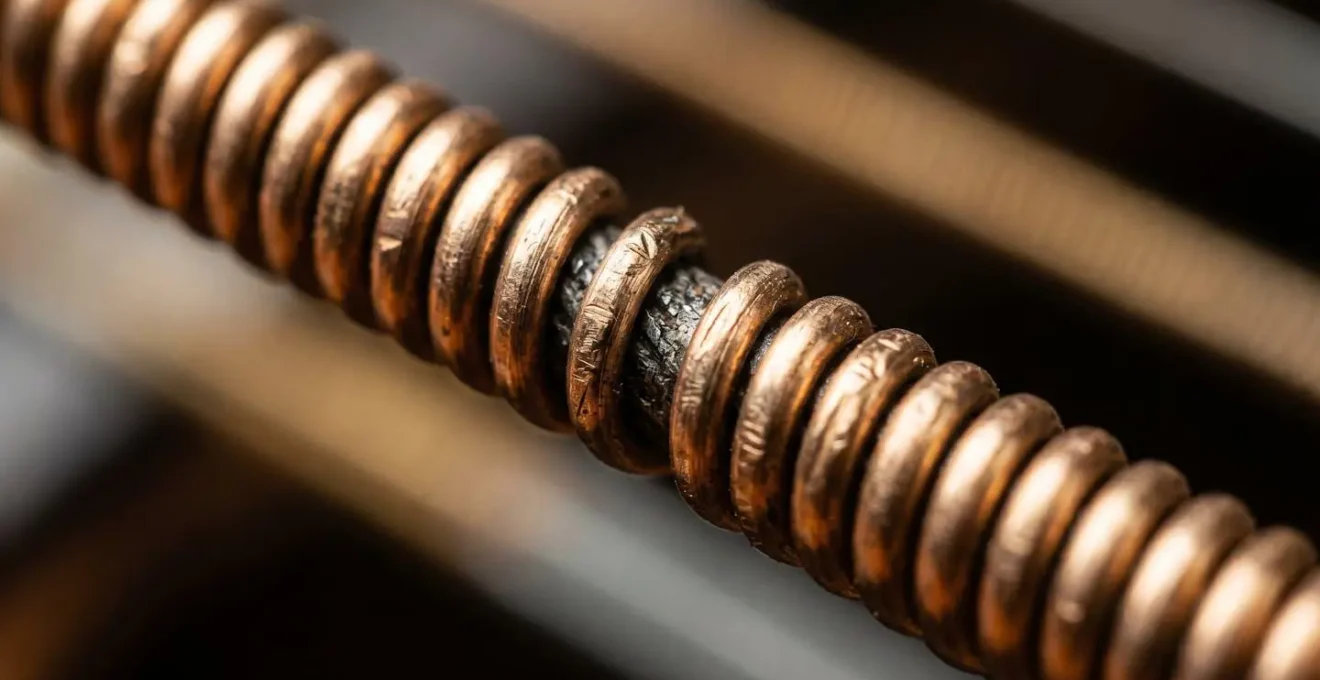
The process of stretching is simple: tune the string up, gently pull it away from the fretboard, and you will hear the pitch drop. Retune and repeat until the string holds its pitch after being pulled. This procedure, which only takes a few minutes, removes the « slack » from the system and ensures that the note you tune to is the note that the string will actually produce under playing conditions. It is a non-negotiable step in preparing your instrument. Without a physically stable instrument, any attempt at ear training is futile, as you will be aiming for a constantly moving target.
Nut Lubrication: The Secret to Staying in Tune with Tremolos
After strings, the single biggest point of failure for tuning stability is friction. Every time you bend a string or use a tremolo bar, the string must slide smoothly through its slot in the nut and over the saddle. If there is too much friction at these contact points, the string can bind or « stick. » When you return the tremolo to its neutral position, the string doesn’t slide back to its original tension, leaving it sharp or flat. You’ll often hear a tell-tale « ping » as the string suddenly releases and jumps back into tune.
The solution is surprisingly simple: lubrication. A properly lubricated nut and bridge saddle allow the string to move without resistance, ensuring it returns to the exact same tension—and thus, the same pitch—every single time. This is especially critical for guitars equipped with tremolo systems, but it benefits every stringed instrument. Forgetting this step is like driving a car without changing the oil; eventually, friction will cause a breakdown.
This isn’t about using messy oils; modern solutions like graphite powder or specialized lubricants are clean and incredibly effective. Applying a tiny amount to the string contact points during every string change transforms an instrument’s reliability. It is a foundational maintenance task that separates amateurs from professionals. A stable instrument is a prerequisite for developing a reliable ear; you cannot learn to hear subtle pitch differences if your guitar is actively fighting against you.
Action Plan: Nut and Saddle Lubrication
- Gently loosen the strings to lift them from the nut slots without removing them completely.
- Apply a minimal amount of lubricant (graphite or a specialized product) to each nut slot using a fine-point tool like a toothpick.
- Apply lubricant to the saddle contact points where the strings pass over the bridge.
- For guitars with string trees or tremolo systems, lubricate these friction points as well, including the tremolo’s pivot points.
- Wipe away any excess lubricant from the instrument’s surface to prevent dirt from accumulating.
432Hz Conspiracy: Should You Tune Lower for « Vibes »?
As you begin your journey into the world of pitch, you will inevitably encounter the debate around A=432Hz tuning. Proponents claim this tuning standard is more « natural, » « healing, » or mathematically aligned with the universe, in contrast to the modern standard of A=440Hz. This topic is a significant distraction for a beginner whose focus should be on foundational listening skills, not esoteric theories.
Let’s be clear: there is no credible scientific evidence to support the claims of 432Hz’s superiority. Historically, tuning pitch has varied wildly by region and era. The standardization of A=440Hz in the 20th century was a practical decision to allow musicians and instrument makers across the globe to be on the same page. Whether an orchestra tunes to 440Hz, 442Hz (common in Europe), or 432Hz is a matter of convention and aesthetic choice, not cosmic law.
For an ear training coach, the lesson here is one of focus and consistency. The « magic » in music doesn’t come from a specific frequency, but from the relationships between frequencies—the intervals, chords, and melodies. Your ability to play in tune depends on learning to hear these relationships accurately against a consistent reference. Chasing different tuning « vibes » before you can reliably tune to *any* standard is counterproductive. Stick to A=440Hz. It is the language everyone else is speaking. Learn to be fluent in it before exploring dialects.
Twice a Year: Why Pianos Need Regular Attention Even If Not Played
It’s a common misconception: if an instrument isn’t being played, it should stay in tune. This couldn’t be further from the truth, and the acoustic piano is the ultimate proof. A piano is a complex machine of wood, felt, and metal, with over 200 strings holding a combined tension of nearly 20 tons. This structure is constantly reacting to its environment, specifically changes in temperature and humidity, which cause the wood of the soundboard and pinblock to expand and contract.
This movement, however slight, alters the tension on the strings, causing the entire instrument to drift out of tune. This is why piano technicians recommend tuning a piano at least twice a year, typically as the seasons change and indoor heating or cooling systems are turned on or off. An unplayed piano in a fluctuating environment will go out of tune just as surely as a heavily played one.
The key lesson here for all musicians is that instruments are dynamic systems. But more importantly, consider how a piano is tuned. Technicians don’t just use a digital meter for every note. While meters provide a reference, the fine-tuning is done by ear. As professional piano technicians use a specific technique where they listen for the speed of the « beats » in different intervals to achieve a balanced tuning across the keyboard, a process called « stretch tuning. » They are actively listening for and managing the very same « wobble » you hear on your guitar. This proves that even with the most complex instruments, the final arbiter of pitch is a trained human ear.
Why Your Bass Sounds Out of Tune Up the Neck
Bassists face a unique set of intonation challenges. The problem is often described as notes sounding fine on the open strings but progressively more out of tune as you play higher up the neck. While poor setup and incorrect intonation are often the culprits, there is also a psychoacoustic element at play. The long, thick strings of a bass guitar produce powerful overtones—secondary, higher frequencies that sound along with the fundamental note you play.
Our brains use this series of overtones to perceive a note’s pitch. As you fret a note higher on a bass string, the vibrating length becomes shorter, which can change the relationship and relative strength of these overtones. If the overtones are not perfectly in tune with the fundamental (a phenomenon known as inharmonicity), your brain can get conflicting information, leading to a perception of the note being « off » or « muddy, » even if a tuner says the fundamental is correct.
When presented with a harmonic series of frequencies… humans tend to perceive that the pitch is f. The interference of two pitches can often be heard as a repetitive variation in the volume of the tone, known as beating.
– Wikipedia contributors, Psychoacoustics article
This is another scenario where the ear must be the final judge. A tuner measures only the fundamental frequency, but your ear hears the entire sonic package: the fundamental plus all its overtones. Learning to hear the « beating » between your fretted note and a reference pitch (like an open string or a drone) is the key to accurate bass intonation. It requires you to listen past the fundamental and tune the overall « timbre » of the note so it sits cleanly in the music.
Tuning by Ear against a Drone: Developing Pitch Sensitivity
We have established that digital tuners are limited and that mechanical stability is essential. Now we arrive at the core of the solution: active ear training. The single most effective method for developing pitch sensitivity is tuning your instrument against a continuous, unwavering reference pitch—a drone.
A drone is simply a sustained note, which can be generated by a keyboard, a synth, or a multitude of apps and websites. The process is straightforward: play a drone of a specific note (e.g., A) and then play the corresponding string on your instrument. Your task is to tune your string until the « beating » or « wobble » between the two notes disappears. When the two pitches are perfectly in sync, the wobble vanishes, and the two sounds merge into one, solid, reinforced tone. You are training your ear to recognize the point of maximum consonance.
This is not a mystical ability; it is a trainable skill. Pitch discrimination improves dramatically with practice. In fact, a comparative study revealed that while trained musicians already had a significant advantage, just two hours of training improved the pitch discrimination abilities of both musicians and non-musicians. By practicing with a drone, you are building a powerful auditory feedback loop. You are teaching your brain to identify dissonance and guiding your hands to correct it, all without looking at a screen. This practice moves tuning from a passive, visual check to an active, engaged listening exercise.
Key Takeaways
- Equal temperament makes major thirds sharp, causing an audible « beating » that tuners ignore but your ears detect.
- Mechanical stability is a prerequisite for ear training; stretching new strings and lubricating friction points is not optional.
- Pitch sensitivity is a trainable skill, and practicing with a drone is the most effective way to learn to eliminate dissonance by ear.
Why a Metronome and Tuner Are More Important Than the Instrument Itself?
The title of this section is a deliberate provocation, but it contains a fundamental truth. A priceless vintage guitar that is played out of time and out of tune is worthless as a musical tool. Conversely, a musician with a modest instrument who has mastered time and pitch can create compelling music. This illustrates that the true « instrument » is not the object in your hands; it’s the trained consciousness of the musician wielding it. The metronome and the tuner are not just accessories; they are the primary tools for calibrating that consciousness.
However, their roles must be understood correctly. The metronome is a guide for internalizing rhythm. The tuner is a reference for internalizing pitch. They are gym equipment for your musical muscles. You use them in the practice room to build strength and accuracy, so that on stage, your own sense of time and pitch can take over. The critical error is to see the tuner as the final word on pitch, rather than as a starting point for listening.
Your journey is to transition from a musician who *uses* a tuner to a musician who has *internalized* the function of a tuner. It’s about developing your ear to the point where you can hear the 14-cent discrepancy in a major third and choose to either live with it or subtly adjust it for musical effect. It’s about building an unshakeable auditory feedback loop that is faster, more nuanced, and more musical than any app.
Ear training is the cornerstone of musical development, offering musicians a method to connect with the essence of music itself. With ear training, we learn to hear what we read, write what we hear, sing what we read, recognize and name what we’re singing or hearing, and play what we sing or hear.
– Gaye Tolan Hatfield, Berklee Online Ear Training course
Stop letting a screen dictate your sound. Begin the real work of listening. Dedicate five minutes every day to tuning one string against a drone. Learn to hear the beats, then learn to make them disappear. This is the path to true intonation.