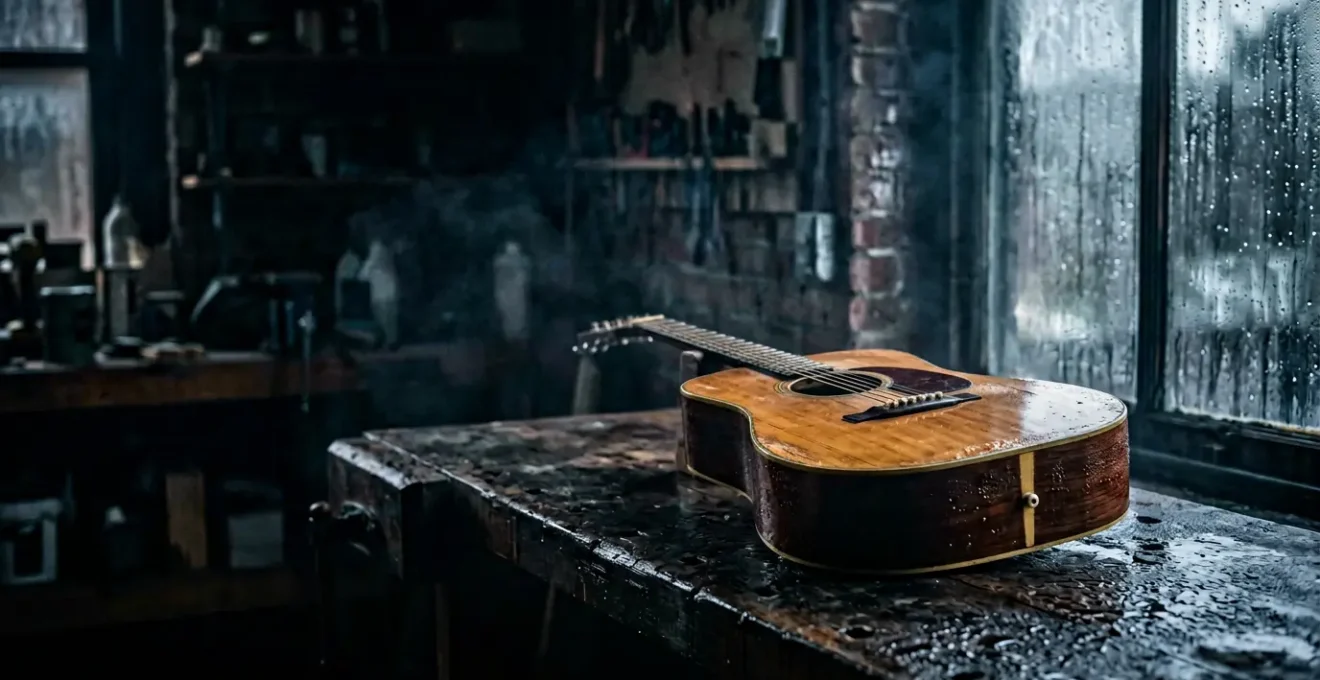
The greatest threat to an instrument’s value is not accidental damage, but passive environmental neglect in places like basements and attics.
- Uncontrolled humidity and temperature swings cause irreversible structural damage, from warped necks to failed glue joints.
- Modifications, even intended as « upgrades, » can permanently destroy up to 80% of a vintage instrument’s collector value.
Recommendation: Treat your instrument like a financial asset. Proactively monitor its environment with simple tools and understand the value of originality before making any changes.
In countless homes, a family heirloom rests in its case—a grandfather’s acoustic guitar, a mother’s violin. It sits forgotten in an attic, a basement, or the back of a closet, waiting. For many families, « storing » this instrument means simply keeping it out of the way. The common wisdom is to keep it dry and in its case, but this advice is dangerously incomplete. These storage spaces, subject to wild swings in temperature and humidity, are not passive holding areas; they are active environments of decay.
The musty smell from a damp basement or the oppressive heat of a summer attic are not just unpleasant—they are the sounds of your asset depreciating. But what if we shifted our perspective? What if we viewed that dormant instrument not as sentimental furniture, but as a tangible asset subject to the same principles of preservation and management as a piece of art or a classic car? The real key to preserving its legacy and financial worth lies not in simply avoiding the obvious, but in understanding the subtle forces that silently erode its value.
This guide reframes instrument storage as an exercise in asset management. We will dissect the environmental and physical threats that turn a potential treasure into worthless wood and wire. By adopting an appraiser’s mindset, you can learn to identify these risks and take concrete steps to protect the structural, aesthetic, and financial integrity of your instrument for generations to come.
This article will guide you through the critical factors that determine an instrument’s long-term health and value. From the hidden dangers of sunlight to the financial impact of a simple « upgrade, » we’ll cover the essential knowledge needed to be a responsible steward of your musical asset.
Summary: Basements and Attics: The Worst Places to Store Musical Instruments
- Sunlight Fading: Why the Window Display Is a Bad Idea
- The Musty Smell: Rescuing an Instrument from a Damp Basement
- Detuning Strings: Should You Loosen Tension for Long-Term Storage?
- Chipboard vs Plywood: Which Case Breath?
- Woodworms and Moths: Protecting Felt and Wood in Storage
- Monitoring the Case: The Cheap Tool That Saves Expensive Repairs
- Modified vs Original: Why Collectors Hate Your Upgrades
- Customizing Your Instrument: Aesthetics vs Value
Sunlight Fading: Why the Window Display Is a Bad Idea
Displaying a beautiful instrument near a window seems natural, but from an appraiser’s perspective, it’s equivalent to parking a classic car permanently in the sun. The damage is twofold, affecting both its finish and its fundamental structure. The first and most obvious impact is aesthetic: ultraviolet (UV) radiation breaks down the chemical bonds in the instrument’s finish, causing lacquers to yellow, cloud, or crack. Colors fade unevenly, creating « tan lines » that are impossible to reverse and are an immediate red flag for any potential buyer, signaling improper care.
More critically, this exposure constitutes a direct assault on the instrument’s material integrity. Sunlight is not just light; it is energy. Heat from direct sun can easily raise the surface temperature of dark wood. At temperatures exceeding 40°C (104°F), the glues holding critical joints—like the neck, bridge, and internal bracing—begin to soften and fail. This leads to lifted bridges, separated bindings, and compromised structural stability, all of which require costly, value-reducing repairs.
The damage goes even deeper. A peer-reviewed 2023 study on tonewoods revealed that UV radiation caused a 19% density decrease in spruce samples. This is not just a color change; it is the physical degradation of the wood itself as UV breaks down lignin, the natural polymer that gives wood its rigidity. The instrument is literally becoming weaker and more fragile at a microscopic level. What was once a vibrant, resonant object is slowly being cooked into a brittle, devalued artifact.
The Musty Smell: Rescuing an Instrument from a Damp Basement
If you open an instrument case stored in a basement and are met with a musty, earthy odor, you are not smelling « old wood. » You are smelling an active biological process that is liquidating your asset’s value. That smell is the off-gassing of mold and mildew, organisms that thrive in the high-humidity environments typical of below-ground spaces. For an instrument made of wood, felt, and glue, this is a catastrophic threat.
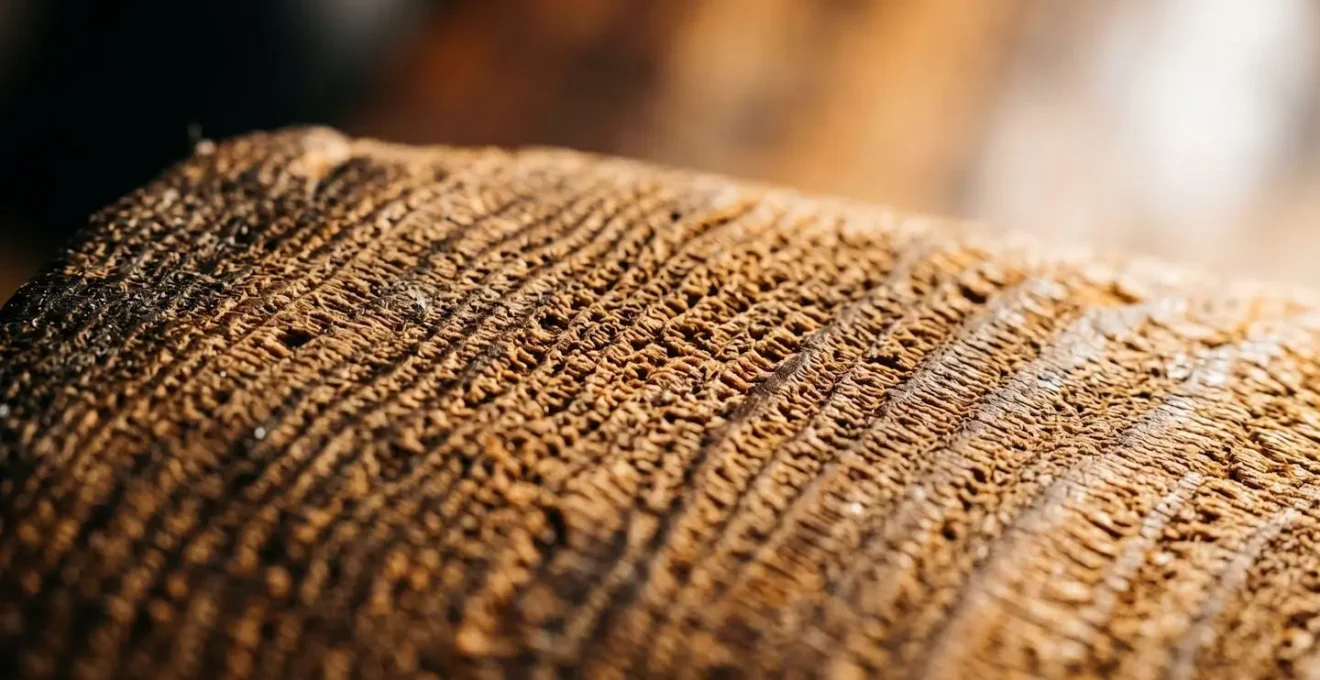
Mold is not a surface problem that can be simply wiped away. Its mycelium network penetrates deep into the porous grain of the wood, as shown in the image below. These organisms feed on cellulose, the primary structural component of wood. As an expert from PNW Mold Control noted in a study on the long-term effects of mold on building materials, this process causes the wood to lose its strength and rigidity. From a preservationist standpoint, the instrument is rotting from the inside out. This compromises not only its structural integrity but also its acoustic properties, deadening its tone permanently.
For an appraiser, a mold-infested instrument is often a complete write-off. The cost of professional remediation is frequently higher than the post-damage value of the instrument. Furthermore, the stigma of mold is permanent. Even if treated, the history of contamination must be disclosed to any future buyer, drastically reducing its marketability. Metal parts will corrode, felt linings will be destroyed, and the glues holding the instrument together will weaken. A damp basement doesn’t just store an instrument; it actively dismantles it.
Detuning Strings: Should You Loosen Tension for Long-Term Storage?
The advice to « loosen the strings » for storage is one of the most common and misunderstood pieces of instrument care. It is not a universal rule but a calculated decision in managing structural liability. A steel-string acoustic guitar has over 150 pounds of constant tension pulling on its neck and top. This force is counteracted by a metal truss rod inside the neck. The instrument exists in a state of carefully engineered equilibrium. Arbitrarily removing all tension can be just as damaging as leaving too much.
Completely slackening the strings allows the truss rod to win the tug-of-war, potentially causing the neck to develop a « back-bow, » which is difficult and expensive to correct. Conversely, leaving an instrument at full tension during drastic humidity and temperature swings (like in an attic) puts immense stress on the wood as it expands and contracts, risking a warped neck or a « bellied » top where the bridge pulls the wood upward. The decision to detune depends entirely on the instrument type and the duration of storage.
A financially sound storage strategy involves adjusting tension based on a clear timeline. Here are the professional guidelines for managing string tension as a function of storage duration:
- Short-Term (under 1 month): Maintain full standard tuning. Instruments are designed to handle continuous tension during regular use.
- Mid-Term (1-6 months): For steel-string instruments with truss rods, detuning is optional but can reduce stress. For classical guitars (which often lack truss rods), it is wise to detune.
- Long-Term (6+ months): Detune by loosening each tuning peg two full rotations. This significantly reduces tension while maintaining enough force to keep the neck and truss rod in a balanced state.
- Classical Guitar Exception: Always detune nylon-string instruments for any storage over a week. The lack of a truss rod makes their necks highly susceptible to bowing forward under tension.
- Never Go Fully Slack: Do not remove all tension without also professionally adjusting the truss rod. Creating a zero-tension state can cause its own set of structural problems.
Chipboard vs Plywood: Which Case Breath?
An instrument’s case is not just a box; it is its personal micro-environment. For a family storing an old instrument, the type of case is one of the most critical factors in long-term value preservation, yet it is often overlooked. The cheap, black « chipboard » cases that come with many entry-level instruments are not just poor physical protection—they are an active environmental threat. Chipboard (or cardboard) is highly hygroscopic, meaning it acts like a sponge, absorbing ambient humidity from a basement and holding it directly against the instrument.
When the environment dries out, the case releases that moisture, creating a dangerous cycle of humidity swings right where the instrument lives. From an asset protection standpoint, a chipboard case in a volatile environment is worse than no case at all. A quality case made of multi-ply plywood, molded ABS plastic, or fiberglass acts as a moisture barrier, slowing down the rate of environmental change and protecting the instrument from rapid fluctuations that cause wood to crack and finishes to check.
The choice of case material is a direct investment in risk mitigation. A sealed, high-quality case can maintain a stable internal humidity for days, buffering the instrument from the worst of its surroundings. The following table, based on a comparison of case materials, outlines the hierarchy of protection from a preservationist’s view.
| Case Material | Moisture Barrier Properties | Structural Integrity | Weight | Typical Application |
|---|---|---|---|---|
| Cardboard/Chipboard | Poor – Acts as moisture sponge, absorbs ambient humidity | Minimal – Degrades quickly with humidity exposure | Very Light | Budget instruments, short-term storage only |
| Multi-ply Plywood | Good – Acts as moisture barrier when properly sealed | Strong – Industry standard for flight cases | Moderate to Heavy | Professional touring, climate-controlled environments |
| ABS Plastic Shell | Excellent – Impermeable to moisture, chemical resistant | Very Strong – High impact resistance | Light to Moderate | Touring musicians, outdoor use, liquid spill protection |
| Molded Fiberglass | Excellent – Complete moisture seal when properly gasketed | Very Strong – Used in marine applications | Moderate | Professional instruments, harsh environments, air travel |
| Carbon Fiber | Excellent – Non-porous, complete moisture barrier | Exceptional – Highest strength-to-weight ratio | Very Light | Premium instruments, frequent travel, professional touring |
Woodworms and Moths: Protecting Felt and Wood in Storage
Beyond the slow creep of humidity, a stored instrument faces a more visceral threat: pests. For a wooden instrument, the most insidious culprits are wood-boring insects like the Powderpost Beetle. These pests don’t announce their presence until the damage is already done. An appraiser knows to look for the tell-tale signs: small, perfectly round exit holes in the wood, often accompanied by a fine, dust-like powder (frass). Each hole signifies that a larva has spent months or even years tunneling through the wood, compromising its structural and acoustic integrity from within.
As documented in a guide by a Nashville storage facility, even instruments stored in cases are vulnerable if the case itself becomes a carrier. A used case, especially one with a plush lining, can be a trojan horse, introducing an infestation to your entire collection. The damage is irreversible. A piece of wood riddled with wormholes is permanently weakened and its value is decimated.
The felt or plush lining of a case presents its own vulnerabilities, primarily to moths and other fabric-eating insects. Their larvae can graze on the lining, leaving bald patches and debris. More insidiously, a cheap or old lining can harbor pest eggs. Therefore, a used instrument case should be treated as a potential biohazard that requires a strict quarantine and inspection protocol before being introduced to a valuable instrument.
Your Action Plan: Vetting a Second-Hand Case
- Quarantine & Isolate: Store the newly acquired used case in a separate room, away from all other instruments, for a minimum of 14 days to allow any hidden issues to manifest.
- Forensic Inspection: Collect data by meticulously examining all interior surfaces, especially plush lining, for signs of insect casings, larval debris, or moth damage on the felt. Check for musty odors indicating mold.
- Humidity Audit: Confront the case’s history. Place a calibrated hygrometer inside the closed case for 24 hours. A reading over 60% RH means the case has absorbed excessive moisture and is a liability.
- Structural Analysis: Assess for loose lining that could hide pest eggs or degrading adhesives. Cheap glues in old cases can off-gas and damage certain instrument finishes, a condition known as ‘case-itis’.
- Asset Protection Decision: Based on your findings, make a go/no-go decision. If any signs of pest or mold contamination are found, the case must be professionally treated or destroyed. Do not risk contaminating your instrument.
Monitoring the Case: The Cheap Tool That Saves Expensive Repairs
The single most important principle in asset preservation is « measure, don’t guess. » You would not manage a financial portfolio without looking at the numbers, yet many instrument owners leave their asset’s environmental health completely to chance. The most cost-effective insurance policy against environmental damage is a small, inexpensive digital hygrometer. This simple device provides the one piece of data that matters most: the relative humidity (RH) inside the case.
The ideal environment for a wooden instrument is between 45% and 55% RH. Below this range, the wood risks shrinking, cracking, and fret ends may protrude sharply. Above it, the wood swells, glue joints are stressed, and the risk of mold growth skyrockets. A hygrometer placed inside the case transforms it from a black box into a monitored environment. It allows you to know, with certainty, if your storage location is safe or if you need to take corrective action, such as using a case humidifier in winter or a dehumidifier in the basement during summer.
However, this data is only useful if it is accurate. Cheap digital hygrometers can be off by as much as 10% out of the box. Before entrusting your instrument’s fate to one, you must calibrate it. The « salt test » is a simple, scientific way to do this at home, ensuring your readings are trustworthy.
- Prepare the Solution: Place a tablespoon of table salt in a small bottle cap and add just enough water to create a thick, wet paste.
- Create a Sealed System: Put the salt paste and your hygrometer together inside a sealed plastic bag or airtight container. Do not let them touch.
- Allow for Equilibrium: Leave the sealed container undisturbed for 8-12 hours. The saturated salt solution will create a stable micro-environment of exactly 75% RH.
- Read the Data: After the waiting period, your hygrometer should read 75%. Note any difference.
- Calibrate the Tool: If your device has a calibration function, adjust it to 75%. If not, simply remember the offset (e.g., « my hygrometer reads 5% low ») and mentally adjust all future readings.
Key Takeaways
- An instrument’s storage environment is not passive; it actively contributes to its appreciation or depreciation.
- Originality is paramount. « Upgrades » almost always decrease an instrument’s financial value in the collector market.
- Proactive monitoring with a calibrated hygrometer is the most cost-effective way to prevent catastrophic, irreversible damage.
Modified vs Original: Why Collectors Hate Your Upgrades
In the world of instrument appraisal, no concept is more critical than originality. While a player might « upgrade » a guitar with new pickups or tuners to improve its sound or playability, a collector or appraiser sees something very different: the destruction of value. A vintage instrument is valued not just for its function but for its status as a historical artifact. Every part, every screw, and every solder joint contributes to its authenticity and its story.
Changing any of these original components is seen as erasing a piece of that history. As one market analysis puts it, this is the core of the collector mentality:
To a collector, a vintage instrument is a historical artifact. Every scratch, ding, and solder joint tells a story. An ‘upgrade’ is seen as erasing a piece of that history and destroying its authenticity.
– Vintage Guitar Market Analysis, Understanding Collector Mentality in Vintage Instrument Markets
This is not a matter of opinion; it is a market reality with a quantifiable financial impact. Any modification that is not fully and easily reversible will lower the instrument’s value. Drilling new holes for a different pickguard, routing the body for a new style of pickup, or refinishing the body are all considered permanent alterations that can slash an instrument’s value by more than half. The instrument may become a better « tool » for a specific player, but it ceases to be a top-tier collectible asset. The following table, based on data from professional market analysis, illustrates this steep depreciation.
| Modification Category | Reversibility | Examples | Estimated Value Impact | Collector Perspective |
|---|---|---|---|---|
| Fully Reversible | Complete – No permanent changes | New strings, replacement strap, different case | 0-5% reduction | Acceptable – Not considered true modification |
| Reversible with Effort | High – Original holes reused | Replacement tuners using original mounting holes, drop-in pickups | 10-20% reduction | Tolerable if original parts are included with sale |
| Non-Original Parts | Moderate – Replacement without alteration | 1965 pickup installed in 1962 guitar, incorrect era tuners | 25-40% reduction | Significant concern – Destroys period-correct authenticity |
| Permanent Alterations | Low to None – Wood or finish compromised | New screw holes drilled, routing for additional pickups, refinishing | 50-70% reduction | Severe devaluation – Often considered ‘player grade’ only |
| Major Structural Changes | None – Cannot be reversed | Neck reset, headstock repair, body refinish | 60-80% reduction | Collector market effectively closed, relegated to player market |
Customizing Your Instrument: Aesthetics vs Value
Understanding the high price of modification does not mean an instrument must remain an untouched museum piece. It simply means that any customization must be approached with financial intelligence. The goal is to enhance the instrument for your use while minimizing the erosion of its long-term asset value. The guiding principle for this is a « no-drill, fully reversible » philosophy.
Today, a massive market exists for high-quality aftermarket parts—pickups, tuners, bridges—that are designed as « drop-in » replacements, utilizing the exact same screw holes and dimensions as the original factory parts. This allows for significant tonal or functional upgrades without any permanent alteration to the instrument’s wood or finish. By choosing these parts, you retain the ability to restore the instrument to its 100% original state at any time, thereby preserving its maximum potential value.
Furthermore, the act of modification itself can be managed to protect value. As many luthiers advise, documentation is key. This transforms a modification from « damage » into documented « provenance. »
Professional instrument repair technicians consistently advise musicians who modify their instruments to maintain detailed documentation. One repair shop owner noted that keeping original parts in labeled bags with the instrument, photographing each step of the modification process, and maintaining a logbook of who performed the work can preserve 50-80% of the value that would otherwise be lost to modifications.
To implement this value-preservation strategy, follow these key steps:
- Research Drop-in Replacements: Prioritize modern parts specifically designed as direct replacements requiring no new holes or permanent changes.
- Adopt a Locking Tuner Strategy: Select modern locking tuners that use the existing vintage mounting hole pattern to improve tuning stability without drilling.
- Use Solderless Electronics: Opt for pre-wired, solderless harnesses that can be swapped without altering the original wiring.
- Preserve the Pickguard Footprint: Any pickguard change must use existing screw holes. Never drill new ones for aesthetic purposes.
- Document Everything: Photograph the instrument before any changes, meticulously label and save all original parts, and keep receipts for any professional work done.
By assessing your storage location with an appraiser’s critical eye and making informed decisions about any potential changes, you transition from being a passive owner to an active and responsible steward of a valuable asset. The next logical step is to evaluate your current storage situation against these principles and implement a proactive plan for its preservation.