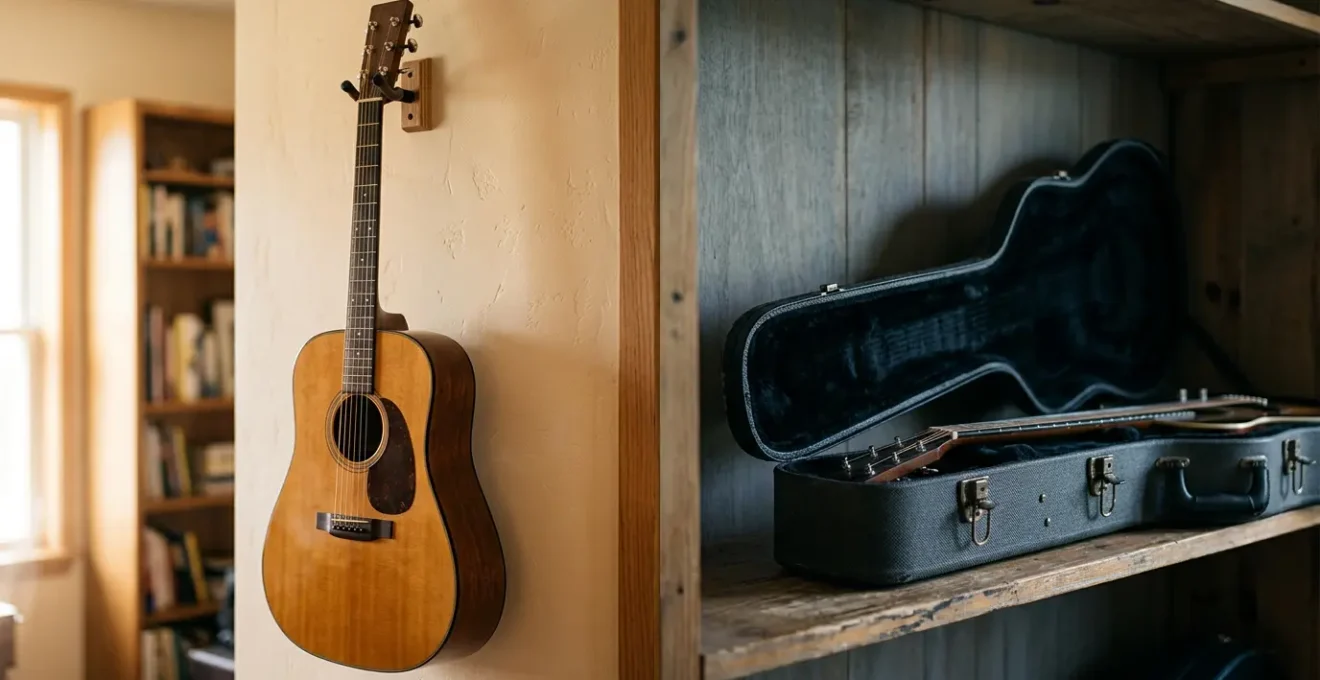
The choice between keeping a guitar accessible on a hanger or safe in a case isn’t a simple trade-off; it’s a constant exercise in risk management.
- Displaying your guitar significantly increases how often you play, but introduces physical and environmental threats.
- Storing your guitar in a case offers superior protection from accidents and humidity swings, but creates psychological friction that can kill your creative impulse.
Recommendation: Instead of choosing one method, build a hybrid system that actively manages the specific risks of your environment while minimizing the barriers to your practice.
For any musician, the question of where to store your instrument is a daily dilemma. On one hand, the sight of your guitar proudly displayed on the wall is an open invitation to create, a constant nudge to pick it up and play. On the other, the hard-shell case sitting in the corner represents a fortress of security, a promise that your cherished instrument is safe from harm. The conventional wisdom pits these two ideas against each other: accessibility versus protection. You are told you must choose between the risk of damage and the risk of forgetting to practice.
This debate, however, is framed incorrectly. It treats the decision as a single, static choice. The reality is that effective instrument storage is a dynamic system of risk management. As a home studio organizer, I see it as a three-pronged strategy. You must simultaneously manage physical risks (like a falling guitar or a clumsy toddler), environmental risks (the silent killers of humidity and temperature), and the often-underestimated psychological risk of creating friction between you and your instrument. A guitar that is perfectly protected but never played has failed its primary purpose.
This guide reframes the « hanger vs. case » debate. We won’t just list pros and cons. We will dissect the specific threats and provide a strategic framework to mitigate them. We’ll cover the physics of a secure wall mount, the hidden dangers of common stands, the science of humidity control, and the behavioral psychology that dictates your practice habits. By understanding these interconnected factors, you can stop making compromises and start building an intelligent storage system tailored to your home, your lifestyle, and your music.
To help you navigate these critical decisions, this article breaks down the key elements of instrument risk management. We’ll explore everything from secure installation to the subtle science of wood movement, giving you the tools to create the perfect balance of safety and inspiration.
Summary : A Strategic Guide to Guitar Storage: Balancing Safety and Accessibility
- Stud Finder: Making Sure Your Les Paul Doesn’t Fall Off the Wall
- The Dog and the Toddler: Why Tripod Stands Are Risky in Family Homes
- Sponge vs Gel Packs: Maintaining Humidity Inside the Case
- The « Out of Sight, Out of Mind » Rule: Why You Practice Less When It’s Cased
- Space Saving: Organizing 5 Guitars in the Space of 1
- Nitro Finish Warning: Stands That Melt Your Guitar’s Paint
- The Heater Danger: Why Acoustic Guitars Split in January
- Wood Movement: How Humidity and Temperature Kill Your Instrument
Stud Finder: Making Sure Your Les Paul Doesn’t Fall Off the Wall
The most visually appealing storage solution is the wall hanger, turning your instrument into a piece of art. However, this method carries the highest potential for catastrophic failure if not executed with near-perfect precision. A heavy instrument like a Les Paul can exert significant force, and relying on a simple drywall anchor is a gamble you should never take. The non-negotiable first step in physical risk management is locating a wall stud—the vertical wood beam inside your wall—to bear the load.
Using an electronic stud finder is essential. These devices detect density changes behind the drywall to pinpoint the edges and center of a stud. This is your anchor point. For situations where a stud is not available in your desired location, you cannot default to standard plastic anchors. You must upgrade to heavy-duty hardware specifically designed for hollow walls, such as toggle bolts or E-Z Anchors rated for at least 50 pounds (23 kg). This is not an area for cutting corners; the cost of a high-quality anchor is microscopic compared to the cost of a broken headstock.
Proper installation goes beyond just finding a stud. Height, clearance, and secure fastening are all part of a successful setup. Follow a rigorous installation protocol to ensure your guitar remains securely on the wall, not in pieces on the floor. Here are the essential steps for a safe installation:
- Use a stud finder to locate the exact center of the wall stud. If mounting into drywall only, use heavy-duty toggle bolts or E-Z Anchors rated for a significant load (≥50 lb).
- Mark your mounting holes at a recommended height of 66-76 inches (167-193 cm) from the floor, holding the hanger in place to ensure the guitar will have full clearance below.
- If mounting to a stud, pre-drill a pilot hole with a 1/8 inch (3mm) bit to prevent the wood from splitting. For drywall anchors, screw them in until they are flush with the wall.
- Fasten the hanger firmly with the appropriate screws, ensuring the baseplate is tight against the wall with absolutely no wobble or play.
- Perform a ‘shake test’ by hanging the guitar and applying gentle side-to-side pressure to confirm its stability. Plan to re-check the screws for any loosening every six months.
The Dog and the Toddler: Why Tripod Stands Are Risky in Family Homes
If wall mounting isn’t an option, the humble tripod stand seems like a practical alternative. It keeps the guitar accessible on the floor, ready to be picked up. However, from a risk management perspective, a standard tripod stand introduces a different kind of threat: instability. Their design, characterized by a narrow base and a high center of gravity, makes them uniquely vulnerable to being knocked over, especially in a dynamic home environment with pets or small children.

The physics are simple and unforgiving. The three small contact points on the floor create a small footprint, and with the bulk of the guitar’s weight held high, it takes very little lateral force—like a curious toddler pulling on a string or a dog’s wagging tail—to tip it over. This makes the tripod stand a high-risk choice for anyone not living in a quiet, controlled space. As the Guitar World editorial staff notes when reviewing stands, even the best ones have inherent limitations.
Tripod stands are fairly sturdy if you’re careful with how you place them, but just bear in mind that they’re not the most stable stands out there.
– Guitar World Editorial Staff, Best guitar stands and guitar hangers 2025 review
The solution is to assess your environment honestly. If you have unpredictable elements (children, pets, frequent houseguests), a tripod stand is likely an unacceptable risk. In these cases, more stable A-frame stands, which have a lower center of gravity, or multi-guitar racks that are heavier and more robust, are far safer alternatives for floor storage.
Sponge vs Gel Packs: Maintaining Humidity Inside the Case
When the risks of open storage are too great, the hard case becomes the default solution. It offers unparalleled protection from physical impact, but it creates a new challenge: managing the micro-environment inside. A sealed case can trap air that is either too dry or too moist, leading to slow but certain damage. The key to in-case storage is environmental stability, specifically maintaining a safe level of relative humidity (RH). For most wooden instruments, industry standards recommend maintaining 45-55% relative humidity to prevent wood from cracking or swelling.
Traditionally, this was managed with « soundhole humidifiers »—typically a perforated soap dish containing a damp sponge. While better than nothing, this is a high-maintenance, one-way system. The user must constantly monitor the sponge, re-wet it before it dries out, and be careful not to over-saturate it, which can introduce its own risks of mould or water damage. This manual process is a perfect example of psychological friction; it’s a chore that is easily forgotten.
Modern solutions have thankfully evolved. Two-way humidity control packs, like those from Boveda, have revolutionized in-case environmental management. These packs contain a salt-based solution that automatically adds or absorbs moisture to maintain a precise RH level (e.g., 49%). This « set it and forget it » system removes the guesswork and daily maintenance. Performance data shows these systems maintain stable humidity levels even in harsh conditions, requiring replacement only every few months when the pack becomes hard. By switching from an active (sponge) to a passive (gel pack) system, you are not just better protecting your instrument; you are removing a barrier from your own routine.
The « Out of Sight, Out of Mind » Rule: Why You Practice Less When It’s Cased
We’ve established that a case is the pinnacle of physical and environmental protection. However, this protection comes at a significant psychological cost. The simple act of putting a guitar in its case, closing the latches, and sliding it into a closet introduces a powerful barrier to creativity: friction. The « out of sight, out of mind » principle is a fundamental aspect of human behavior, and it applies directly to your practice habits. An instrument that requires several steps to access is an instrument that will be played less often.
Think about the moments of spontaneous inspiration. You have five minutes to spare, a melody pops into your head, or you just feel the urge to noodle. If the guitar is on a stand, you pick it up. The barrier to entry is zero. If it’s in a case, you must retrieve the case, find a space to open it, unlatch it, and take the guitar out. By the time you’ve done that, the fleeting moment of inspiration may have already passed. This isn’t about laziness; it’s about the small, cumulative hurdles that our brains are wired to avoid. An experienced musician will tell you that accessibility is the single greatest driver of practice frequency.
Having your guitar out on a stand or hanger means you’re far more likely to pick it up and play, just purely because it’s there. I’ve been playing guitar for over twenty years so take it from me when I say if you store your guitar in case you’ll quickly forget it’s there.
– Guitar World Senior Editor
This is the central paradox of guitar storage. The safest place for your guitar is also the place where it is least likely to be used for its intended purpose. Your personal storage strategy must therefore find a way to honor this psychological reality. It might mean accepting a small amount of risk for your main « beater » guitar by leaving it out, while keeping your more valuable instruments cased for long-term storage.
Space Saving: Organizing 5 Guitars in the Space of 1
For any musician with more than one instrument, the storage challenge multiplies quickly. A collection of individual tripod stands consumes a massive amount of floor space, and a stack of hard cases creates a cumbersome, inaccessible pile. Optimizing your space is not just about tidiness; it’s about maintaining the principles of accessibility and protection at scale. The solution lies in high-density storage systems that leverage vertical space.
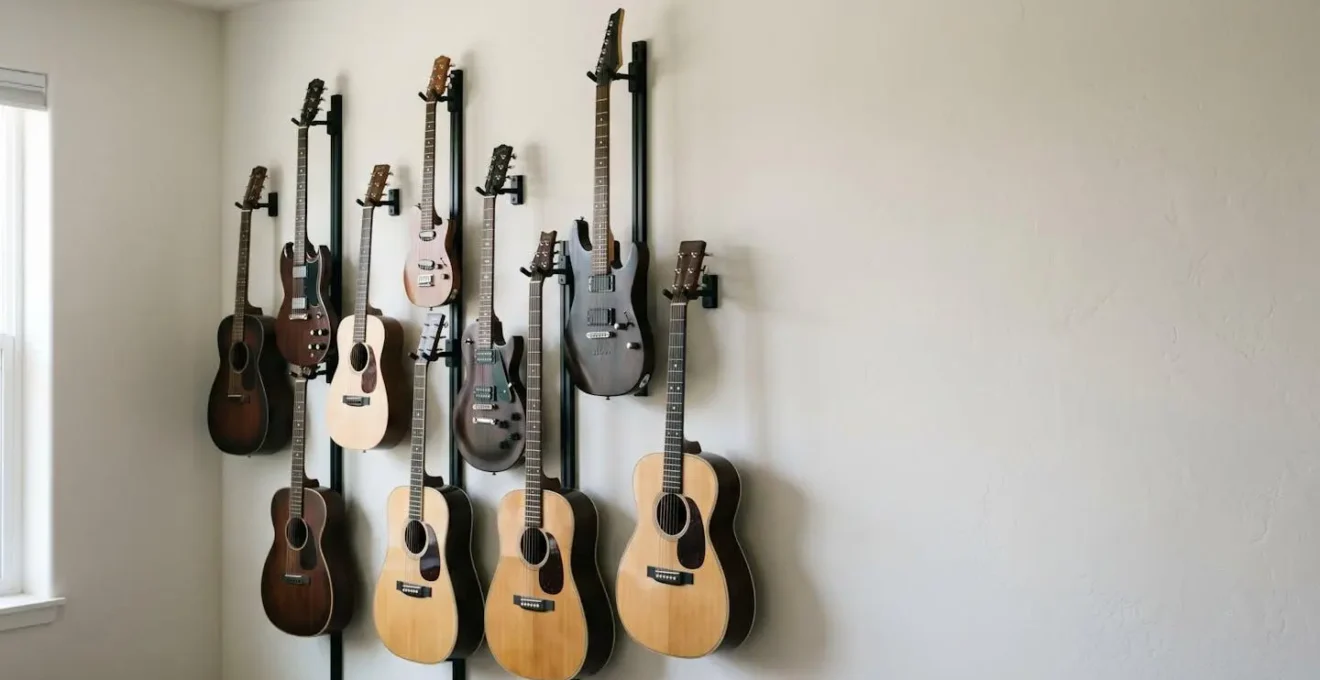
Multi-guitar racks and wall-mounted rail systems are game-changers for home studios. A floor rack can comfortably hold 5 to 7 guitars—in or out of their cases—in roughly the same footprint as two clumsy tripod stands. For example, some professional case racks can hold up to 9 cases in a space just over a meter wide. This not only reclaims your floor but also organizes your collection in a way that each instrument remains easily accessible.
Wall-mounted systems take this concept even further. By installing vertical rails, you can stagger multiple hangers up a single section of wall, turning an entire wall into a functional and beautiful display. This is the ultimate expression of space efficiency, allowing you to store a large collection in a way that keeps every instrument visible and ready to play, completely eliminating the « out of sight, out of mind » problem. For musicians living in smaller apartments or homes, these systems aren’t a luxury; they are an essential tool for co-existing with your passion.
Nitro Finish Warning: Stands That Melt Your Guitar’s Paint
Beyond physical and environmental risks lies a more insidious threat: chemical reaction. Many vintage and high-end guitars (notably those from Gibson and Martin) are finished with nitrocellulose lacquer. This traditional finish is prized for its thinness and ability to age gracefully, but it has a critical vulnerability: it remains chemically reactive for its entire life. Certain synthetic materials, particularly common types of vinyl, plastic, and rubber found on inexpensive guitar stands and hangers, can act as a solvent, literally melting the finish on contact.
This damage is irreversible. It often appears as a sticky, discolored patch where the guitar’s neck or body rested on the stand’s foam padding. For a collector or any owner of a valuable instrument, this is a devastating and entirely avoidable mistake. The problem is that many stand manufacturers do not explicitly label their products as « nitro-safe, » leaving the owner to discover the hard way. Reputable brands like Hercules often use a proprietary foam that is specifically designed to be safe for all finishes, but you should never assume.
If you own a nitro-finished guitar, you must be vigilant. As a user on a PRS Guitars forum noted, choosing the right brand is key, stating, « Hercules stands are also safe for Gibson and PRS finishes. Nitro-safe foam, lots of Nitro guitars and never any issues. » If you are unsure about your stand, the safest course of action is to retrofit it. You can cover all contact points with a 100% cotton cloth (an old t-shirt works perfectly) as a simple, effective barrier. This small precaution is a critical piece of expert-level instrument care that protects your investment from a silent and costly threat.
The Heater Danger: Why Acoustic Guitars Split in January
While we often focus on the controlled environment inside a case, the ambient conditions of the room itself pose the greatest environmental threat, especially during winter. When you turn on your central heating, furnace, or wood stove, you are actively pumping dry air into your home. This can cause the relative humidity to plummet. In colder climates, it’s not uncommon for indoor humidity to drop to dangerously low levels. For instance, some testimonials have reported indoor humidity below 20% RH during winter months, far below the safe zone for any wooden instrument.
Acoustic guitars, with their large, thin sheets of solid wood, are particularly vulnerable. As the wood loses its internal moisture to the dry air, it shrinks. This shrinkage can cause a cascade of problems: the top can sink and crack, the bridge can pull off, and the fretboard can shrink, leaving sharp fret ends (fret sprout) protruding from the sides of the neck. This isn’t a possibility; it’s an inevitability in an uncontrolled environment.
Protecting your instrument during heating season requires proactive risk management. It starts with monitoring your environment with a digital hygrometer and taking corrective action when the humidity drops. Avoid storing guitars near heat sources like radiators or vents, as these are micro-environments of extreme dryness. When bringing a guitar in from the cold, always let it acclimate inside its case for several hours before opening to prevent rapid temperature changes from causing the finish to crack (known as finish checking).
Action plan: Winter guitar protection protocol
- Install a hygrometer in your guitar storage area by October to establish baseline humidity readings before heating season begins.
- When ambient humidity drops below 40%, activate room humidification systems and place in-case humidity control packs in all guitar cases.
- Map home microclimates—avoid storage near forced-air HVAC vents, radiators, wood stoves, or direct sunlight from windows.
- When bringing a cold guitar indoors, leave it in its closed case for 3-4 hours to acclimate gradually to room temperature before opening.
- Maintain storage temperature between 66-77°F (19-25°C) and 40-50% humidity, checking readings weekly during winter months.
Key Takeaways
- The ideal storage solution is a hybrid system balancing accessibility against physical and environmental risks.
- Wall hangers are excellent for access but require flawless installation into studs to prevent catastrophic failure. Tripod stands are inherently unstable in active households.
- Maintaining a stable humidity level between 40-55% RH is the single most important factor in preventing long-term damage like cracks and warping.
Wood Movement: How Humidity and Temperature Kill Your Instrument
At the heart of every warning about humidity and temperature is a simple, powerful force of nature: wood movement. Wood is a hygroscopic material, which means it naturally absorbs and releases moisture to stay in equilibrium with its surrounding environment. As it absorbs moisture in high humidity, it swells. As it releases moisture in low humidity, it shrinks. This constant, invisible process is the root cause of most structural damage in acoustic and even electric guitars.
An acoustic guitar is a finely balanced system of tension. The strings exert hundreds of pounds of pressure on a thin, delicate top. This system is designed to work perfectly within a specific environmental range. Experts in guitar care recommend maintaining a range of 40-50% RH for acoustic guitars and 40-55% for electrics. When the humidity deviates too far from this safe zone, the wood’s movement begins to work against the guitar’s construction. In dry conditions, the shrinking top can no longer withstand the string tension, leading to cracks. In wet conditions, the swelling wood can cause the top to bulge, raising the action and making the guitar unplayable.
Different types of guitars have different levels of vulnerability to this movement. A solid-top acoustic is extremely sensitive, while a laminate-body guitar is more resilient. Even a solid-body electric guitar is not immune; its wooden neck can warp, and the fretboard can shrink, causing fret sprout. Understanding how your specific instrument is constructed is key to assessing its risk level.
This table breaks down the vulnerability of common guitar types:
| Guitar Type | Humidity Vulnerability | Optimal RH Range | Primary Risks |
|---|---|---|---|
| Solid-Top Acoustic | Extremely High | 40-50% | Top cracking, body separation, bridge lifting, fret sprout |
| Laminate Acoustic | Moderate | 40-55% | Neck warping, reduced stability compared to solid wood but more resilient to cracks |
| Solid-Body Electric | Low (body), Moderate (neck) | 40-55% | Neck relief changes, fret sprout, finish checking—body largely immune to cracking |
| Vintage (Pre-1970) | Very High | 45-50% (narrower tolerance) | Aged wood more sensitive, finish checking, historical/monetary value at risk |
Being able to spot the early warning signs of humidity damage is a crucial skill. For low humidity, look for sharp fret ends and a sunken top. For high humidity, look for a swollen or bulging top and unusually high string action. Catching these signs early allows you to take corrective action before permanent damage occurs.
Now that you understand the complex interplay of physical, environmental, and psychological risks, you can move beyond the simple hanger-versus-case debate. The next step is to perform an audit of your own living space, your collection, and your habits to design a storage system that keeps your instruments both safe and inspiring.