
Distinguishing Baroque from Classical music isn’t about memorizing facts, but about learning to hear two completely different storytelling methods.
- Baroque music tells a story of continuous energy, built on a harpsichord « engine » and decorated with intricate, improvisational melody.
- Classical music tells a story of conflict and resolution, using balanced phrases and a clear narrative structure with contrasting « thematic characters. »
Recommendation: Focus on listening for the ‘sonic architecture’: is it one continuous, ornate texture (Baroque), or a balanced drama of themes (Classical)?
You’re listening to the radio, and a magnificent piece of orchestral music begins. You know it’s old, but is it Bach or Mozart? Handel or Haydn? For many music lovers, the line between the Baroque (roughly 1600-1750) and Classical (roughly 1750-1820) periods feels blurry. It’s a common frustration, a sense that you *should* be able to tell them apart, but the clues remain just out of reach. You might have heard the usual advice: look for the harpsichord, listen for complexity versus simplicity. While true, these are just items on a checklist.
These surface-level tips don’t teach you how to listen. They don’t explain the fundamental shift in philosophy, emotion, and structure that occurred in Western music. The real key isn’t just identifying instruments; it’s about understanding the completely different *musical narrative* each era is trying to tell. The transition from Baroque to Classical wasn’t just a change in style; it was a revolution in how music communicated ideas and emotions, mirroring the broader cultural shift from the grand, divine order of the Baroque to the human-centric logic and reason of the Enlightenment.
But what if the true secret wasn’t in a checklist, but in learning to hear the sonic story? This guide will move beyond the obvious. We’ll train your ear to recognize the underlying « emotional grammar » and « sonic architecture » of each period. You will learn not just to identify features, but to understand *why* they exist and what they signify. It’s time to stop guessing and start hearing the difference with confidence.
This article breaks down the essential sonic clues that distinguish these two monumental eras. By exploring the unique sound, structure, and emotional language of each, you will develop the skills to identify them by ear, transforming your listening experience from passive appreciation to active discovery.
Summary: Distinguishing Baroque from Classical Music by Ear
- The Basso Continuo: Spotting the Baroque Signature Sound
- Trills and Turns: Why Baroque Melodies Are So Busy?
- Balance and Form: The Classical Era’s Obsession with Structure
- Where are the Trombones? Counting Players to Guess the Era
- Terraced Dynamics vs Crescendo: How Volume Shifts Reveal the Style
- Bo Diddley Beat: Tracing the 3-2 Clave in Rock and Roll
- Theme A vs Theme B: Identifying the Characters of the Story
- Decoding Sonata Form: The Roadmap of Classical Symphonies
The Basso Continuo: Spotting the Baroque Signature Sound
The single most powerful clue to identifying Baroque music is a sound you might not even consciously notice at first: the basso continuo. Think of it as the tireless harmonic engine of the entire era. It consists of a bass instrument (like a cello or bassoon) playing the bass line, while a keyboard instrument (almost always a harpsichord, sometimes an organ) plays the same bass line with one hand and fills in the chords with the other. This combination provides the harmonic and rhythmic foundation for the entire ensemble.
The harpsichord’s bright, plucked sound is the continuo’s most recognizable element. Its constant presence is a near-universal feature in Baroque instrumental music. According to musicologists, the basso continuo was so fundamental that the harpsichordist often served as the conductor, their continuous playing holding the group together. When the Classical era arrived, this practice vanished. Composers wanted more control and a different texture, so the continuo was abandoned, leaving a « space » that was filled by other instruments.

As the image above illustrates, the harpsichord’s mechanical nature, with quills plucking the strings, is key to its sound. It cannot vary its volume by touch, a limitation that profoundly shaped Baroque music. To train your ear, listen specifically for that metallic, jangling layer of chords humming beneath the melody. If you hear that constant, chugging harmonic support from a harpsichord, you are almost certainly in the Baroque period. Its absence is an equally strong clue that you’ve moved into the Classical era or later.
Trills and Turns: Why Baroque Melodies Are So Busy?
If the basso continuo is the engine of Baroque music, then the melody is its dazzling, jewel-encrusted bodywork. Baroque melodies are famously « busy, » filled with rapid scales, trills, turns, and other ornaments. But this isn’t just decoration for its own sake. In the Baroque era, ornamentation was a core part of the music’s emotional grammar and a vehicle for the performer’s own creativity. Composers often wrote relatively simple melodic lines, expecting the performer to embellish them, much like a jazz musician improvises over a chord progression today.
This improvisational spirit meant that every performance was unique. Two recordings of the same Bach sonata can sound remarkably different depending on the performer’s choices. These ornaments—the trills (rapidly alternating between two notes), mordents (a single quick alternation), and turns (a small group of notes « turning » around a central pitch)—were used to add emphasis, tension, and brilliance. An interesting historical detail is that, according to historical performance practice, Baroque trills generally begin on the auxiliary note (the note above the written one), creating a momentary, pleasing dissonance before resolving.
In contrast, Classical composers like Mozart and Haydn sought clarity and elegance. They wanted more control over the final product, so they wrote out most of the ornaments themselves. The melody became cleaner, more « singable, » and less cluttered. So, when you listen, pay attention to the density of the melodic line. Is it a whirlwind of virtuosic, seemingly spontaneous flourishes? That’s the improvisational spirit of the Baroque. Or is it a clear, balanced, and elegant tune where every note feels perfectly placed by the composer? That’s the structural precision of the Classical era.
Balance and Form: The Classical Era’s Obsession with Structure
As the Baroque era’s divine grandeur gave way to the Age of Enlightenment’s focus on reason and humanism, music underwent a radical transformation. Classical composers became obsessed with clarity, balance, and order. This is most audible in their melodies, which are often built on a simple and highly satisfying « question and answer » pattern. You’ll hear one short musical phrase that sounds like a question (an antecedent phrase), often ending on an unresolved chord. It is immediately followed by a second phrase that provides a sense of closure and resolution (a consequent phrase).
This creates a feeling of perfect symmetry and balance. The phrases are typically of equal length (e.g., two or four bars each), making the music feel logical, predictable, and pleasing. This structure was a direct reflection of Enlightenment ideals, which championed rationality and clear communication. Music was designed to be understood and enjoyed by a wider public, not just to overwhelm the senses in a cathedral. As one analysis of the period notes, the goal was to create simple, singable melodies that everyone could enjoy and remember.
Baroque music, on the other hand, often features long, spinning, and continuous melodies that unfold without such clear-cut symmetrical breaks. A single melodic idea might be developed and elaborated over a long stretch, creating a feeling of forward momentum rather than balanced repose. To spot the Classical style, listen for this « question and answer » dynamic. Can you tap your foot and feel the even, balanced length of the musical sentences? Do you feel a sense of neatness and order in the melody? If so, you’re hearing the architectural mind of a Classical composer at work.
Where are the Trombones? Counting Players to Guess the Era
Another powerful clue is the sheer size and sound of the ensemble. The difference in the sonic weight between a Baroque and a Classical orchestra is immediately noticeable. A Baroque orchestra was a relatively small, intimate affair. Research shows that Baroque orchestras typically had 16-20 musicians, perfect for the aristocratic chambers or church settings where the music was most often performed. The ensemble was primarily composed of strings, the basso continuo, and a few woodwind instruments like flutes, oboes, and bassoons.
The Classical era, however, saw the rise of the public concert hall and a growing middle-class audience. To fill these larger spaces with sound, the orchestra expanded dramatically. Classical orchestras grew to include 30-60 musicians, creating a richer, more powerful, and dynamic sound. This expansion wasn’t just about adding more strings; it was about introducing new colors to the orchestral palette. The most significant addition was the clarinet, an instrument almost entirely absent from Baroque music. Its warm, smooth, and vocal-like tone became a favorite of composers like Mozart. The transverse flute also supplanted the softer-sounding recorder, which had been popular in the Baroque period.
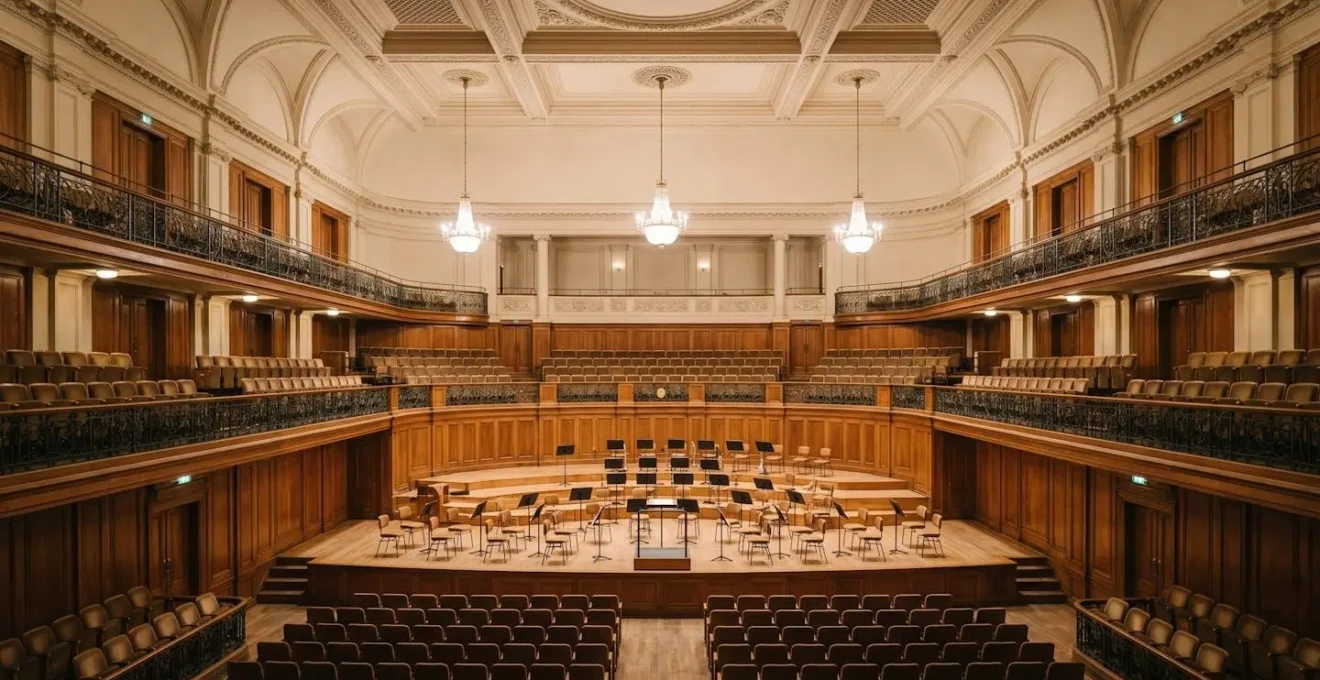
So, when you listen, try to gauge the scale of the sound. Does it feel light, clear, and chamber-like, with individual instrument lines easy to pick out? That’s likely a smaller Baroque ensemble. Or does it sound full, lush, and powerful, with a blended texture and the warm, rounded tones of clarinets? That’s the bigger, more « public-facing » sound of the Classical orchestra, designed for the grand concert hall.
Terraced Dynamics vs Crescendo: How Volume Shifts Reveal the Style
How a piece of music gets louder and softer is one of the most revealing stylistic fingerprints. In the Baroque era, volume changes were typically abrupt and dramatic. Composers used what is known as « terraced dynamics. » This means the music shifts suddenly from a soft section to a loud section, or vice-versa, with no gradual transition. It’s like flipping a light switch: the volume is either on (forte) or off (piano). This effect was often achieved by changing the number of instruments playing; a soft passage for a solo violin might be followed by a loud passage for the full orchestra.
This practice was partly a result of the era’s primary keyboard instrument: the harpsichord. As mentioned, a harpsichordist cannot change the volume by playing softer or harder. This mechanical limitation heavily influenced the era’s approach to dynamics. The concept of a gradual swell in volume—the crescendo—was largely absent. It was the invention and popularization of a new instrument that changed everything. As noted in music history, the harpsichord was replaced by the piano (fortepiano) during the Classical period, which, for the first time, allowed for gradual dynamic changes.
The fortepiano (literally « soft-loud ») could respond to the player’s touch, enabling the crescendo and decrescendo (getting gradually softer). Classical composers seized on this new technology to create waves of emotion, building tension and drama in a way that was impossible before. A gradual, swelling crescendo became a hallmark of the Classical style. So, listen for how the volume changes. Are the shifts sudden and block-like? You’re hearing Baroque terraced dynamics. Is the orchestra swelling and fading with emotional intensity, like a dimmer switch? That is the sound of the Classical crescendo.
Bo Diddley Beat: Tracing the 3-2 Clave in Rock and Roll
Now for a quick, and perhaps surprising, detour. The deep listening skills we’re honing to distinguish Baroque from Classical can be applied to almost any genre. The ability to isolate a core pattern—a rhythmic signature—is a universal tool for musical understanding. As a fascinating example, let’s look at the « Bo Diddley beat, » a rhythmic pattern that became a cornerstone of rock and roll. While it sounds worlds away from a Bach concerto, its story is also one of traceable DNA.
The famous beat—*BUMP-ba-dump-ba BUMP BUMP*—is a syncopated five-accent rhythm. Its roots can be traced back to the « son clave, » specifically the 3-2 clave pattern (three beats in the first measure, two in the second) that is fundamental to Afro-Cuban music. This rhythmic cell migrated and mutated, finding a new home in the hands of early rock and roll pioneer Bo Diddley in the 1950s. He made it his signature, using it in hits like « Bo Diddley » and « Who Do You Love? »
This rhythmic figure became so infectious that it spread throughout popular music. You can hear its influence in Buddy Holly’s « Not Fade Away, » The Who’s « Magic Bus, » U2’s « Desire, » and even George Michael’s « Faith. » Just as the basso continuo is a sonic marker for the Baroque, this specific 3-2 clave-derived pattern is a marker for a huge swath of rock history. It demonstrates that music is often built on foundational patterns, or « memes, » that travel across time, geography, and genre. This brief tangent reminds us that active listening is about recognizing these fundamental building blocks, whether in a symphony hall or a rock club.
Theme A vs Theme B: Identifying the Characters of the Story
If Classical music is a story, then its main themes are the characters. This is the heart of the « musical narrative » of the Classical era. Unlike Baroque music, which typically explores a single mood or « affect » throughout a movement, Classical music is built on contrast and drama. This is most clearly heard in the juxtaposition of two distinct themes, often called Theme A and Theme B.
Think of them as the protagonist and a secondary character in a play. Theme A, the primary theme, is usually presented first. It’s often bold, energetic, and firmly in the piece’s « home » key (the tonic). It establishes the main character and setting. Then, after a short transition, the music introduces Theme B. This second theme is designed to contrast with the first. It might be more lyrical, gentle, or graceful, and it’s always presented in a different, conflicting key (often the dominant). This creates an immediate sense of musical tension and conflict between the two « characters. »
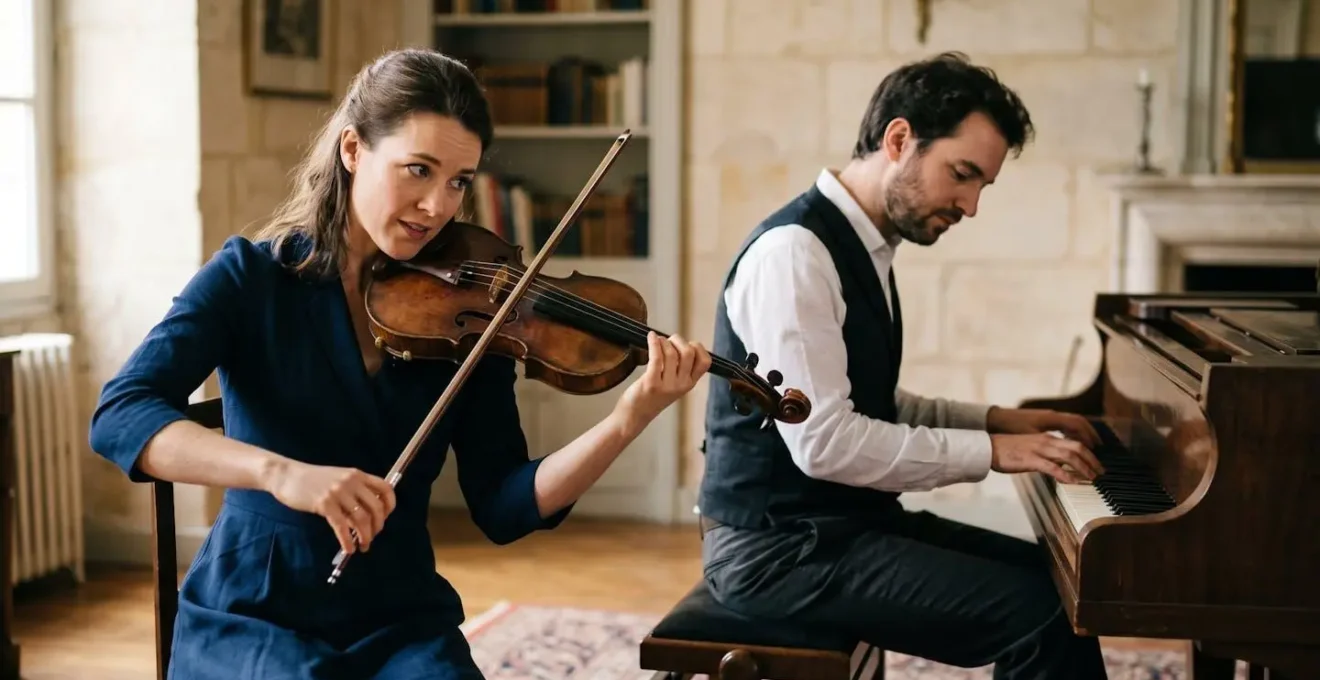
The entire first section of a Classical movement (the exposition) is dedicated to introducing these contrasting thematic characters and their conflicting tonal worlds. The rest of the movement is then devoted to their interaction, development, and eventual resolution. Listening for this is like watching a story unfold. First, you meet the hero (Theme A). Then, you meet another character who provides contrast or conflict (Theme B). Your mission as a listener is to identify these two personalities. Can you hum the first tune? Now, can you hear when a new, different-sounding tune arrives in a new key? If you can spot this dramatic entry of a second character, you’ve unlocked the narrative secret of Classical music.
Key Takeaways
- Baroque music is defined by its continuous energy, driven by the harpsichord-led basso continuo and featuring ornate, improvisational melodies.
- Classical music is defined by balance, clarity, and structure, using symmetrical « question-and-answer » phrases and a narrative form built on contrasting themes.
- The shift from the small, intimate Baroque orchestra to the larger, more powerful Classical orchestra (with new instruments like the clarinet) creates a distinctly different sonic weight and color.
Decoding Sonata Form: The Roadmap of Classical Symphonies
We’ve identified the characters; now it’s time to understand the plot. The « musical narrative » of conflict and resolution in the Classical era is formalized in a structure called sonata form. This became the most important structural blueprint for composers like Haydn, Mozart, and Beethoven. Understanding its basic roadmap is the ultimate key to identifying Classical music with certainty. Sonata form is essentially a three-act drama: Exposition, Development, and Recapitulation.
Act 1: Exposition. This is where we meet the characters. The composer presents Theme A (the hero) in the home key, followed by Theme B (the contrasting character) in a new, conflicting key. This section establishes the central conflict of the movement.
Act 2: Development. This is the adventure or conflict section. The composer takes fragments of Theme A and/or Theme B and puts them through a dramatic journey. The themes are transformed, broken apart, combined in new ways, and taken through many different keys. This section is often turbulent, unstable, and full of surprises.
Act 3: Recapitulation. This is the resolution. We hear the return of Theme A, sounding triumphant and familiar as it brings us back to the home key. But here’s the crucial part: Theme B, which was originally in a conflicting key, now also appears in the home key. The conflict is resolved, the two characters are united in the same tonal world, and the movement ends with a sense of stability and closure.
Your Action Plan: Decoding Sonata Form
- Listen for the ‘Hero’: At the beginning (Exposition), hum or remember the first main tune you hear. This is Theme A in the stable home key.
- Spot the ‘New Character’: Listen for the arrival of the second theme (Theme B). It will have a different mood and, crucially, will sound like it has shifted to a new tonal ‘location’ (a new key).
- Embrace the ‘Adventure’: During the Development, don’t try to follow everything. Just notice that the music feels unstable, with familiar melodic fragments appearing in new, sometimes chaotic, ways.
- Recognize the ‘Homecoming’: Listen for the big moment when Theme A returns exactly as you first heard it. This signals the start of the Recapitulation and feels like a triumphant return.
- Confirm the ‘Resolution’: After the hero’s return, listen for Theme B again. This time, it will sound different—more settled and final—because it is now played in the home key, resolving the initial conflict.
Now that you are equipped with the tools to listen for sonic architecture, emotional grammar, and musical narrative, your journey into the magnificent worlds of Baroque and Classical music can truly begin. The next time a piece comes on the radio, close your eyes and ask: is this one continuous, glorious unfolding of energy, or a balanced drama of conflict and resolution? The answer is waiting in the sound.