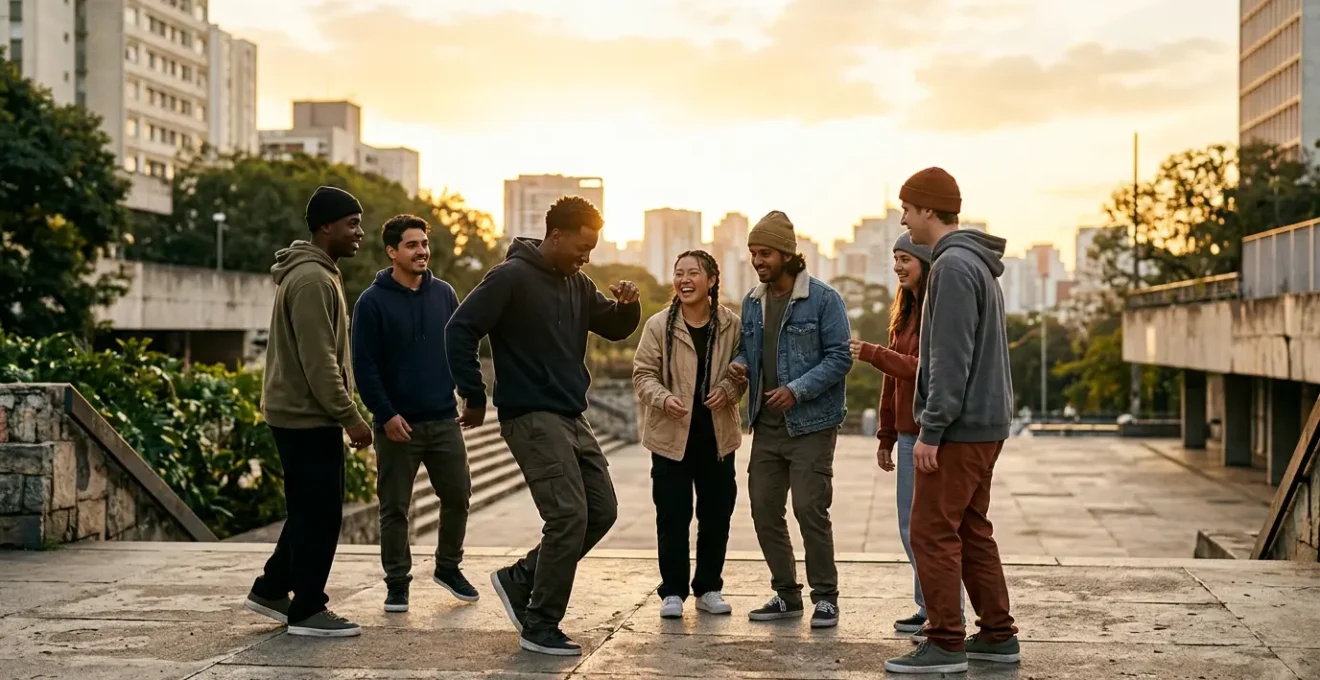
Contrary to viewing hip-hop as just a music genre, it functions as an adaptable cultural toolkit—a universal grammar of resistance and self-creation that youth worldwide use to build their identities.
- Hip-hop’s influence extends far beyond sound, shaping a symbolic economy of fashion, innovating language, and creating new models of entrepreneurship.
- Through a process of « glocalization, » its core themes of struggle and authenticity are translated to fit local contexts, making it a powerful vehicle for social commentary everywhere.
Recommendation: To understand contemporary youth culture, one must analyze how hip-hop’s elements are adopted and remixed to articulate specific, local identities.
When tracing the origins of a global cultural phenomenon, it’s easy to get lost in a timeline of dates and places. For hip-hop, that story conventionally begins in the Bronx of the 1970s, a narrative of block parties and the four foundational pillars: DJing, MCing, graffiti, and breakdancing. This historical framework is essential, but it fails to answer the most critical question: how did a hyper-local art form, born from urban neglect, evolve into the primary engine for youth identity construction across the planet? The common answer—that it « gives a voice to the voiceless »—is true but incomplete. It doesn’t explain the mechanisms of its transmission or the depth of its integration into the very fabric of modern life.
The real power of hip-hop lies beyond the beat. If we look closer, we see not just a music genre, but a sophisticated and modular cultural toolkit. This toolkit contains aesthetics for self-presentation, linguistic codes for community building, narratives for social critique, and blueprints for economic empowerment. But what if the key to its global success wasn’t its American origin, but its profound adaptability? This article moves beyond the historical account to unpack the sociological processes that allowed hip-hop to become a universal language. We will explore how it provided the tools for generations to define themselves through fashion, how it literally changed the words we speak, and how it transformed local struggles into a shared global consciousness. This is the story of how a sound became a worldview.
To fully explore this transformation, this analysis delves into the specific mechanisms of hip-hop’s cultural power, from its aesthetic codes to its role in shaping the modern self. The following sections break down how this movement has systematically redefined youth identity on a global scale.
Summary: Deconstructing Hip-Hop’s Global Influence on Identity
- Sneakers and Streetwear: How Music Defined the Wardrobe of a Generation
- Slang to Dictionary: How Lyrics Change the Way We Speak
- The Message: Rap as the CNN of the Inner City
- From Bronx to Tokyo: How Local Struggles became Universal
- Hustle Culture: Musicians Becoming Moguls and Brand Owners
- Snare on 2 and 4:How to Choose Your First Electric Violin If You’re Classically Trained?
- I Listen Therefore I Am: Why Music Define the Teenage Self
- Music as an Emotional Outlet: Why Teenagers Need to Play Loudly?
Sneakers and Streetwear: How Music Defined the Wardrobe of a Generation
Hip-hop’s most visible impact is arguably on what we wear. Streetwear is not merely a fashion trend; it’s a symbolic economy where clothing and footwear act as markers of cultural literacy, social status, and identity. This connection is so profound that a comprehensive industry survey revealed that 80% of consumers indicated hip-hop as a major influence on the style. Artists like Run-DMC with their shell-toe Adidas and LL Cool J with his Kangol hat didn’t just wear brands; they imbued them with cultural capital, transforming consumer goods into artifacts of belonging. This process established a direct line from the turntable to the closet, creating a visual language understood from New York to Seoul.
The economic scale of this cultural shift is staggering. It has created a market that operates on principles of scarcity, authenticity, and insider knowledge. The value of a sneaker is determined not by its manufacturing cost, but by the story it tells and the community it represents. This powerful synergy between music and apparel has fueled a massive industry, with the global streetwear market projected to reach $734.05 billion by 2034. The illustration below captures the essence of this exchange, where the sneaker is more than an object; it is a point of connection, a piece of history, and a tool for economic empowerment within the community.
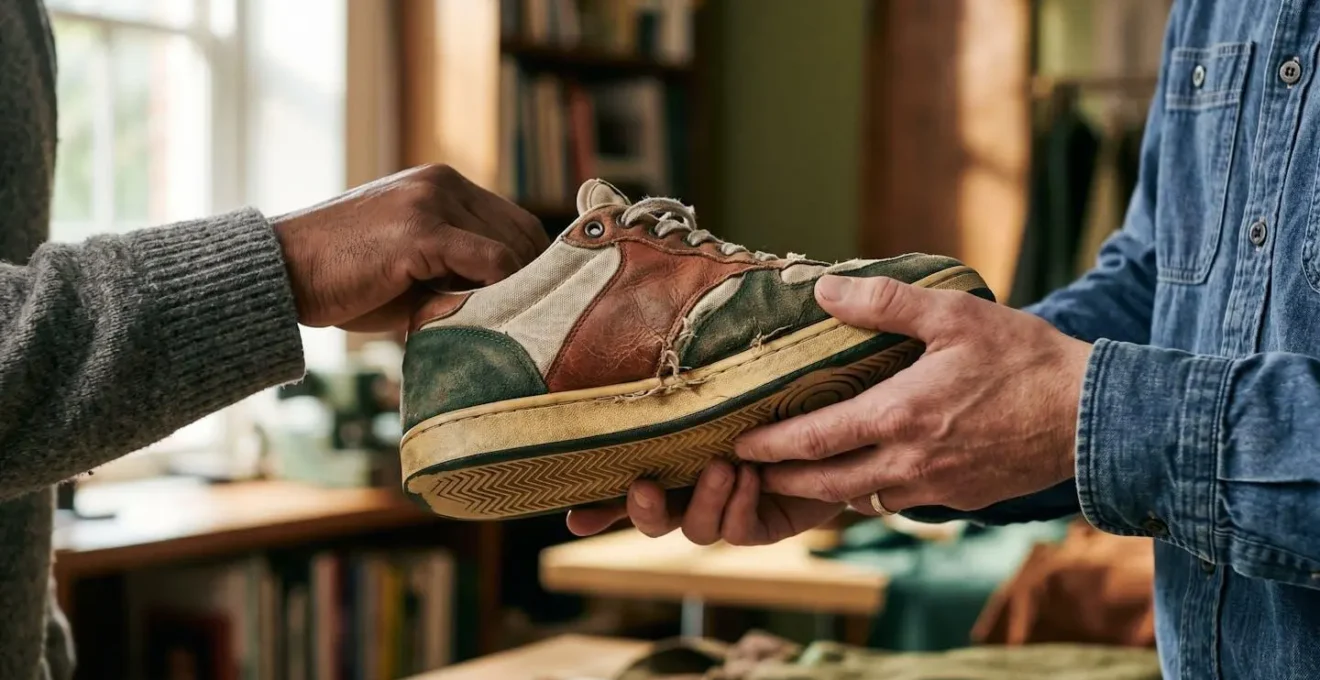
As the image suggests, the exchange of these cultural items builds a circular economy based on shared knowledge and passion. This aesthetic dimension of the hip-hop toolkit provides youth with a tangible way to perform their identity, to signal allegiance to a global tribe while expressing their individual style. It’s a uniform for a movement that has no central leadership, where your choice of footwear can say more about your values than a spoken declaration.
Slang to Dictionary: How Lyrics Change the Way We Speak
If streetwear is hip-hop’s visual language, then its lyrical innovation is its spoken dialect—a constantly evolving lexicon that defines in-groups and influences mainstream speech. Hip-hop has always been a laboratory for linguistic creativity, a space where artists coin new terms, repurpose existing words, and develop unique syntactical structures. This is a core component of its cultural toolkit, providing youth with a code to communicate experiences that mainstream language often fails to capture. It’s an assertion of identity through vernacular, a way of shaping the world by naming it on your own terms. This process is about more than just « cool » words; it’s about linguistic self-determination.
The impact ranges from specific vocabulary to fundamental changes in dialect. As cultural linguist H. Samy Alim noted in a study for PBS, this inventiveness is a hallmark of what he calls « Hip-Hop Nation Language. » He points to artists who popularized new terms, giving a concrete example of this phenomenon:
Much of the distinctiveness of Hip-Hop Nation Language comes from its inventiveness with vocabulary, from ‘Puffy’ Combs popularizing benjamins for ‘$100 bills’ to E-40’s coinage of new slang terms like What’s crackulatin for ‘What’s happenin.’
– H. Samy Alim, PBS – Do You Speak American: Hip Hop Language Study
This influence runs even deeper than slang. Sociolinguistic research on the impact of Southern rappers, for instance, shows that their music has contributed to phonological shifts in African American English (AAE), affecting how the language is spoken by insiders and even influencing mainstream speakers. The music doesn’t just add words to the dictionary; it actively shapes the evolution of a dialect. For youth building their identity, adopting this language is a way to connect with a larger community and express a worldview that is both authentic and globally recognized.
The Message: Rap as the CNN of the Inner City
Before it became a global phenomenon, hip-hop served a vital local function: it was the primary news source for communities ignored by mainstream media. This idea was famously crystallized by Public Enemy’s Chuck D, who declared that « Rap was Black America’s CNN. » This wasn’t hyperbole; it was a statement of fact. In an era before social media, rappers were journalists, their lyrics serving as dispatches from the front lines of urban poverty, systemic racism, and police brutality. They reported on the realities of their environment with an unfiltered honesty that was both radical and essential, providing a counternarrative to the often-distorted portrayals in traditional news outlets.
The turning point for rap as social commentary can be traced to a single track: « The Message » by Grandmaster Flash and the Furious Five. Released in 1982, the song’s vivid depiction of inner-city struggle (« It’s like a jungle sometimes, it makes me wonder how I keep from goin’ under ») shifted hip-hop’s focus from party rhymes to profound social critique. This track laid the groundwork for generations of artists, from N.W.A. to Kendrick Lamar, to use their platform for activism and storytelling. It established MCing as a form of testimony, a way to document life and demand accountability.
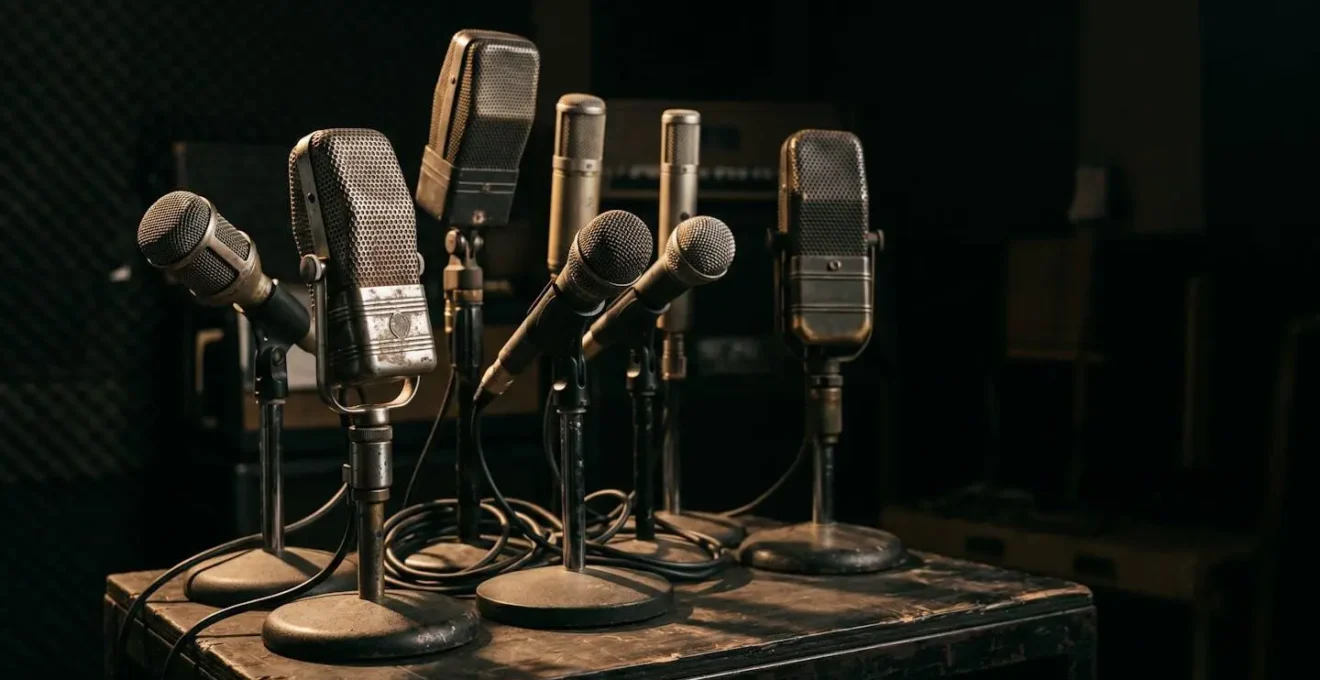
The image above metaphorically represents this function: a convergence of voices creating a decentralized, community-driven news network. Each microphone symbolizes a different perspective, a unique story that, when combined with others, creates a more complete and truthful picture of society. For young people, this aspect of the hip-hop toolkit provides not only a source of information but also a framework for their own social and political awakening. It teaches them to question official narratives and empowers them to tell their own stories, making the personal political.
From Bronx to Tokyo: How Local Struggles became Universal
Hip-hop’s global journey is a masterclass in what sociologists call « glocalization »: the process by which a global phenomenon is adapted to suit local conditions and sensibilities. The culture didn’t spread through corporate force but through grassroots connections, as youth around the world recognized a reflection of their own struggles in the narratives coming out of the Bronx. The themes of marginalization, the search for identity, and the desire for respect are universal. Hip-hop provided a ready-made « cultural toolkit » that could be used to articulate these feelings, whether in the banlieues of Paris, the favelas of Rio, or the sprawling metropolis of Tokyo.
A prime example of this process is the evolution of Japanese hip-hop. As detailed in Ian Condry’s ethnographic research, the genre truly took root in Japan when local artists shifted from imitating American gangster tropes to rapping about their own realities. A music store manager in 2003 noted that Japanese hip-hop matured when artists began singing about « reality and everyday life, » topics that resonated deeply with a local audience. This transformation shows the toolkit in action: the core elements—rhythmic flow, sampling, social commentary—were kept, but the content was localized to reflect Japanese society. It became a tool for Japanese youth to discuss their own anxieties and aspirations.
This adaptability is the secret to hip-hop’s universal appeal. It speaks to fundamental human questions that transcend borders. As Alain-Philippe Durand, a dean at the University of Arizona, observes:
Hip-hop gets at the central questions of humanity and the global challenges we face, like immigration, identity, poverty, freedom of expression
– Alain-Philippe Durand, University of Arizona – Hip-Hop at 50: Global Culture, Global Voices
By providing a flexible framework to address these issues, hip-hop empowers youth everywhere to craft a hybrid identity—one that is simultaneously part of a global movement and deeply rooted in their own local experience.
Hustle Culture: Musicians Becoming Moguls and Brand Owners
Beyond aesthetics and politics, hip-hop provides a powerful blueprint for economic empowerment. The « hustle » mentality, born from the necessity of creating opportunity where none existed, evolved into a sophisticated form of entrepreneurship. Rappers were among the first artists to understand that their influence was a brand, and they leveraged it to build empires extending far beyond music. This transition from musician to mogul provided a new, tangible model of success for youth, particularly those in marginalized communities. It demonstrated that cultural capital could be converted into economic capital.
Figures like Jay-Z (from Roc-A-Fella Records to ventures in sports and spirits), Dr. Dre (Beats by Dre), and Rihanna (Fenty Beauty) are not exceptions; they are the logical conclusion of hip-hop’s entrepreneurial ethos. As research from Stanford University noted, this has had a major societal impact: « For many youth the heroes and success stories of the inner-city are rappers. The popularity of rap and the spin-offs of hip-hop culture—fashion lines… movies, and television shows—have had a major impact on American marketing trends. » These artists became aspirational figures who proved that you could achieve success on your own terms, without compromising your authenticity.
This entrepreneurial spirit has become a central part of the hip-hop identity toolkit. It teaches resilience, strategic thinking, and the importance of ownership. Market research confirms that prominent figures like Pharrell Williams and Kanye West have turned their brand collaborations into major cultural events, further blurring the lines between art and commerce. For a young person looking to find their place in the world, this aspect of hip-hop offers a path to self-sufficiency, making the dream of building something from nothing feel attainable.
Action plan: Auditing Your Brand’s Cultural Resonance
- Points of contact: List all channels where your brand’s voice is expressed (social media, product design, ad copy).
- Collecte: Inventory existing cultural references. Are they authentic or superficial? (e.g., using slang correctly vs. forced appropriation).
- Cohérence: Does your brand’s message align with the values of the culture it references? (e.g., community, authenticity, resilience).
- Mémorabilité/émotion: Identify what makes your brand’s narrative unique versus generic. Is it telling a story that resonates emotionally?
- Plan d’intégration: Develop a strategy to replace inauthentic elements and fill narrative gaps, prioritizing genuine connection over trend-chasing.
Snare on 2 and 4:How to Choose Your First Electric Violin If You’re Classically Trained?
On the surface, a question about electric violins seems entirely out of place in a discussion of hip-hop. But viewed through a sociological lens, the title itself serves as a powerful metaphor for hip-hop’s cultural mechanism: How does a « classically trained » system adapt when confronted with the disruptive rhythm of a new paradigm—the « snare on 2 and 4 »? The snare hitting the second and fourth beats is the backbone of hip-hop rhythm, a simple but revolutionary framework that redefined popular music. It represents a new language, a new logic.
The « classically trained » musician in this metaphor can be any established institution: traditional musicology, legacy media, or even a non-American culture first encountering hip-hop. Initially, the new rhythm seems foreign, perhaps even simplistic or crude compared to the complex orchestrations of the « classical » tradition. The challenge is to move beyond a rigid framework and learn to speak the new language. It requires a fundamental shift in perspective—to see sampling not as theft but as collage, to hear repetitive beats not as monotonous but as the foundation for lyrical complexity, and to recognize vernacular expression as a valid artistic form.
The « electric violin » thus becomes the symbol of the hybrid tool needed to navigate this new space. It is an instrument that bridges two worlds—the acoustic tradition and the electronic future. It represents the hybrid identity that emerges from cultural encounters. When a Japanese artist picks up a microphone or a French designer adopts sneaker culture, they are, in essence, choosing their « electric violin. » They are not abandoning their « classical training » (their own cultural heritage) but are adapting it with a new tool to create something novel: a glocalized expression that is both authentic to their experience and fluent in the global language of hip-hop.
I Listen Therefore I Am: Why Music Define the Teenage Self
Adolescence is a period of intense identity formation, a time when individuals begin to separate from their families and forge a sense of self. In this process, music often plays a central role, acting as a mirror and a blueprint. The phrase « I listen, therefore I am » captures this perfectly. The music a teenager chooses becomes a badge of identity, a declaration of values, and a way to find a tribe. It helps them answer the fundamental question: « Who am I? » Hip-hop, with its rich and diverse « cultural toolkit, » offers a particularly potent framework for this journey of self-discovery.
The genre provides pre-fabricated yet highly customizable identities. A teenager can adopt the intellectual consciousness of Kendrick Lamar, the entrepreneurial ambition of Jay-Z, or the rebellious energy of early N.W.A. This is the concept of modular identity in action: picking and choosing elements to construct a persona that feels authentic. For many, especially those from diaspora or minority communities, hip-hop offers a crucial « third space » for identity, existing outside the often-conflicting pressures of their ancestral culture and the dominant mainstream culture.
A powerful example of this is found in research on Southeast Asian American youth. The study demonstrated how hip-hop functioned as a unique cultural identity that transcended race and ethnicity, fostering a sense of belonging. For these young people, who sometimes felt caught between traditional family expectations and American society, hip-hop provided a language and a style to craft their own narratives. In some cases, learning to rap or engage with hip-hop’s linguistic codes literally helped them find their voice when family communication structures felt restrictive. It became the tool through which they could define themselves, to themselves and to the world.
Key takeaways
- Hip-hop’s influence is not just musical but structural, providing a « cultural toolkit » for fashion, language, and entrepreneurship.
- The genre’s global success is due to « glocalization, » its ability to be adapted to articulate local struggles using a universal framework.
- For youth, hip-hop serves as a primary vehicle for identity construction, offering modular personas and a « third space » for those between cultures.
Music as an Emotional Outlet: Why Teenagers Need to Play Loudly?
Beyond identity construction, music serves a vital cathartic function for young people. The teenage years are often fraught with intense emotions, social pressures, and a sense of powerlessness. Music provides a safe and structured outlet to process these feelings. The act of « playing loudly, » whether literally through speakers or metaphorically by embracing a culture that is unapologetically bold, is an act of emotional externalization. It’s a way of making internal turmoil tangible and, therefore, manageable. It is a declaration that « I am here, and I feel things intensely. »
Hip-hop is particularly effective as an emotional outlet because its very structure is built on narrative and testimony. The genre provides frameworks for articulating struggle, resilience, anger, and joy. Research has shown that for youth from underprivileged backgrounds facing systemic hardships, creative arts like rapping and dancing serve as vital channels to articulate their experiences. The process of writing lyrics, for example, can be a form of structured emotional processing, allowing an individual to organize their thoughts and transform pain into art. This connects them to a global community that shares similar experiences, reinforcing that they are not alone.
This function is not just about venting; it’s about building resilience. As one educational analysis notes, hip-hop’s themes of identity and social justice offer models of determination for youth worldwide. By engaging with these narratives, young people learn strategies for coping with adversity. The music validates their struggles while simultaneously offering a vision of triumph. It is a tool not just for feeling, but for healing and for growing. It gives them the permission and the means to « play loudly, » ensuring their emotional reality is seen and heard in a world that often demands their silence.
To truly understand the contemporary world, it is no longer possible to ignore the grammar of hip-hop. It has written itself into our language, our fashion, and our aspirations. For students of sociology and culture, the next step is to move beyond passive listening and begin to actively deconstruct the hip-hop artifacts in your own environment, analyzing how this global toolkit is being used to build the identities of tomorrow.