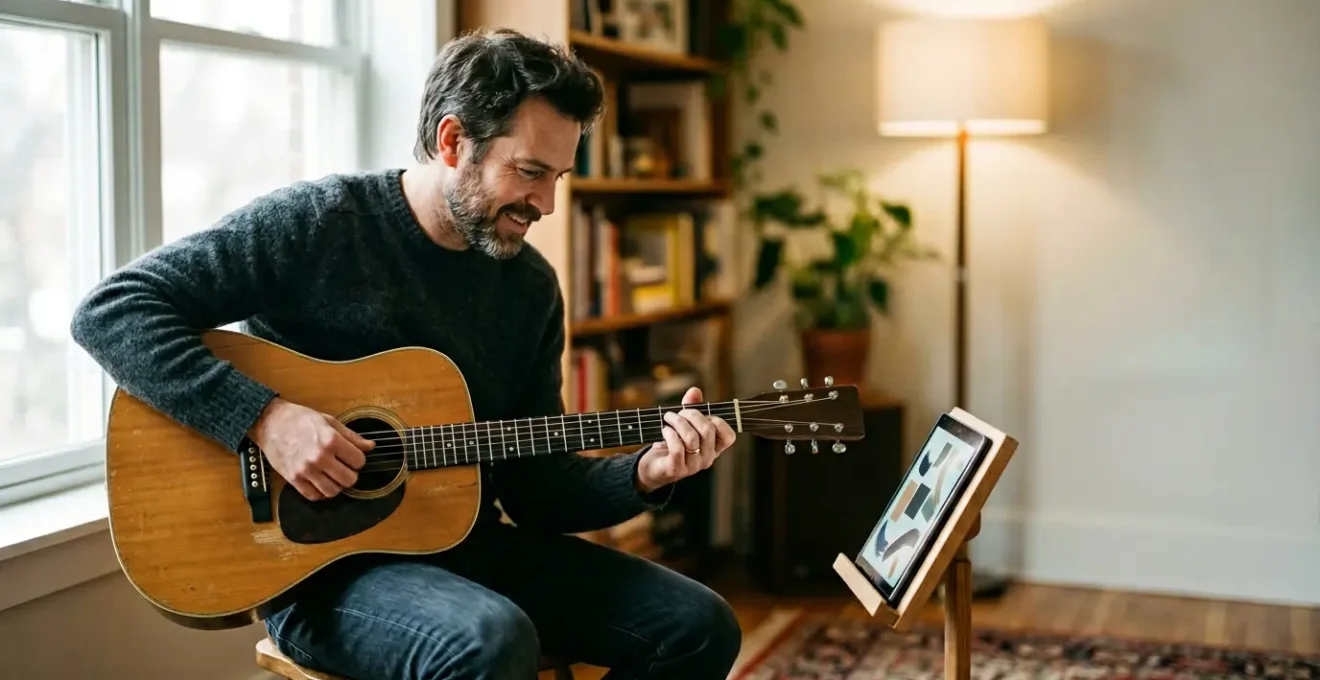
Contrary to popular belief, learning an instrument after 40 isn’t about overcoming disadvantages; it’s about leveraging unique adult cognitive strengths.
- Short, focused practice (15 minutes/day) is more effective than long, infrequent sessions.
- Adult analytical skills allow for a much faster grasp of music theory than children possess.
- Playing music as an adult provides a measurable « neurological dividend, » actively building cognitive reserve.
Recommendation: Stop trying to learn like a child and adopt an adult-centric strategy that turns your life experience and logical mind into your most powerful learning tools.
There’s a pervasive myth that whispers a discouraging tune into the ears of anyone over 40 considering a musical instrument: « You’re too old. Your brain isn’t plastic anymore. You should have started as a kid. » This belief, rooted in a misunderstanding of how we learn, has silenced countless potential musicians before they even play their first note. We’re told that the window for musicality closes with childhood, leaving adults with stiff fingers and even stiffer minds. The common advice often feels hollow— »be patient, » « just have fun »—failing to address the very real frustrations of slow progress and a packed schedule.
But what if this entire premise is wrong? What if the adult brain isn’t a liability but a secret weapon? The key to unlocking your musical potential isn’t to mourn a lost childhood but to embrace the power of your mature mind. This isn’t about brute force repetition or finding hours you don’t have. It’s about a strategic approach I call Cognitive Leverage: using the analytical, pattern-recognizing, and goal-oriented brain you’ve spent decades building. You already know how to learn, how to manage projects, and how to see the big picture. These are superpowers in the world of music, not weaknesses.
This guide offers a new operating manual for the adult learner. We will dismantle the myth of age as a barrier and provide a neuro-positive framework for real, tangible progress. We’ll explore how to make significant strides in just 15 minutes a day, why your logical mind is built to master music theory, and how playing an instrument delivers a profound Neurological Dividend, actively enhancing your cognitive health for years to come. It’s time to trade discouragement for a strategy that works with your brain, not against it.
This article provides a structured path for the adult music learner. The following sections break down the key challenges and advantages, offering practical advice and evidence-based strategies to guide your journey.
Summary: A Guide to Adult Music Learning After 40
- 15 Minutes a Day: Progressing Without Quitting Your Job
- Stiff Fingers: Stretching Exercises for Older Beginners
- Campfire Guitar vs Concert Hall: Defining Success for Yourself
- Pedagogy for Adults: Why You Don’t Want a Teacher for Kids
- Why Adults Learn Theory Faster Than Kids: Using Your Logic
- Musical Reserve: How Playing Delays Cognitive Decline by Years
- Does Piano Practice Make You a Faster Typist?
- Fine Motor Skills: How Piano and Guitar Build Dexterity for Life
15 Minutes a Day: Progressing Without Quitting Your Job
The number one obstacle for any aspiring adult musician isn’t talent or age; it’s time. The idea of carving out an hour each day feels like a fantasy. Here lies the first and most critical mindset shift: for adult learners, progress is driven by efficiency over endurance. The goal is not to practice long, but to practice smart. The « all or nothing » approach—where you skip practice all week hoping for a long weekend session—is the fastest path to quitting. Instead, the key is consistency, even at a micro-level.
This isn’t just a motivational platitude; it’s backed by the science of skill acquisition. Research consistently shows that frequency trumps duration. In fact, studies suggest that 15 minutes of daily focused practice is more effective for building muscle memory and neural pathways than a single, marathon 75-minute session once a week. Your brain consolidates learning during sleep, so short, daily inputs create a powerful compounding effect. Each day, you aren’t starting from scratch; you’re building directly on the foundation laid the day before. This approach transforms practice from a monumental task into a manageable daily ritual.
To make this happen, you need a system. The « habit-stacking » technique is exceptionally effective. Instead of trying to find new time, anchor your micro-practice session to an existing, non-negotiable daily habit. This removes the mental load of deciding when to practice. Over time, the cue of your morning coffee or preheating the oven automatically triggers the impulse to pick up your instrument. This is how you build a sustainable habit that delivers results without derailing your life.
Your 15-Minute Practice Action Plan
- Anchor the Habit: Connect your practice to a solid daily routine. For example, « Right after I pour my morning coffee, I will practice scales for 5 minutes. »
- Automate the Start: Link practice to automatic triggers with a clear beginning and end, such as « While the oven preheats for dinner, I will do my finger exercises. »
- Set a Micro-Goal: Define a single, achievable objective for each 15-minute session. An example could be « Transition smoothly between the G and C chords three times in a row. »
- Embrace the Metronome: Use a metronome app from day one. Start with slow, steady beats to build clean muscle memory before gradually increasing the tempo.
- Log Your Wins: Keep a simple practice journal. Noting « nailed the G-C transition » provides a dopamine hit and creates a record of tangible progress, which is vital for adult motivation.
Stiff Fingers: Stretching Exercises for Older Beginners
While the adult mind is an asset, the adult body can present real challenges. After decades of typing, gripping, and living, your hands may not have the immediate suppleness of a child’s. Acknowledging this isn’t a sign of defeat; it’s the first step toward a targeted, physical strategy. The feeling of « stiff fingers » is a common and solvable problem. The solution is to treat your hands like an athlete would: with dedicated warm-ups and conditioning exercises designed to build flexibility, strength, and independence.
Before you even touch your instrument, dedicate three to five minutes to gentle stretching. This increases blood flow, warms up the tendons and ligaments, and significantly reduces the risk of strain. Simple exercises like making a soft fist and then slowly extending the fingers as wide as possible, or gently bending each finger back with the opposite hand, can dramatically improve your range of motion over time. Think of it as pre-heating the engine; you wouldn’t redline a cold car, and you shouldn’t ask your hands to perform complex movements without preparation.
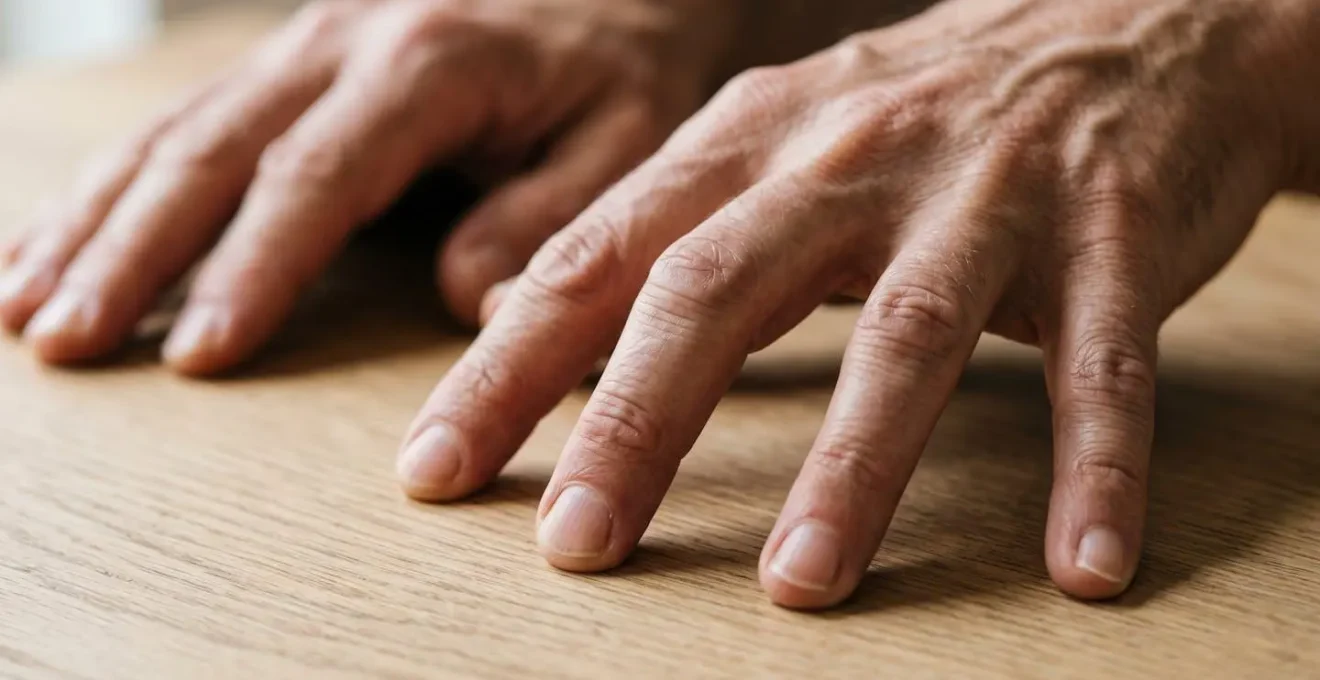
Beyond basic flexibility, the real game-changer is developing finger independence. This is the ability to move one finger without the others unconsciously tensing up or moving with it—a skill crucial for both piano and guitar. As the legendary piano pedagogue Carl Czerny outlined in his work, this is a trainable skill. In his methodology, he emphasized that « finger independence exercises like playing staccato with one finger while others play legato can greatly enhance control. » You can practice this away from the instrument by placing your hand flat on a table and trying to lift each finger individually while keeping the others relaxed and in contact with the surface. It will feel awkward at first, but this targeted neurological training builds the precise motor pathways you need to play cleanly and efficiently.
Campfire Guitar vs Concert Hall: Defining Success for Yourself
One of the most paralyzing traps for adult learners is an undefined, and often impossibly high, standard of success. Children learn within a structured system of recitals and exams, but as an adult, you have the freedom—and the responsibility—to define your own finish line. Without a clear, personal « why, » you’ll inevitably compare yourself to virtuosos on YouTube or the memory of a childhood prodigy and feel perpetually inadequate. This is where you must engage in what I call Goal Architecture: consciously designing a definition of success that aligns with your life and brings you joy.
Are you learning in order to play your favorite Beatles songs around a campfire? To accompany yourself singing a ballad? To play duets with your child? Or simply for the private, meditative joy of creating sound? Each of these is a valid and worthy goal. « Campfire guitarist » is not a lesser achievement than « concert pianist »; it is a different one. By setting a concrete, personal, and realistic goal, you create a tangible benchmark for progress. Instead of feeling frustrated that you can’t play a Rachmaninoff concerto, you can celebrate the victory of cleanly executing the four chords to « Wonderwall. »
This philosophy of personal satisfaction is the key to long-term motivation. It’s about focusing on the process, not a distant, professional-level performance. This sentiment is echoed by many who have successfully navigated this journey, finding fulfillment far from the concert hall. As one adult learner shared about their experience:
I try to do 30 minutes on most days, or just scales on my busiest days. You don’t have to practice 40 hours a day to get good, as LingLing’s mom suggests, unless you’re trying to compete. I hope this article will inspire someone to pursue learning a musical instrument, even as an adult.
– Grace Ke, Encore: Learning a New Musical Instrument in Your 40s
Your musical journey is yours alone. Grant yourself permission to define what « good enough » means, and you will unlock a sustainable source of motivation and enjoyment that external validation can never provide.
Pedagogy for Adults: Why You Don’t Want a Teacher for Kids
Finding the right guide is critical, but this is where many adult learners make a fundamental error. They seek out a teacher who is « great with kids, » assuming that good teaching is universal. This often leads to a Pedagogical Mismatch. The methods used to teach children—relying on games, colorful books, and rote memorization—are designed for a brain that learns implicitly and lacks the abstract reasoning skills of an adult. For you, this approach can feel slow, condescending, and deeply frustrating.
You need a teacher who specializes in andragogy (adult education). An instructor for adults understands that you are a goal-oriented, self-directed learner with a wealth of life experience. They will skip the cartoon characters and get straight to the « why » behind the « what. » They will leverage your Cognitive Leverage, explaining the logic of a chord progression or the pattern within a scale, allowing your analytical mind to connect the dots quickly. They respect your time by providing an efficient, no-fluff curriculum, and they collaborate with you to align lessons with your personal musical goals, whether it’s a specific song or a particular technique.
A great teacher for adults is a coach, not just an instructor. They understand that your practice schedule may fluctuate, and they provide strategies for maintaining momentum during busy weeks. They integrate your personal music tastes from day one, knowing that learning a song you love is a more powerful motivator than any abstract exercise. When vetting a potential teacher, you are not a passive student; you are a client hiring a specialist. Be prepared to interview them to ensure their philosophy matches your needs.
To find the right fit, you need to ask the right questions. Here are key points to cover when vetting a potential music teacher:
- Adaptability: How do you adapt your curriculum to an adult’s busy schedule and fluctuating practice time?
- Personalization: How do you incorporate a student’s personal musical tastes from the very first lesson?
- Methodology: Do you focus on explaining the « why » (music theory and patterns) alongside the « what » (playing the notes)?
- Flexibility: Can you provide a flexible learning pace that accommodates adult life without adding pressure?
- Goal Orientation: How do you customize lessons to help me achieve my specific objectives, like playing a favorite song or improvising?
Why Adults Learn Theory Faster Than Kids: Using Your Logic
Here we arrive at the adult learner’s single greatest, yet most overlooked, advantage: a fully developed analytical mind. While children may absorb motor skills with sponge-like ease, they often struggle for years to understand the abstract architecture of music. This is where you, the adult, can leapfrog them. Your brain is a master of pattern recognition. You’ve spent a lifetime categorizing information, understanding systems, and making logical connections. Music theory, at its core, is a system of logic and patterns.
Concepts that can baffle a child for years—like key signatures, chord functions (e.g., why a G7 chord « wants » to resolve to a C major), and rhythmic notation—are things an adult brain is primed to grasp. Research into adult music education confirms this, showing that adults can grasp abstract musical concepts like harmony, rhythm, and form more quickly than children because they have already encountered similar hierarchical patterns in language, mathematics, or even project management. You don’t need to learn what a « pattern » is; you just need to learn what this specific pattern sounds like.
This is your Cognitive Leverage in action. When a teacher explains that a major scale is just a sequence of whole and half steps (W-W-H-W-W-W-H), you don’t just memorize it; you understand it as a formula. You can then apply that formula to any starting note to build any major scale. This is a level of abstraction that is difficult for a young child. As NYU Psychology Professor Gary Marcus, who documented his own journey learning guitar at 38, explains:
Adults are more analytical. One thing I was able to do was understand music theory and comprehend it in a way that kids couldn’t.
– Gary Marcus, Guitar Zero: The New Musician and the Science of Learning
Stop seeing your analytical nature as a barrier to « just feeling the music. » It’s your fast track. Embrace your ability to deconstruct, analyze, and understand the system. Learning the language of music theory isn’t a chore; it’s the cheat code you’ve earned with age.
Musical Reserve: How Playing Delays Cognitive Decline by Years
If the personal joy of playing isn’t motivation enough, the profound neurological benefits should be. Learning an instrument after 40 is not just a hobby; it’s one of the most powerful forms of cognitive training available. While passive activities like listening to music or doing crossword puzzles are beneficial, the active process of learning and playing an instrument creates a uniquely holistic brain workout. It engages auditory, visual, and motor cortices simultaneously, while also demanding high-level executive functions like memory, focus, and problem-solving.
This intense, multi-modal engagement builds what neuroscientists call cognitive reserve. Think of it as building a stronger, more resilient brain network. A higher cognitive reserve doesn’t necessarily prevent age-related diseases like Alzheimer’s, but it can significantly delay their onset and reduce their impact, allowing the brain to function at a higher level for longer. The evidence for this « Neurological Dividend » is compelling. For instance, a landmark study found that just six months of piano lessons resulted in a measurable 6% improvement in working memory performance in older adults, a crucial aspect of fluid intelligence.

The physical changes in the brain are just as striking. Passive activities often lead to a gradual decline in brain volume in certain areas, but active musical practice can halt or even reverse this trend. This was demonstrated powerfully in a recent study that tracked brain changes in older adults learning piano.
Case Study: The Piano Training and Cognitive Reserve Trial
A randomized controlled trial involving 132 healthy adults aged 62 to 78 explored the effects of musical practice on the brain. One group received one hour of piano lessons per week and was asked to practice for 30 minutes daily. A control group was assigned to an active listening program without playing. After six months, MRI scans revealed that the control group experienced a typical loss of gray matter volume in the right primary auditory cortex. In stark contrast, the piano-playing group’s gray matter volume in that same area was preserved. The study concluded that musical practice enhances brain plasticity and actively builds cognitive reserve, helping to stave off age-related decline.
Does Piano Practice Make You a Faster Typist?
The benefits of musical practice often spill over into other areas of life in surprising ways. One of the most frequently discussed, and often debated, is the link between playing the piano and typing speed. While it’s not a direct one-to-one transfer—the tactile feedback and required force are different—the foundational skills built by piano practice create an incredibly strong predisposition for typing proficiency. The connection lies in the shared demands for fine motor skills, bimanual coordination, and motor learning.
Piano playing is an exceptional training ground for finger dexterity and independence. Your brain learns to send discrete, rapid signals to ten different digits, a level of complexity far beyond most daily tasks. This enhanced neural wiring doesn’t just disappear when you leave the piano bench. When you move to a computer keyboard, the foundational pathways for intricate finger movements are already established. You are not learning to type from scratch; you are adapting a highly developed skill to a new context.
The evidence for this crossover effect is more than just anecdotal. Researchers have explored this connection and found a tangible link. While a pianist won’t magically become a 120-WPM typist overnight, their capacity for motor learning is significantly accelerated. In a fascinating experiment, research by the Max Planck Institute for Informatics showed that pianists could learn to « play » words and sentences on a piano keyboard just as quickly as professionally trained typists could type them on a QWERTY keyboard. This demonstrates that the core skill of translating mental symbols (letters or notes) into rapid, precise finger movements is highly transferable.
So, while taking up piano solely to improve your typing speed might be an indirect route, the improved dexterity and hand-eye coordination are a very real and practical side effect. It’s another example of how the skills honed through music enrich other aspects of your physical and cognitive life, reinforcing the idea that your practice time is an investment with compound interest.
Key Takeaways
- Embrace Efficiency Over Endurance: 15 minutes of focused, daily practice builds skill more effectively than long, infrequent sessions, making progress achievable for busy adults.
- Use Your Cognitive Leverage: Your adult brain’s ability to recognize patterns and understand logic allows you to grasp music theory much faster than a child can. This is your superpower.
- Earn a Neurological Dividend: Actively learning an instrument is a powerful form of brain training that builds cognitive reserve, demonstrably preserving brain matter and delaying cognitive decline.
Fine Motor Skills: How Piano and Guitar Build Dexterity for Life
Beyond the cognitive leaps and surprising skill transfers, the practice of an instrument offers a fundamental and lasting physical benefit: the cultivation of advanced fine motor skills. In a world increasingly dominated by swiping and tapping, the precise, nuanced movements required to play an instrument like the piano or guitar represent a powerful counter-movement, building a level of dexterity that supports lifelong hand health and function.
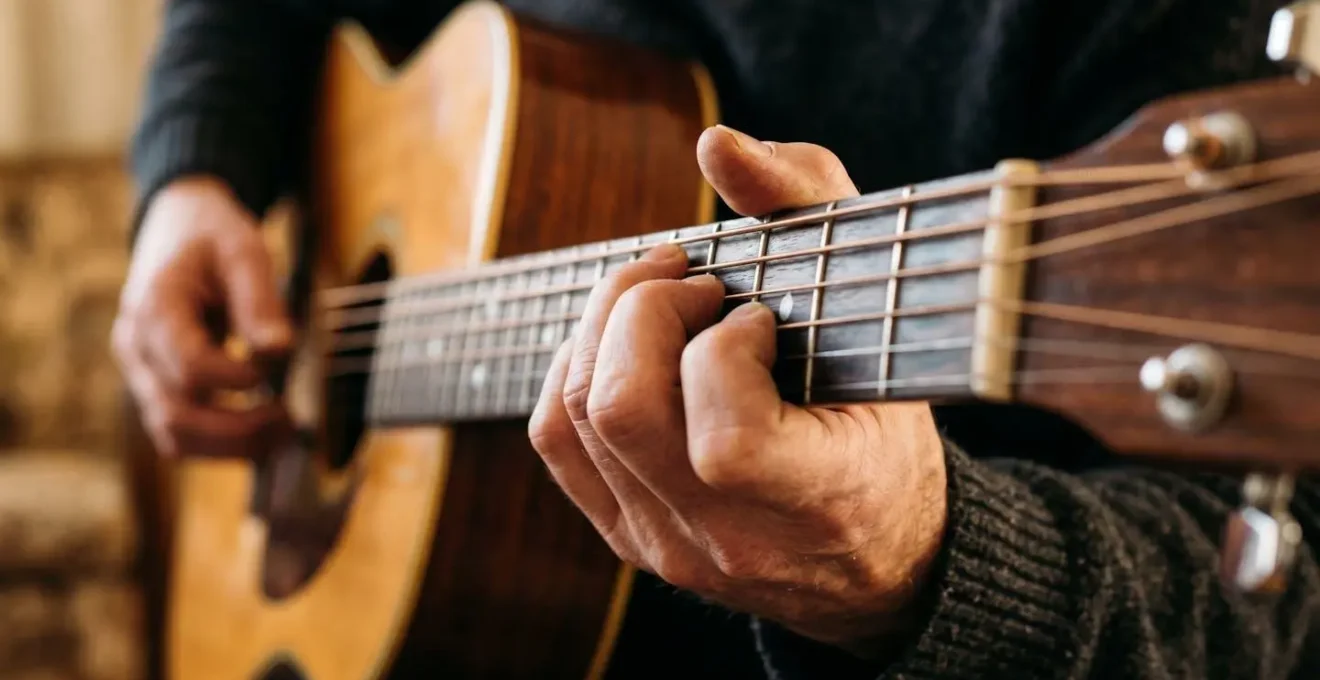
Instruments like the guitar demand a sophisticated division of labor between the hands. The fretting hand develops strength and precision, holding down strings with just enough pressure in exactly the right location, while the strumming or picking hand masters rhythm and dynamic control. Every chord change is a complex, synchronized dance of tiny muscles. This process forges strong neural connections between your brain and your fingertips, enhancing your proprioception—your sense of where your body parts are in space without looking.
The piano is perhaps the ultimate fine motor skill gym. It is one of the few activities in the world that requires the coordinated, independent use of all ten fingers. As research on the topic has noted, the piano is one of the rare instruments that require the use of all five fingers on each hand with almost equal usage. This balanced, bimanual training is unparalleled. It strengthens the weaker, non-dominant hand and builds a robust corpus callosum—the neural bridge that connects the two hemispheres of your brain, allowing for faster and more efficient communication between them.
This isn’t just about playing music. The dexterity, strength, and coordination you build at the keyboard or on the fretboard translate directly into everyday life. From buttoning a shirt and handwriting to performing delicate repairs or simply maintaining hand strength as you age, the benefits are tangible and enduring. Learning an instrument is a commitment to maintaining a vital physical connection with the world, ensuring your hands remain capable, expressive, and strong for the rest of your life.
The journey of learning an instrument after 40 is not about reclaiming lost youth, but about embracing the unique strengths of adulthood. It’s about trading the myth of « it’s too late » for the reality of « it’s the perfect time. » Start today by choosing one small, manageable habit—and play your first note.